 Safekipedia
70 Pine Street
Adapted from Wikipedia · Discoverer experience
70 Pine Street, once called the 60 Wall Tower, Cities Service Building, and American International Building, is a very tall building with 67 floors and a height of 952 feet (290 m). It stands in the Financial District of Lower Manhattan, New York City. Designed by the architects Clinton & Russell, Holton & George, it was built between 1930 and 1932 in the Art Deco style. When it was finished, it was the tallest building in Lower Manhattan and was one of the tallest buildings in the world.
The building has a special brick, limestone, and gneiss outside with interesting designs, including the triangular logo of the Cities Service Company and sun shapes. Inside, there is an Art Deco-style lobby and special elevators that go between floors. It even has a three-story top floor that was once planned as a home for the company's founder but became a public observatory.
Even though it was built during a tough time called the Great Depression, the building did well and made enough money to cover its costs by 1936. It was bought by the American International Group in 1976 and later by another company in 2009. In 2011, the building and its lobby were named official New York City landmarks. In 2016, it was changed from an office building to a place where people live.
Site
70 Pine Street is located in the Financial District of Lower Manhattan in New York City, New York, U.S. The building sits on a plot of land bounded by Pine Street to the south, Pearl Street to the east, and Cedar Street to the north. This plot covers about 32,000 square feet (3,000 m2), with measurements of 247 feet (75 m) along Pine and Cedar Streets and 116 feet (35 m) along Pearl Street. The ground slopes downward toward Pearl Street, creating both an upper lobby from Pine Street and a lower lobby from Pearl Street. Nearby buildings include 56 Pine Street, the Down Town Association building, 90–94 Maiden Lane, 48 Wall Street, and 60 Wall Street.
Architecture
70 Pine Street is a 67-story building that stands 952 feet tall. The roof is 850 feet above ground, and the top story reaches 800 feet high. The building has a spire-topped, Gothic-like appearance. It was designed by the architectural firm Clinton & Russell, Holton & George in the Art Deco style.
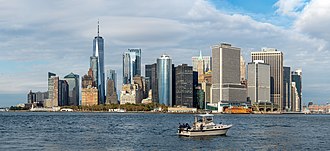
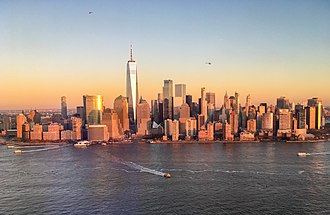
When completed, 70 Pine Street was the third-tallest building in the world, after the Empire State Building and the Chrysler Building in Midtown Manhattan. It was also the tallest building in Lower Manhattan until 1969. The building features many setbacks on its exterior, which were required by city rules to let light reach the streets below. These setbacks also became a key part of the Art Deco style.
The building’s lower stories are covered with Indiana limestone and Minnesota granite, while the upper stories have buff-colored brick. It has five entrances, with four leading to the main lobby. Inside, the lobby is designed in the Art Deco style with marble walls and colorful decorations. The building originally had an observation deck on the top floors, which was open to the public until it closed during World War II. Today, the top floors house a fine-dining restaurant.
The building also included innovative features for its time, such as double-deck elevators and a unit-ventilating system that provided fresh air without noise or dust. These helped make the building efficient and comfortable for its many employees.
History
Henry Latham Doherty became wealthy by leading many companies in the manufactured gas and electric utility sectors in the late 1800s and early 1900s. He formed the Cities Service Company as a utility firm in 1910, and his business interests grew a lot over the next years. At that time, his main offices were at 60 Wall Street, which he had used since 1906.
Doherty bought more land in Lower Manhattan to build a new, tall building. Architects Clinton & Russell designed it in the Art Deco style. Construction began in 1930 and took two years to complete. The building was finished in 1932 and was one of the tallest in the world at that time.
Originally called the Cities Service Building, it later became known as 70 Pine Street. Over the years, it had many uses, from offices to homes. Today, it is a mix of apartments, shops, and restaurants.
Impact
The building earned an award in 1932 for being the best structure built in the Financial District that year. It caught the eye of famous photographer Weegee, who took many pictures of the people and services inside. The skyscraper became a symbol of the lively Jazz Age, appearing in famous photos of Lower Manhattan.
In later years, critics praised its beautiful design. In 2011, the building was officially recognized as an important landmark in New York City for its special Art Deco style and its role in the city's skyline.
Images
Related articles



This article is a child-friendly adaptation of the Wikipedia article on 70 Pine Street, available under CC BY-SA 4.0.
Images from Wikimedia Commons. Tap any image to view credits and license.