 Safekipedia
Addition
Adapted from Wikipedia · Discoverer experience
Addition, usually denoted with the plus sign +, is one of the four basic operations of arithmetic, along with subtraction, multiplication, and division. When you add two whole numbers, you get the total or sum of those values. For example, if you have three apples and someone gives you two more, you will have five apples in total. This can be written as "3 + 2 = 5", which is read as "three plus two equals five".
Addition can be done not just with real objects like apples, but also with numbers on their own. This includes different types of numbers like integers, real numbers, and complex numbers. Addition is part of arithmetic, a branch of mathematics, and it is also used in other areas like algebra with objects such as vectors and matrices.
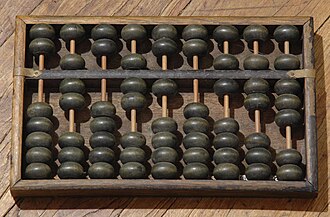
Addition has some special properties. It is commutative, which means the order of the numbers does not matter: 3 + 2 is the same as 2 + 3. It is also associative, meaning that when adding more than two numbers, the way you group them does not change the result. Addition is a simple skill that even young children learn in primary education, usually starting with small numbers and the decimal system. Tools to help with addition have existed for thousands of years, from the ancient abacus to modern computers.
Notation and terminology
Addition is shown using the plus sign "+" between numbers, and the result is written with an equals sign. For example, 1 + 2 = 3 means "one plus two equals three." Sometimes, addition is understood without any symbols. When a whole number is followed directly by a fraction, it means their sum, called a mixed number. For example, 3 1/2 is the same as 3 + 1/2, which equals 3.5.
The numbers being added are called terms, addends, or summands. These words come from Latin. The word "addition" comes from the Latin word addere, meaning "to give to." The words "sum" and "summand" also come from Latin, where summa means "the highest" or "the top."
Definition and interpretations
Addition is one of the four basic operations of arithmetic, along with subtraction, multiplication, and division. It combines two or more numbers to find their total or sum.
One simple way to think about addition is by combining groups of objects. For example, if you have two groups of apples — one with three apples and another with two apples — together you have five apples. This idea works well for whole numbers but can be tricky when we think about fractions or negative numbers. Another way to see addition is by measuring lengths. If you have a piece of string that is 4 units long and you add another piece that is 3 units long, the total length is 7 units.
Properties
Addition is commutative, meaning you can change the order of the numbers you add and still get the same result. For any two numbers a and b, a + b is always the same as b + a.
Addition is also associative. This means that when adding three or more numbers, the way you group them does not change the total. For any three numbers a, b, and c, (a + b) + c is the same as a + (b + c). For example, (1 + 2) + 3 is the same as 1 + (2 + 3).
Adding zero to any number does not change that number. Zero is called the identity element for addition because a + 0 is always equal to a. This idea was first described a long time ago by a mathematician named Brahmagupta.
When adding numbers with units, like inches or milliliters, they need to be the same type of unit. For example, adding 50 milliliters to 150 milliliters gives 200 milliliters. But you cannot add something like 3 meters to 4 square meters because they are different kinds of measurements.
Performing addition
Innate ability
Studies from the 1980s show that babies look longer at unexpected situations. An experiment by Karen Wynn in 1992 found that five-month-old babies expect 1 + 1 to be 2 and are surprised when it seems otherwise. Older toddlers, between 18 and 35 months, can also add small numbers using objects like ping-pong balls.
Some animals, like primates, can also add. Experiments with monkeys show they can add up to small numbers. Even Asian elephants have shown basic arithmetic skills.
Addition by counting
Children usually start by learning to count. They use objects or fingers to add, counting the total. As they learn, they discover "counting-on," where they count up from the larger number. Over time, they remember common sums and learn to figure out new ones from these.
Single-digit addition
Knowing how to add single digits (numbers from 0 to 9) is important. There are 100 possible pairs, and learning them is a big part of early math lessons. Students use different strategies to learn these facts quickly.
Carry
When adding numbers with more than one digit, if the sum in a column is more than 9, the extra digit is carried to the next column. For example, adding 59 and 27, the ones column makes 16, so the digit 1 is carried to the tens column.
Decimal fractions
To add decimal numbers, align the decimal points and add trailing zeros if needed. Then add normally, keeping the decimal point in the same place in the answer.
Scientific notation
Numbers in scientific notation are written as a number times 10 raised to a power. To add them, they must have the same exponent, then the main numbers are added.
Non-decimal
Addition in other number systems, like binary, works similarly to decimal addition. When the sum in a column is more than the base, the extra is carried to the next column.
Computers
Addition is key for computers. Early machines used mechanical parts, while modern digital computers use electronic circuits to add numbers quickly. Some computers use special methods to speed up addition, and errors can happen if numbers get too large.
| + | 0 | 1 | 2 | 3 | 4 | 5 | 6 | 7 | 8 | 9 |
|---|---|---|---|---|---|---|---|---|---|---|
| 0 | 0 | 1 | 2 | 3 | 4 | 5 | 6 | 7 | 8 | 9 |
| 1 | 1 | 2 | 3 | 4 | 5 | 6 | 7 | 8 | 9 | 10 |
| 2 | 2 | 3 | 4 | 5 | 6 | 7 | 8 | 9 | 10 | 11 |
| 3 | 3 | 4 | 5 | 6 | 7 | 8 | 9 | 10 | 11 | 12 |
| 4 | 4 | 5 | 6 | 7 | 8 | 9 | 10 | 11 | 12 | 13 |
| 5 | 5 | 6 | 7 | 8 | 9 | 10 | 11 | 12 | 13 | 14 |
| 6 | 6 | 7 | 8 | 9 | 10 | 11 | 12 | 13 | 14 | 15 |
| 7 | 7 | 8 | 9 | 10 | 11 | 12 | 13 | 14 | 15 | 16 |
| 8 | 8 | 9 | 10 | 11 | 12 | 13 | 14 | 15 | 16 | 17 |
| 9 | 9 | 10 | 11 | 12 | 13 | 14 | 15 | 16 | 17 | 18 |
Addition of numbers
Addition is one of the basic operations in arithmetic, along with subtraction, multiplication, and division. It combines two numbers to find their total or sum. For example, adding 3 apples and 2 apples gives a total of 5 apples.
Addition is first learned with whole numbers. There are different ways to define addition, such as using sets of objects or following specific rules step by step. As numbers get more complex, like fractions or real numbers, addition rules are built from the simpler whole number rules. This helps us understand how to add many types of numbers correctly.
Generalizations
See also: Group (mathematics), Ring (mathematics), Module (mathematics), Vector space, Field (mathematics), and Algebra over a field
Many ways to add numbers come from algebra, where we study rules for combining numbers. These ideas also show up in set theory and category theory.
Abelian group
Main article: Abelian group
In group theory, a group is a set where you can combine any two elements. When the order doesn’t matter, this combining is called addition. These groups are called Abelian or commutative.
Linear algebra
Main articles: Vector addition, Matrix addition, Modular arithmetic, and Linear combination
In linear algebra, we can add vectors and matrices. For vectors, we add their matching parts together. For matrices, we add the matching numbers in each position.
For example:
In modular arithmetic, numbers "wrap around" after reaching a certain value. For example, in a system with 12 numbers, adding 10 and 4 gives 2, because 10 + 4 = 14, and 14 wraps around to 2.
The idea of addition can be stretched to many other mathematical settings. In abstract algebra, addition can mean any way of combining things that is associative and commutative.
Linear combinations mix numbers and sums, useful when normal addition would break a rule, like in game theory or quantum mechanics.
Set theory and category theory
Addition ideas also appear in set theory with ordinal numbers and cardinal numbers. In category theory, the idea of adding shows up in the coproduct operation.
Related operations
Arithmetic
Main articles: Subtraction, Multiplication, and Division (mathematics)
Subtraction is closely linked to addition. Think of subtraction as adding a special kind of number called an opposite, or negative, number. For example, subtracting a number is the same as adding its opposite. This idea helps us understand how numbers work together.
Multiplication can be seen as adding a number many times. If you add the same number over and over, you get multiplication. This works well with whole numbers, but there are more advanced ways to think about multiplication too.
In more advanced math, addition and multiplication have special rules that help us solve problems. These rules show how numbers and operations fit together in patterns.
Division is another math operation that connects to addition. Division can sometimes be expressed using addition, but it has its own unique properties too.
Ordering
The idea of finding the larger of two numbers is similar to addition. When you add two numbers that are very different in size, the result is close to the larger number. This idea is useful in many areas of math and science.
In some special areas of math, addition and finding the maximum of two numbers swap roles. This helps solve certain kinds of problems in a simpler way.
Images
Related articles




This article is a child-friendly adaptation of the Wikipedia article on Addition, available under CC BY-SA 4.0.
Images from Wikimedia Commons. Tap any image to view credits and license.