 Safekipedia
Alsos Mission
Adapted from Wikipedia · Discoverer experience
The Alsos Mission was an organized effort by a team of British and United States military, scientific, and intelligence personnel to discover enemy scientific developments during World War II. Its chief focus was to investigate the progress that Germany was making in the area of nuclear technology, and to seize any German nuclear resources that would either be of use to the Manhattan Project or worth denying to the Soviet Union. It also looked into German chemical and biological weapon development and the means to deliver them, as well as any other advanced technology from the Axis powers.
The Alsos Mission was created after the September 1943 Allied invasion of Italy as part of the Manhattan Project's mission to coordinate foreign intelligence related to enemy nuclear activity. The team had a twofold assignment: to search for personnel, records, material, and sites to evaluate these programs and to prevent their capture by the Soviet Union. Alsos personnel followed close behind the front lines in Italy, France, and Germany, sometimes going into enemy-held territory to secure valuable resources before they could be destroyed or scientists escape.
The Alsos Mission was commanded by Colonel Boris Pash, a former Manhattan Project security officer, with Samuel Goudsmit as chief scientific advisor. It was jointly staffed by the Office of Naval Intelligence (ONI), the Office of Scientific Research and Development (OSRD), the Manhattan Project, and Army Intelligence (G-2), with field assistance from combat engineers assigned to specific task forces.
Alsos teams were successful in locating and removing a substantial portion of the German research effort's surviving records and equipment. They also took most of the senior German research personnel into custody, including Otto Hahn, Max von Laue, Werner Heisenberg and Carl Friedrich von Weizsäcker. By November-December 1944, they had concluded that there was no threat of a German atomic bomb, and that the German nuclear program had only reached an experimental phase, not a production phase. After the defeat of Japan, an Alsos mission was sent in to evaluate its nuclear program as well.
Origin
The Manhattan Project was the Allied effort to develop nuclear weapons during World War II, led by the United States with help from the United Kingdom and Canada. It was created because scientists, many of whom had fled from Nazi Germany, were worried that Germany might be building its own atomic bomb.
After the Allies invaded Italy in September 1943, there was concern that information about enemy nuclear programs was not being collected and shared well. To fix this, Brigadier General Leslie Groves, who led the Manhattan Project, started the Alsos Mission. This was a small team made up of military officers, scientists, and intelligence experts. Their job was to find out what enemy nations, especially Germany, were doing with science and technology, including nuclear weapons research. The team was led by Lieutenant Colonel Boris Pash and included scientists and investigators from different groups.
Italy
In December 1943, the Alsos Mission went to Algiers and then moved to Italy. They spoke with important leaders and scientists to learn about enemy technology. They looked at documents and talked to experts but found little about nuclear work.
When Rome was about to be captured in June 1944, the team entered the city. They made sure important places like the University of Rome were protected and talked to more scientists. They learned that Germany’s nuclear efforts were not very advanced but gathered useful information about other advanced weapons like rockets.
Western Europe
Britain
In December 1943, Groves sent Furman to Britain to discuss setting up a London office for the Manhattan Project with the British government. Lieutenant Commander Eric Welsh, head of the Norwegian Section of MI6, was not impressed with Furman's knowledge. Groves chose Captain Horace K. Calvert to lead the London office. Working with Welsh and Michael Perrin from Tube Alloys, the office gathered information on German scientists and possible nuclear research sites.
France
In August 1944, Pash and a special agent searched for a top French scientist near Brittany. They later found him in Paris and interviewed him about German scientists' activities. The Alsos Mission also looked into German science activities in places like Rennes, Antwerp, and Brussels, gathering important information and materials.
Germany
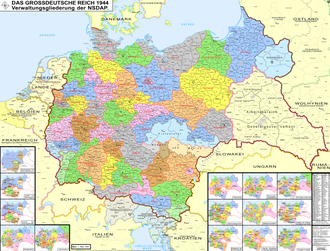
As Allied forces moved into Germany, Alsos Mission teams searched for German nuclear facilities and scientists. They found documents and materials in places like Strasbourg, Heidelberg, and Haigerloch. In April 1945, they captured important scientists including Werner Heisenberg. By the end of the war, the Alsos Mission had gathered crucial information showing Germany was far behind in developing nuclear weapons.
Japan
Plans for the invasion of Japan included an Alsos Mission because of worries that Japan might use balloons carrying harmful substances to attack the United States. In March 1945, a scientist named L. Don Leet was chosen to lead the science part of this mission in Japan. His team arrived in Manila in July 1945 and later traveled to Japan after the war ended. They visited many research places in Japan, such as Tokyo Imperial University and Waseda University, and talked to over 300 Japanese scientists. They learned about Japan’s work on technology like radar and rockets, as well as their efforts in chemical and biological warfare. Another group from the Manhattan Project also came to Japan and found that Japan’s nuclear program had not succeeded because they did not have enough uranium and the project was not a high priority.
Legacy
After visiting the German project at Haigerloch, scientists realized that Germany's efforts in nuclear technology were much smaller than expected. The facilities were simple and not very advanced compared to what the Allies were developing.
The Alsos Mission did not greatly help defeat Nazi Germany because Germany's nuclear and biological weapons programs were smaller and less dangerous than people thought. However, the mission helped gather important scientific knowledge that influenced future technology and science.
Images
Related articles



This article is a child-friendly adaptation of the Wikipedia article on Alsos Mission, available under CC BY-SA 4.0.
Images from Wikimedia Commons. Tap any image to view credits and license.