Android (operating system)
Android is an operating system developed by Google, designed mainly for smartphones and tablets. These were originally touchscreen-based mobile devices, and Android later went to other devices, such as TVs. It is based on a modified version of the Linux kernel and other open-source software. First released in 2008, Android is the most popular operating system in the world, with 4 billion users, and it is the most used operating system for smartphones. The latest version, released on June 16, 2026, is Android 17.
At its core is the Android Open Source Project (AOSP), which was originally made only for a smartphone. It is free and open-source software (FOSS), primarily licensed under the Apache License. However, most devices run the proprietary Android open-core version developed by Google. This version comes with extra closed-source software already installed, most notably Google Mobile Services (GMS). GMS includes core apps such as Google Chrome, the digital distribution platform Google Play, and the Google Play Services development platform. Other Google services, including Firebase Cloud Messaging, which is used for push notifications, are recommended for apps.
Although AOSP is free, the "Android" name and logo are trademarks of Google, which restricts the use of Android branding on "uncertified" products. Most smartphones and other devices based on AOSP run Google's ecosystem, which is known simply as Android. Some use vendor-customized user interfaces and software suites, such as One UI. Many modified distributions exist, including competing Amazon Fire OS and community-developed LineageOS. The source code has also been used to build Android systems for other devices, such as Android TV for televisions, Wear OS for wearables, Android Automotive for in-car systems, and Android XR for virtual reality headsets. It has also been used for PCs, such as Googlebook OS or One UI on Galaxybooks. Commercial products like micro consoles have used Android too.
Software packages on Android, which use the APK format, are generally distributed through a proprietary application store. Non-Google platforms include vendor-specific Amazon Appstore, Samsung Galaxy Store, and Huawei AppGallery. Third-party options include Aptoide, Cafe Bazaar, ApkMirror, GetJar, and the open-source F-Droid.
Since 2011, Android has been the most used operating system worldwide on smartphones. It has the largest installed base of any operating system in the world, with over three billion monthly active users. It accounts for 45% of the global operating system market.
History
See also: Android version history
Android was started in Palo Alto, California, in October 2003 by Andy Rubin, Chris White, Rich Miner, and Nick Sears. Rubin had earlier created the T-Mobile Sidekick at his previous company, Danger, Inc. The team first tried to build software for digital cameras, but in April 2004 they changed their focus to phones, as a rival to Symbian and Microsoft Windows Mobile. Google bought the company in July 2005, and the team built a mobile platform based on the Linux kernel. The first commercial Android smartphone, the HTC Dream, was announced on September 23, 2008. That same year, the Open Handset Alliance, a group of technology companies, was formed to develop an open mobile platform.
Since 2008, Android has received many updates that improved the system and added features. Early versions were named after desserts. In 2010, Google launched its Nexus series of devices, and in 2016 it introduced the Pixel phones. Hugo Barra spoke for Android from 2008 to 2013, and later he joined Xiaomi. In 2019, the company Huawei planned its own system, Harmony OS, after it lost easy access to Android during a trade dispute. Android 10 was released in September 2019, and it was the first version not to be named after a dessert. In December 2024, Google announced Android XR for virtual and augmented reality devices. In May 2026, Google announced Googlebook, a device running a desktop version of Android, which is intended to eventually replace the Chrome OS system used on Chromebook laptops.
Features
For a more comprehensive list, see List of features in Android.
See also: Android software development and Google Play
Android is mainly used by touching the screen. People swipe, tap, and pinch to move things on the screen, and they can type on a virtual keyboard. Game controllers and keyboards can connect by Bluetooth or USB. Some phones vibrate to give haptic feedback. Built-in sensors such as accelerometers, gyroscopes, and proximity sensors let some apps respond to how the device is moved, such as turning the screen sideways or steering in a racing game. The home screen is the main starting point, similar to the desktop on a computer. It shows app icons and widgets that update by themselves, like a weather forecast. Swiping down from the top shows a status bar with notifications and quick settings, such as WiFi and the flashlight. Since Android 4.1 "Jelly Bean", some notifications can expand to show more information. Other screens let users see all their apps and switch between recently used ones.
Most Android devices come with Google apps already installed, such as Gmail, Google Maps, Google Chrome, and YouTube, along with Google TV. Apps are written with the Android software development kit, often using Kotlin, which replaced Java as Google's preferred language in May 2019. Apps can be installed from Google Play Store or from an APK file. Storage can be expanded with SD cards. Because phones run on batteries, Android suspends apps that are not in use and closes inactive ones when memory is low. Some hidden settings for developers for debugging are available in "Developer options," which can be turned on by tapping the build number seven times.
See also: Android hardware requirements
The main hardware for Android is 64-bit ARM chips (the ARMv8-A design) and 32-bit ARMv7-A chips. Later versions also officially support x86-64 and 32-bit x86 chips. Before that official support, the unofficial Android-x86 project supported x86 chips. Since 2012, Android devices with Intel processors began to appear, including phones and tablets. Android first ran on 64-bit x86 and then on ARM64. An unofficial, experimental version for the 64-bit RISC-V design was released in 2021. Android once supported 32-bit and 64-bit MIPS chips, and Google has removed RISC-V support.
For smartphones running Android 15, the minimum amount of RAM ranges from 4 GB for full Android down to 2 GB, in which case manufacturers must use the Android Go Edition. Android supports all versions of OpenGL ES and Vulkan. Android devices can include many optional parts, such as cameras, GPS, orientation sensors, gaming controls, accelerometers, gyroscopes, barometers, magnetometers, proximity sensors, pressure sensors, thermometers, and touchscreens. Over time, the phone function became optional, so parts such as microphones are no longer always required. Android once required an autofocus camera, but this was relaxed to a fixed-focus camera, and the camera was dropped as a requirement entirely when Android started to be used on set-top boxes. Some companies also run Android on regular PC hardware with a keyboard and mouse, and the Android SDK emulator can run Android on x86 computers.
Devices
Android runs on many kinds of devices, including smartphones, tablets, cars, computers, smartwatches, and smart TVs. Most Android-powered devices are smartphones. Unlike iOS and HarmonyOS, its two main competitors in mobile operating systems, Android devices are made by many different manufacturers. These include Samsung, Xiaomi, Vivo, Oppo, iQOO, OnePlus, Honor, Google, Sony, Lenovo, Sharp, Realme, Nothing, and Tecno.
Development
Google develops Android and makes its source code available to the Android Open Source Project (AOSP), an open source effort led by Google, once new changes are ready. The first source code was released in 2007, and all releases use the Apache License. AOSP code runs with few changes on some devices, mainly the former Nexus and current Android One series, but most device makers change it to run on their own hardware. Android's source code does not include some device drivers or the code for Google Play Services, so most Android devices, including Google's own, mix free and open source software with proprietary software. Some projects build full systems on AOSP as free software, the first being CyanogenMod, described in the open-source community section below.
See also: Android version history
Google releases a new major Android version each year, for new devices and for over-the-air updates to existing ones. The latest major release is Android 17. Because Android runs on so many kinds of hardware, updates and security patches have often been slow, arriving months late or not at all, and manufacturers often focus on their newest devices. Wireless carriers can add delays too. Google began separating some parts of the system in 2012 so they could be updated separately, including Google Play Services, a closed-source system providing APIs for Google services. In 2017, with Android 8.0, Google introduced Project Treble to make updates easier for manufacturers, and in 2019, with Android 10, it introduced Project Mainline to deliver core updates through the app store. Android's Linux kernel is based on long-term support branches, and the Linux Foundation and Linux distribution experts describe Android as a Linux distribution, though some, like Google engineer Patrick Brady, say it is not Linux in the traditional sense. Android uses Android Runtime (ART) to run apps, after earlier using Dalvik, and it uses Bionic as its C library instead of the GNU C Library. Bluetooth moved from BlueZ to BlueDroid, and the Toybox utilities are used in newer versions. By default, Android users do not get root access, which can be gained by using security flaws or by unlocking the bootloader, as on Google Pixel, OnePlus, and Nothing phones using Fastboot. Unlocking resets the system to factory state. Some makers, such as those using Samsung Knox, block rooting, and Play Integrity API helps developers spot tampering. Rooting can help the open-source community improve devices, but malware and viruses can also use it. Community systems such as LineageOS, the successor to CyanogenMod, often bring updates to older devices, add features, or run on other devices like the HP TouchPad. Android has also been ported to iPad, iPod touch, and iPhone 7 devices, and the 1st generation Pixel smartphone uses the device codename sailfish.
| Version | Release date |
|---|---|
| 1.0 | September 23, 2008 |
| 1.1 | February 9, 2009 |
| 1.5 (Cupcake) | April 27, 2009 |
| 1.6 (Donut) | September 15, 2009 |
| 2.0–2.1 (Eclair) | October 26, 2009 |
| 2.2 (Froyo) | May 20, 2010 |
| 2.3 (Gingerbread) | December 6, 2010 |
| 3.0 (Honeycomb) | February 22, 2011 |
| 4.0 (Ice Cream Sandwich) | October 18, 2011 |
| 4.1–4.3 (Jelly Bean) | July 9, 2012 |
| 4.4 (KitKat) | October 31, 2013 |
| 5.0–5.1 (Lollipop) | November 12, 2014 |
| 6.0 (Marshmallow) | October 5, 2015 |
| 7.0–7.1 (Nougat) | August 22, 2016 |
| 8.0–8.1 (Oreo) | August 21, 2017 |
| 9 (Pie) | August 6, 2018 |
| 10 | September 3, 2019 |
| 11 | September 8, 2020 |
| 12–12L | October 4, 2021 |
| 13 | August 15, 2022 |
| 14 | October 4, 2023 |
| 15 | October 15, 2024 |
| 16 | June 10, 2025 |
| 17 | June 16, 2026 |
See also: Mobile security and Comparison of open-source mobile phones
See also: WARRIOR PRIDE
See also: Device mapper
See also: Behavioral targeting and DeGoogle
Security and privacy
In 2020, Google started the Android Partner Vulnerability Initiative to make Android safer and formed an Android security team. Research from Trend Micro found that one of the most common kinds of Android malware sends text messages to premium-rate telephone numbers without the user knowing. Google says that dangerous malware is very rare and has argued that some security companies exaggerate the threat to sell protection software. A survey by F-Secure found that only 0.5% of reported Android malware came from the Google Play store. In 2021, reports described spyware called Pegasus, which can infect iOS and Android phones, sometimes using 0-day exploits. Studies of data traffic showed that some pre-installed software collects and shares data by default, and users cannot opt out. Google's security patches cannot fix either of these problems. In 2013, reports revealed that the National Security Agency and Government Communications Headquarters could read much of the information on Android and other smartphones, as part of the 2013 mass surveillance disclosures. Later reports said they could also collect data from apps such as Angry Birds. The Guardian described a wiki-style guide to the data that could be taken from each app. The Rovio company said it would rethink its advertising partners. Leaked Vault 7 documents from the Central Intelligence Agency showed abilities for cyber warfare, including reaching the operating systems of most smartphones. Google said in 2015 that Google Nexus devices would receive monthly patches, sold through the Google Store. Researchers at the University of Cambridge found that 87.7% of Android phones had known but unfixed security vulnerabilities. Writers at Ars Technica and TechCrunch described how updates were slow to reach many devices. Many phones also lost protection because older devices stopped getting updates, and some apps can reach Wi-Fi locations and track users. Apps such as Foursquare, Google Latitude, and Facebook Places use location data. In 2018, a problem affecting Android 10 was found and could steal login details. Avast found harmful adware on some new devices. In 2020, Twitter asked users of Android Oreo and Android Pie to update their app to protect direct messages.
Android apps run in a sandbox, a separate area that cannot reach the rest of the system without permission. Google uses Google Bouncer to scan apps, and the "Verify Apps" feature was added with Android 4.2 "Jelly Bean". Since Android 6.0 "Marshmallow", users are asked for each permission when an app first needs it. Some pre-installed apps, such as Google Play Services, cannot be turned off. Older apps still use the earlier all-or-nothing approach. Studies of antivirus software from companies such as Avast, AVG, Bitdefender, ESET, F-Secure, Kaspersky, McAfee, Norton, Sophos, and Trend Micro found that they did not protect well against unknown or targeted malware. Google's Find My Device service, first called Android Device Manager, lets users find or wipe a lost phone. Android uses verified boot to check that code comes from an official source and is not changed, with verify steps for the bootloader and system files for integrity. This also blocks a downgrade attack. Some versions use dm-verity, a feature of the Linux kernel that checks block devices, to help stop persistent rootkits. Many people also worry about privacy because of the Google Play Services app and changes that device makers add to Android.
Criticism and controversy
See also: European Ecodesign Directive § Smartphones, mobile phones, cordless phones and tablets
Main article: Keep Android Open
Android has faced criticism about privacy. In 2019, Google was fined €50 million by the French CNIL for not giving users enough information. In 2021, researcher Douglas Leith showed that data from Android devices was sent to Google's servers even when the phone was sleeping and had no Google account on it. Several Google applications, such as Chrome, Message and Docs, sent data, but YouTube was the only one to add a unique identifier. In 2022, Leith showed that phones sent information about communications, including phone and text messages, to Google. Timestamps, sender and receiver, and other data went to Google Play Services, even when the "Usage and Diag" feature was turned off, and these data did not follow GDPR rules. In Australia, in 2022, Google was ordered to pay A$60 million (US$40 million) by the Federal Court of Australia for misleading consumers about collecting location data. The Australian Competition and Consumer Commission (ACCC) found that around 1.3 million Australian Google account owners were affected. In the United States, a penalty of USD 391 million was agreed between Google and the DoJ in a privacy case brought by a group of attorneys general from 40 states. At that time, The New York Times released a long investigation into these privacy concerns.
Android devices, especially low-end and mid-range models, have also been criticized for short software support. Many users found that their devices got only one or two major updates. This happened partly because manufacturers did not want to pay for costly updates, which were often tied to contracts with chip makers such as Qualcomm. To help, Google introduced Project Treble, which made updates easier to deliver. Some companies, like Fairphone, said that Qualcomm's policies limited their support, and Apple executives pointed to Android's mixed update system. Some community groups created other systems for older devices, including LineageOS, Sailfish OS, Ubuntu Touch and PostmarketOS. Other companies, including Samsung and Qualcomm, have since offered longer support. In August 2025, Google also announced that all developers must register to distribute apps on certified Android phones, including through third-party stores like F-Droid. This will start in Brazil, Indonesia, Singapore and Thailand in September 2026, and in the rest of the world in 2027. The rule will not directly affect degoogled custom ROMs, such as GrapheneOS. Many activists, experts and developers have criticized it through the Keep Android Open initiative, and the Electronic Frontier Foundation said that the required fees and government-issued identification could discourage free and open-source communities and expand Google's control, which could lead to more centralization of power.
Licensing
Android's source code is open-source. This means Google builds it in private and shares the code publicly when a new version comes out. Google shares most of it, including the network and phone stacks, under the non-copyleft Apache License version 2.0, which lets people change and share it. The license does not cover the "Android" name, so device makers and wireless carriers must get permission from Google. Changes to the Linux kernel are released under the GNU General Public License version 2, which was developed by the Open Handset Alliance. The only version not shared right away was the tablet-only 3.0 Honeycomb release. Andy Rubin explained in an official Android blog post that it was rushed out for the Motorola Xoom, and Google did not want other companies to give phones a "really bad user experience" by using a tablet version on them. Only the base Android system is open-source. Most Android devices also include closed software such as Google Mobile Services, with the Google Play Store, Google Search, and Google Play Services, which provides APIs for working with Google services. Device makers must license these and meet Google's rules. Some makers, such as Samsung Experience, replace some apps with their own versions. Google has also made some features exclusive to the Google Pixel line. Some devices need "binary blob" drivers. The best-known fully open-source options are LineageOS and MicroG, which replaces Google Play Services.
Some people have criticized this setup. Richard Stallman and the Free Software Foundation have said that closed drivers and the Play Store, which can install or remove apps, can leave devices open to backdoors, and they recommend alternatives such as Replicant. Others argue that because developers must buy the Google-branded license, the open system has become a freemium service. Google licenses Google Mobile Services and the Android name only to makers whose devices meet its standards. Versions of Android that change the system heavily do not include these Google parts, so they must use a different app store. One example is Amazon's Fire OS, used on the Kindle Fire tablets. Many devices sold in mainland China also lack Google services, since Google does not do business there. In 2012, Google forced Acer Inc. to stop making a device that ran Alibaba Group's Aliyun OS, which Google said was an incompatible version of Android. Alibaba said its system was different and mainly used HTML5 apps, but most of the apps in its store were pirated. Google has also replaced some older Android parts, such as Search, Music, and Calendar, with closed versions, which it abandoned in favor of non-free alternatives.
Reception
When Android was unveiled in 2007, it received a lukewarm reaction. Analysts were impressed by the technology companies that had partnered with Google, but it was unclear whether phone makers would replace their existing systems with Android. Companies such as Nokia and Microsoft were not worried. Nokia said "we don't see this as a threat." Since then, Android has grown to become the most widely used smartphone operating system. Its open-source design lets companies such as Nokia, Amazon, Barnes & Noble, Ouya, Baidu and others fork the software and make their own versions for new devices. Ars Technica called it "practically the default operating system for launching new hardware." However, the many different Android devices have caused "fragmentation," which makes it harder for developers to create apps that work the same way everywhere.
Main article: Usage share of operating systems
Android is the largest mobile operating system, with a 76% market share as of Q1 2025. It is the most used operating system on phones in many countries, and in India it has over 96% market share. On tablets, usage is more even, as iOS is a bit more popular globally. Android tablets were slow to catch on at first, partly because there were few high-quality tablet apps. Paid Android apps were once easy to pirate, and Google later added tools to help protect them. As of September 2026, Android 16 is the most popular version on smartphones, at 26%.
| Version | Release date | API level | Kernel | Launched with |
|---|---|---|---|---|
| 17 | June 16, 2026 | 37 | 6.18 | Pixel 6 to 10 |
| 16 | June 10, 2025 | 36 | 6.12 | Pixel 6 to 10 |
| 15 | August 13, 2024 | 35 | 6.6 | Pixel 6 to 9 |
| 14 | October 4, 2023 | 34 | 6.1 | Pixel 4a (5G), Pixel 5, Pixel 5a, Pixel 6, Pixel 6 Pro, Pixel 7, Pixel 7 Pro, Pixel 7a, Pixel 8, Pixel 8 Pro, iQOO 11 Pro, Lenovo Tab Extreme Wi-Fi, Nothing Phone 1, OnePlus 11, Oppo Find N2, Oppo Find N2 Flip, Realme GT 2 Pro, Tecno Camon 20 series, Vivo X90 Pro, Xiaomi 12T, Xiaomi 13, Xiaomi 13 Pro, Xiaomi Pad 6 |
| 13 | August 15, 2022 | 33 | 5.x | Pixel 4, Pixel 4 XL, Pixel 4a, Pixel 4a (5G), Pixel 5, Pixel 5a, Pixel 6, Pixel 6 Pro, Pixel 7, Pixel 7 Pro, Pixel 7a, Asus ZenFone 8, Lenovo P12 Pro, OnePlus 10 Pro, Oppo Find X5 Pro, Vivo X80 Pro, Realme GT2 Pro, Xiaomi 12, Xiaomi 12 Pro, Xiaomi Pad 5, Redmi K50 Pro, Sharp AQUOS sense6, Tecno Camon 19 Pro, ZTE Axon 40 Ultra |
Legal issues
Further information: Smartphone patent wars, Patent troll, and Google litigation
Main article: Oracle v. Google
Main article: Antitrust cases against Google by the European Union § Android investigation
Android has been involved in many patent, copyright, and antitrust cases. On August 12, 2010, Oracle sued Google over claimed copyright and patent problems with the Java programming language. Google said Android's Java system was based on Apache Harmony, a clean room version of Java, and on a separately built virtual machine called Dalvik. In 2012, a jury found that Google did not infringe Oracle's patents, and in 2014 the Federal Circuit partly reversed the lower court and sent the fair use question back for review. In 2015, Google said that Android Nougat would switch to OpenJDK, which is licensed under the GNU General Public License with a linking exception. In April 2021, the Supreme Court of the United States ruled that Google's use of the Java APIs was within fair use. Some companies also fought Android indirectly through proxy wars, targeting device makers. Apple and Microsoft sued several manufacturers, and Apple's legal action against Samsung was especially well known. In 2012, Microsoft said it had signed patent license agreements with eleven Android device makers, including HTC. Microsoft also tied its Android software to patent licenses, requiring Microsoft Office Mobile and Skype on Android devices. In August 2011, Google bought Motorola Mobility for US$12.5 billion, which was seen in part as a way to protect Android. Google also bought over a thousand patents from IBM in December 2011.
In 2013, FairSearch, a lobbying group, filed a complaint about Android with the European Commission, claiming that its free distribution was predatory pricing. The Free Software Foundation Europe disputed these claims. In 2016, the EU filed a formal antitrust complaint against Google. In 2018, the European Commission ruled that Google had broken antitrust rules and fined the company €4.3 billion. Russia's Federal Antimonopoly Service fined Google in 2016 after a complaint by Yandex. In September 2021, the Fair Trade Commission (South Korea) fined Google $177 million for restricting makers such as Samsung Electronics from using modified versions of Android. In 2025, the Competition Commission of India charged Google over preinstalled apps on Android TV, and Google settled by paying a fine.
Other uses
Google has made versions of Android for certain uses. These include Wear OS, which was first called Android Wear, for wearable devices like wrist watches. There is also Android TV for televisions, Android Things for smart or Internet of things devices, and Android Automotive for cars. Google has also opened Android for uses like the Android Auto app for cars and Daydream, a Virtual Reality platform. Because Android can be changed to fit different needs, device makers have used it on laptops, netbooks, desktop computers, cameras, home automation systems, game consoles, routers, printers, payment terminals, automated teller machines, inflight entertainment systems, and robots. It has even run on simple objects like calculators, single-board computers, feature phones, electronic dictionaries, alarm clocks, refrigerators, landline telephones, coffee machines, bicycles, and mirrors.
Ouya, a video game console that runs Android, became one of the most successful Kickstarter campaigns, crowdfunding US$8.5m for its development. Later, other Android-based consoles followed, such as Nvidia's Shield Portable, an Android device shaped like a video game controller. In 2011, Google showed "Android@Home", a cloud based home automation technology that uses Android to control devices like light switches, power sockets and thermostats.
In 2011, Parrot unveiled an Android-based car stereo called Asteroid, and in 2012 it followed with the touchscreen-based Asteroid Smart. In 2013, Clarion released its own Android-based car stereo, the AX1. In January 2014, at the Consumer Electronics Show (CES), Google announced the Open Automotive Alliance, a group of car makers including Audi, General Motors, Hyundai, and Honda, along with Nvidia. The group aims to create Android-based in-car entertainment systems. Android also comes preinstalled on a few laptops, and users can install it on personal computers. Google's ChromeOS can also run Android apps. On computers, Android adds support for keyboards and mice, and the "Alt-Tab" key combination switches apps quickly. In October 2015, The Wall Street Journal reported that Android would become Google's main laptop operating system, with ChromeOS joining it by 2017. Google said there was no plan to phase out ChromeOS, and that Android support for tablets used in education ends at least 3 years after release (EOL dates). In 2016, Google announced Daydream, a virtual reality platform that used a smartphone with a virtual reality headset and controller made by Google. However, it did not catch on and was discontinued in 2019.
Mascot
2D Android robot logo (2008–2023)
3D Android robot logo (2023–present)
A giant Android mascot at the Googleplex in 2008
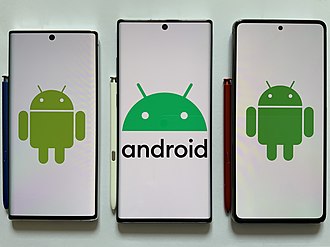
The mascot of Android is a green android robot, which matches the software's name. For a long time it had no official name. The Android team at Google reportedly called it "Bugdroid." In 2024, a Google blog post revealed its official name, "The Bot."
The robot was designed by then-Google graphic designer Irina Blok on November 5, 2007, when Android was announced. Some reports said she had been given a project to create an icon, but Blok said in an interview that she developed it on her own and made it open source. The design was not first presented to Google, but it quickly became common in the Android development team. Developers there liked the figure, which was free to use under a Creative Commons license, so they made their own versions of it. Its popularity among the team led Google to adopt it as an official icon, part of the Android logo, when Android launched to consumers in 2008.

Quiz time!
5 questions about Android (operating system)
What is the official name of the green Android robot, which a Google blog post revealed in 2024?
Pictures
Keep exploring



This article is a child-friendly adaptation of the Wikipedia article on Android (operating system), available under CC BY-SA 4.0.
Images from Wikimedia Commons. Tap any image to view credits and license.