 Safekipedia
Astana
Adapted from Wikipedia · Discoverer experience
Astana is the capital city of Kazakhstan. With a population of 1,622,245 within the city limits, it is the second-largest in the country after Almaty, which was the national capital until 1997. The city lies on the banks of the Ishim river in the north of Kazakhstan. It is located within the Akmola Region but administers itself.
Astana’s history is marked by rapid growth, especially after becoming the capital. Today, Astana is known for its modern and futuristic architecture, housing important government buildings, including the Akorda Residence, the Parliament House, and the Supreme Court. It has become a center for culture, education, and business in Kazakhstan and Central Asia.
The city is famous for its modern landmarks, including the Baiterek, the Khan Shatyr Entertainment Center, and the Hazrat Sultan Mosque, one of the largest in Central Asia. Visitors can explore cultural places such as the Astana Opera and the National Museum of the Republic of Kazakhstan, as well as parks like Presidential Park and Central Park.
Astana has hosted important international events, such as the 2011 Asian Winter Games and Expo 2017, showing its ability to organize large-scale events. The city’s transport system includes the Nursultan Nazarbayev International Airport and two railway stations, Astana-1 and Astana-Nurly Zhol. It is also home to important universities, such as Nazarbayev University and L.N. Gumilyov Eurasian National University, making it a growing center for education and innovation.
Names
The city now known as Astana was first founded in 1830 and had several names over time. It was called Akmoly, then Akmolinsk, later Tselinograd, and then Akmola again. When it became the capital of Kazakhstan in 1997, it was renamed Astana, meaning "capital city" in the Kazakh language. In 2019, it was named Nur-Sultan in honor of a former president, but in 2022, the name was changed back to Astana.
Today, Astana holds a record for having the most name changes of any capital city in modern times.
History
Many centuries ago, a place called Bozok was located where Astana is today. It was a military fortress along the Silk Road. The name "Boz" has several meanings in Turkic languages, such as 'untouched earth' or 'virgin soil'. Over time, the area grew and became an important settlement.
The settlement of Akmoly was founded on the Ishim river in 1830. It became a town called Akmolinsk in 1832. The town had a good position connecting many important places. In 1863, it became an official town. Over the years, it grew and developed. During World War II, Akmolinsk helped transport important tools and equipment from other parts of the Soviet Union. After the war, the city became a center for economic revival.
In 1961, the city was renamed Tselinograd to reflect its role in a big farming project. The city grew quickly with new buildings and housing. After Kazakhstan became independent in 1991, the city's name was changed back to Akmola, and then to Astana in 1998 when it became the capital. Astana was chosen as the capital because of its good location and resources. In 2019, the city was briefly renamed Nur-Sultan, but in 2022, it returned to its current name, Astana.
Geography
Astana is almost 1,000 km (620 mi) from the country's largest city and former capital, Almaty. The nearest big cities are Karaganda (200 km (120 mi)) and Omsk in Russia (450 km (280 mi)).
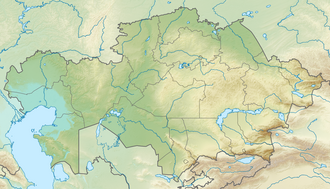
Astana is located in central Kazakhstan on the Ishim River in a flat, semi-arid steppe region. The city covers 722.0 square kilometres (278.8 sq mi) and sits 347 metres (1,138 ft) above sea level. The city experiences a cold climate with warm summers and long, very cold winters. Summer temperatures can reach 35 °C (95 °F), while winter temperatures often drop to between −30 °C and −35 °C (−22 °F to −31 °F). Strong winds are common, especially in the open parts of the city.
Demographics
As of January 2025, Astana has a population of 1,528,703 people—more than three times the population in 2002, which was 493,000.
By 2026, most people in Astana are ethnic Kazakhs, making up 83% of the city. Other groups include 8% Russian, 1.4% Ukrainian, 1% Tatar, 0.6% Uzbek, and 6% from other backgrounds.
The city has grown quickly since becoming the capital in 1997. Many people from across Kazakhstan and nearby countries have moved there for jobs and opportunities.
Religion
Islam and Christianity—especially Russian Orthodoxy, Roman Catholicism, and Protestantism—are the main religions in Astana. Other faiths such as Judaism, Lutheranism, Buddhism, and Hinduism are also practiced.
Astana is home to the largest mosque in Kazakhstan and Central Asia, the Astana Grand Mosque. The Palace of Peace and Reconciliation, built in 2006, welcomes leaders of many world religions and includes spaces for different faiths such as Judaism, Islam, Christianity, Buddhism, Hinduism, Taoism, and others. The city also has Central Asia's largest synagogue and the Our Mother of Perpetual Help Cathedral for the Catholic community. Astana is also the headquarters for the Eastern Orthodox Church.
Metropolitan area
The area around Astana includes the districts of Arshaly, Shortandy, Tselinograd, and part of Akkol in Akmola Region. This larger area is home to about 1.2 million people.
| Year | Pop. | ±% |
|---|---|---|
| 1897 | 9,688 | — |
| 1926 | 12,781 | +31.9% |
| 1939 | 33,209 | +159.8% |
| 1959 | 102,276 | +208.0% |
| 1970 | 179,514 | +75.5% |
| 1979 | 233,638 | +30.2% |
| 1989 | 277,365 | +18.7% |
| 1999 | 312,965 | +12.8% |
| 2009 | 613,006 | +95.9% |
| 2021 | 1,234,042 | +101.3% |
| Source: | ||
Economy
Further information: Economy of Kazakhstan
Astana's economy is based on trade, industrial production, transport, communication, and construction. The city produces building materials, foodstuff, and mechanical engineering products.
Astana plays an important role in global trade and finance. It is part of the Belt and Road Initiative and is a leader in the CIS region for financial services. The Astana International Financial Center opened in July 2018 to help grow business in Central Asia. Many big companies have their headquarters in Astana, which has helped the city grow quickly since it became the capital. The city has also attracted lots of visitors, making tourism an important part of its economy.
Diplomacy platform
Astana is a place where important talks about global issues happen. It has hosted meetings between the government of the Syrian Arab Republic and groups that oppose that government. The city was planned to hold a big meeting for the World Trade Organization in 2020, but this was delayed because of health concerns. Religious leaders from around the world have met in Astana since 2003 to talk about peace and working together.
Cityscape
See also: List of tallest buildings in Astana
Astana is divided into four districts. Almaty District was created in 1998 and has an area of 21,054 hectares with a population of 375,938 people. Yesil District, also called the left bank of the city, was created in 2008 and covers 31,179 hectares with 119,929 people. Saryarka District was created in 1998 and covers 19,202 hectares with 339,286 people. Baykonyr District was created in 2018 and covers 18,129 hectares with 233,351 people.
In 1998, Kazakhstan asked famous architects and urban planners to design the new capital. Japanese architect Kisho Kurokawa won the competition, and his plan focused on keeping the old city while building new areas to the south and east of the Ishim River. North of the railway line are industrial and older residential areas. The city centre, between the railway and the river, is where most new buildings are going up. To the west and east are higher residential areas with parks, and to the south of the river are new government buildings and a diplomatic quarter, which are still being built. The city’s planner wants Astana to feel like a Eurasian version of Berlin, not just an administrative centre like Canberra.
Two famous buildings in Astana are the Palace of Peace and Reconciliation and the Khan Shatyr Entertainment Center.: 20 Their designs reflect the history of the Eurasian steppes.
Sport
Main article: Sport in Astana
Astana is a city with many sports teams and events. The main football team is FC Astana, which plays in the Kazakhstan Premier League. They have won many titles and play at Astana Arena. There are also several ice hockey teams, such as Barys Astana, which is part of a big league.
Astana has teams for cycling and basketball too. The city has hosted important tournaments, like the Asian Winter Games and speed skating championships. There is also a big martial arts palace where young athletes can train in many sports.
Education
See also: List of educational institutions in Astana
Astana has many universities and colleges. In the 2013/2014 school year, 53,561 students were studying at 14 higher education places, which was 10% more than the year before. The biggest university is the L.N.Gumilyov Eurasian National University, with 16,558 students. It started in 1996 when two older schools joined together. The oldest university is the S. Seifullin Kazakh Agro Technical University, which opened in 1957. Nazarbayev University is a special school for research, started in 2010 with help from top universities around the world.
There are about 103,000 students in Astana's schools, including 71 public schools and 12 private schools. The Miras International School was the first private high school, opening in 1999. The Haileybury Astana school opened in 2011 and is connected to a school in the United Kingdom. Astana also has special schools for very smart students, like the Nazarbayev Intellectual Schools, and international schools such as the QSI International School of Astana.
Transportation
Astana has many ways to get around, including buses, taxis, and share taxis. Over 720,000 people use public transport every day. There are many bus lines and three share taxi routes.
The city also has an airport called Nursultan Nazarbayev International Airport. It is busy, with many people flying in and out each year. There are also train stations, with trains going to places like Almaty. Roads and highways connect Astana to other cities too.
Since 2008, people have been able to travel on the Esil River in Astana. This helps the city stay connected to other places.
Expo 2017
Main article: Expo 2017
In 2010, Astana offered to host a big world exhibition called Expo 2017. The main idea was about how energy affects our lives today, and the theme was "Future Energy."
The Expo officially started on June 10, 2017, with leaders from many countries coming to celebrate. It was the first big world fair ever held in Central Asia. The main building, called Nur Alem, was the largest round building in the world. Over four million people came to see the Expo.
Notable landmarks
Astana has many special places you can visit. Akorda is where the President of the Republic of Kazakhstan lives and works. The Astana Grand Mosque is the biggest mosque in Central Asia and was finished in 2022. Baiterek is a tall tower that was built in 1996 to celebrate when Astana became the capital instead of Almaty.
Other important spots include the Independence Palace for big events, the Kazakh Eli monument on Independence Square with a tall statue of a special bird, and the huge Khan Shatyr shopping tent, which is one of the largest in the world. Nurjol Boulevard is a nice walking area with fountains, and the Palace of Peace and Reconciliation is a grand hall for important meetings. There is also the Shabyt Palace, which is part of the Kazakh National University of Arts.
Theaters, concert halls, and museums
Astana has many places where people can enjoy art, music, and learn about history. The city has 27 libraries, 8 state museums, and 10 beautiful parks. In 2011, over 415,000 people visited the museums, which also offered thousands of tours.
Some special places in Astana include the Central Concert Hall Kazakhstan, where famous musicians and important events take place. There is also the Astana Circus, one of the newest and most modern circuses in the country. The National Opera and Ballet Theater named after K. Baiseitova and Astana Opera offer wonderful performances of music and dance. The National Museum of the Republic of Kazakhstan is the largest museum in Central Asia, showing the rich history of the area. Other interesting spots include the Modern Art Museum, the Presidential Center of Culture, and the Museum of The Future (Nur-Alem Pavilion), where visitors can learn about energy and imagine what cities might look like in 2050.
Twin towns – sister cities
See also: List of twin towns and sister cities in Kazakhstan
Astana is twinned with several cities around the world, showing friendship and cooperation.
Astana also works together with friendly cities to share ideas and support each other.
Smart city initiative
The Smart Astana project is a plan by the city’s leaders to use technology to improve places like hospitals, schools, ticket booking, and street lights. All these projects work together using an app called Smart Astana.
Astana also holds an annual event called the Astana Innovations Challenge to show the importance of smart city ideas. The world’s first smart sustainable city hub is planned to open there, helping new ideas and startups become part of Kazakhstan’s infrastructure.
Images
Related articles



This article is a child-friendly adaptation of the Wikipedia article on Astana, available under CC BY-SA 4.0.
Images from Wikimedia Commons. Tap any image to view credits and license.