 Safekipedia
Australian rules football
Adapted from Wikipedia · Discoverer experience
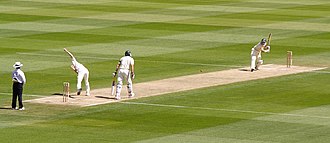
Australian rules football, also called Australian football or Aussie rules, is a fun and exciting contact sport played between two teams of 18 players. The game is played on a large oval field, often a modified cricket ground. Players score points by kicking an ovoid ball between the goal posts. Kicking the ball between the central posts earns six points, while kicking it between a central and outer post earns one point, called a "behind."
During the game, players can move anywhere on the field and use any part of their bodies to handle the ball. The main ways to move the ball are kicking, handballing, and running with it. Players must bounce or touch the ball on the ground while running with it. One special part of the game is the mark, where a player who catches a kicked ball under certain conditions gets to make an unimpeded play. Players can tackle opponents, but dangerous contact is not allowed.
The sport began in Melbourne, Victoria, in 1858, inspired by English public school football games. The Melbourne Football Club created the first laws of Australian football in May 1859. Today, Australian football is very popular in Australia, with the Australian Football League being the country's wealthiest sporting body. The AFL Grand Final is a big event held each year at the Melbourne Cricket Ground, drawing huge crowds. The sport is also played in many other countries in different forms.
Name
Further information: Names of Australian rules football
Australian football has many fun nicknames! People call it Australian rules football, Aussie rules, football, or just footy. In places where other types of football are more popular, many folks use the name AFL, which stands for the Australian Football League. The league also uses this name in some local competitions.
History
Origins
Primitive forms of football were played in the Australian colonies in the early 1800s. Football was seen as a fun activity, especially compared to more popular sports like cricket and horse racing. In Melbourne in 1858, private schools began organizing football games, inspired by rules from schools in England. The first match was between Melbourne Grammar and St Kilda Grammar.
A letter was published calling for a football club with rules to keep cricket players fit during winter. This led to several informal games, where players used different rules they knew. One notable game was between Melbourne Grammar and Scotch College, which ended in a tie.
First rules
In 1859, the Melbourne Football Club was formed, creating the first official rules for Australian football. These rules aimed to make the game simpler and safer than other football styles at the time. The new rules did not include offside laws, making the game different from English styles.
Early competition in Victoria
Other clubs soon formed, and the first competition began in 1861. The rules were kept consistent, and a new rule called the running bounce was added in 1866. The game was played on rough fields, and cricket grounds were sometimes used, though not always allowed.
Spread to other colonies
Football spread to South Australia, Tasmania, and other areas, with each place creating its own rules at first. By the 1870s, most places adopted the Victorian rules. The first national competition began in 1908, and the sport grew in popularity, especially during gold rushes in Australia and New Zealand.
Emergence of the VFL
In 1896, several clubs formed the Victorian Football League (VFL), which later became the Australian Football League (AFL). The VFL introduced new rules and structures, making the sport more organized and popular.
Interstate football and the World Wars
Australian football grew in places like New South Wales and New Zealand around the time Australia became a nation. However, both World War I and World War II affected the sport, with many players serving in the military and some clubs struggling.
Towards a national league
The idea of a national league grew, especially after a club moved from Melbourne to Sydney in 1982. More clubs from outside Victoria joined the league, which was renamed the AFL in 1990. The AFL continues to grow, with new clubs joining and efforts to expand the sport internationally.
Laws of the game
Main article: Laws of Australian rules football
For terminology, see Glossary of Australian rules football.
See also: Australian football tactics and skills
See also: Australian rules football positions
Players and equipment
In a standard match, a team can have between 14 and 18 players on the field at any time. Each team can have up to four extra players, called interchange players, who can swap in and out of the game. Some leagues might use even fewer players. Teams can also choose one substitute player for one special swap during the game.
Players wear basic gear like a jersey, shorts, socks, and football boots. They can also wear headbands or gloves if they want. Some protective gear, like helmets, is allowed if approved. Players are not allowed to wear jewelry that could be dangerous.
Ball
The game uses an oval-shaped ball. For men's games, the ball is about 72 to 73 cm around, and for women's games, it's a bit smaller. The ball needs to be inflated to the right pressure. The most common colors are red and yellow, with yellow used in the afternoon or indoors for better visibility.
Field
Australian rules football is played on an oval field, not a rectangle. The field is between 135 and 185 metres long and 110 and 155 metres wide. There are goal posts at each end, with two tall posts and two smaller posts beside them. The white lines around the field mark where players can and cannot go.
Match duration
A game lasts for 80 minutes, split into four 20-minute quarters. The clock stops for scores and injuries. There are breaks between quarters, with a longer half-time break after the second quarter.
Officiation
Each game has several umpires to make sure the rules are followed. There are field umpires in the middle of the field, boundary umpires along the sides, and goal umpires at each end to count the scores. At higher levels, a video review system helps check close calls.
Game skills
Ball movement
.jpg)
Kicking
Handballing
Players can move the ball by kicking or punching it with a closed fist, called a handball. If they don't do this, the other team gets a free kick. Players can run with the ball but must touch it every 15 metres.
Tackling
Players can tackle opponents to make them pass the ball, but only from the front or side between the shoulders and knees. Tackling too high, too low, or from behind can get a free kick for the other team. Players can also block opponents near the ball without having it themselves.
Marking
A player taking a mark on the chest
A player leaping to take a spectacular mark
If a player catches the ball after it's been kicked more than 15 metres, they get a mark. They can then either kick the ball from where they caught it or keep playing if the umpire says so.
Rucking
Further information: Ruck (Australian rules football)
Rucking is a special skill done by tall players called rucks. They jump to get the ball when it starts play and pass it to a teammate.
Misconduct
If a player breaks a rule, the other team gets a free kick from where the mistake happened. If a player misbehaves after a free kick or mark, they might get a 50-metre penalty, moving the spot closer to the goal.
Scoring
There are two ways to score. A goal, worth six points, is scored by kicking the ball between the tall goal posts. A behind, worth one point, is scored if the ball goes between a goal post and a smaller post, hits a goal post, or is touched before going through the goal or behind line. The team with the most points wins. If it's tied, it's a draw.
Governing bodies and competitions
Australian rules football has a season that runs from March to August, with important playoff games in September and October. In some parts of Australia, the game is played during the wet season instead.
The main group that oversees the sport in Australia is called the AFL. There are also seven groups in different parts of Australia that are connected to the AFL. These groups organize games for clubs at different levels. In 2003, the AFL became the main world group for the sport. There are also groups around the world that help manage amateur clubs and competitions.
In club competitions, the goal is to win the premiership, decided by playoff games after the regular season. The top teams play in these playoffs, ending with a big Grand Final match. Some leagues have different levels, where the best teams from lower levels can move up, and the worst teams from higher levels can move down.
Women and Australian rules
Further information: Women's Australian rules football
Many women have always been very interested in Australian rules football. Even in the 1800s, about half of the people watching games were women, which is more than in many other sports. This is because the game started in public parks where everyone could enjoy it together.
Women began playing organized teams in the 1910s, and women's leagues grew in the 1980s. In 2017, a big national league for women called AFL Women's (AFLW) started with eight teams. By a later season, all 18 major clubs had women's teams, and soon there will be 19 teams when Tasmania joins in 2028.
Variations and related sports
Further information: Variations of Australian rules football
Many games similar to Australian rules football have been created to make the sport more fun and easy for everyone to play. These include Auskick for kids aged between 5 and 12, kick-to-kick and its fun versions like end-to-end footy and marks up, rec footy, 9-a-side footy, masters Australian football, handball, and longest-kick contests. Players in other countries also enjoy versions of the game that fit their local fields, such as metro footy on gridiron fields and Samoa rules on rugby fields. Since 2018, AFLX has become popular — a faster version of the game with seven players per side on a soccer-sized pitch.
International rules football
Main article: International rules football
See also: Comparison of Gaelic football and Australian rules football
Because Australian rules football and the Irish sport of Gaelic football are quite similar, they created a mixed version called international rules football. The first matches were played in Ireland during the 1967 Australian Football World Tour. Over the years, new rules were tested, and in 1984, the International Rules Series began with teams from Australia’s state leagues (later the AFL) and Ireland’s Gaelic Athletic Association (GAA). This became a yearly event in 1998 but paused in 2007. It started again in Australia in 2008 with updated rules to keep players safe.
Global reach
Main article: Geography of Australian rules football
Australian rules football has been played in many places around the world. In the past, it was played in New Zealand and by Australians studying in Edinburgh University and London University. After World War II, the game grew in places like Papua New Guinea and Nauru, where it is now a popular sport.
Today, people in many countries enjoy playing Australian rules football. Over twenty countries have teams that work with the main Australian league. The sport is especially popular in North America, Europe, and Asia. Many players from different backgrounds now join teams in Australia, including players from Ireland.
Cultural influence and popularity
Australian football is very popular in Australia. In 2024, many people watched games, with over 38,000 fans at each match on average. About 1.3 million Australians are members of football clubs. It's also a big part of TV, with millions watching the big final game each year.
Australian football has inspired many artists, writers, and musicians. Painters have captured games in their artwork, and poets have written about the sport. Even movies, songs, and video games have been made about Australian football, showing how much it means to many people in Australia.
Australian Football Hall of Fame
Main article: Australian Football Hall of Fame
In 1996, to celebrate 100 years of the VFL/AFL, the Australian Football Hall of Fame was created. That year, 136 important players from different competitions were honored. Each year after that, a group of experts picks a few more players to join this special group. By 2024, over 300 players were part of the Hall of Fame.
Some of these players are chosen for an even more special title called Legend. Only a small number can earn this title, and as of 2024, there are 32 players with Legend status.
Images
Related articles



This article is a child-friendly adaptation of the Wikipedia article on Australian rules football, available under CC BY-SA 4.0.
Images from Wikimedia Commons. Tap any image to view credits and license.