 Safekipedia
Baroque architecture
Adapted from Wikipedia · Discoverer experience
Baroque architecture is a very fancy and detailed style that started in Italy in the late 1500s. It was first used by the Catholic Church, especially the Jesuits, to show power and beauty against the Reformation and the Protestant church. This style spread all over Europe and even to places like Russia, the Ottoman Empire, and the Spanish and Portuguese colonies in Latin America.
Baroque buildings took ideas from earlier Renaissance architecture, like domes and colonnades, and made them taller, grander, and more decorated. Inside, artists used special painting and sculpture to make it look like you were seeing heaven. There were lots of golden decorations, twisted columns, and beautiful paintings on the ceilings and walls. In palaces, big staircases became very important parts of the design.
The style grew and changed over time. In the early days, famous buildings like the Church of the Gesù and St. Peter's Basilica showed this new way of building. Later, great artists like Gian Lorenzo Bernini created amazing works such as the colonnade of St. Peter's Square. By the late 1600s, Baroque style could be seen in many countries, with each place adding its own special touch. One of the most decorative forms was called Rococo, known for covering every space with detailed sculptures and paintings.
History
Early Baroque (1584–1625)
Baroque architecture began in the late 16th and early 17th century in Rome. It aimed to inspire awe and reverence in people by using dramatic effects like contrast, movement, and painted ceilings that looked like heaven. This style was favored by religious groups who wanted to attract and inspire many people.
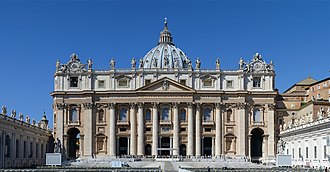
In Rome, one of the first Baroque architects, Carlo Maderno, designed the new façade of Saint Peter's Basilica to match the huge dome built earlier by Michelangelo. Other early examples in Rome included the Church of the Gesù with its ornate interior, and Santa Susanna.
High Baroque (1625–1675)
Pope Urban VIII became a major supporter of the Baroque style. He hired Gian Lorenzo Bernini, who created grand buildings, interiors, squares, and fountains that turned Rome into a grand performance space. Bernini redesigned several churches and created famous works like the Baldacchino in St Peter's Basilica.
The High Baroque spread across Italy. In Venice, Santa Maria della Salute was built. In Rome, the Barberini Palace featured impressive interiors, including a huge fresco painted by Pietro da Cortona. Other notable works included San Carlo alle Quattro Fontane by Francesco Borromini and Santi Luca e Martina by Pietro da Cortona.
In France, King Louis XIII sent Jacques Lemercier to study the new style in Rome. Lemercier designed the Pavillon de l’Horloge at the Louvre Palace and the Sorbonne Chapel. Later, under Louis XIV, architects like Louis Le Vau and Jules Hardouin-Mansart built the grand Palace of Versailles, with its famous Hall of Mirrors.
Late Baroque (1675–1750)
During the Late Baroque, the style spread across Europe. In Italy, the Basilica of Superga near Turin was built. In France, the Palace of Versailles continued to be decorated, including the Hall of Mirrors.
In England, Christopher Wren rebuilt St. Paul's Cathedral and designed Greenwich Hospital and Hampton Court Palace. Other architects like Inigo Jones, John Vanbrugh, and Nicholas Hawksmoor also created notable Baroque buildings.
In the Grand Duchy of Lithuania, Baroque architecture developed through three phases. The style was introduced by the Jesuits and seen in buildings like the Corpus Christi Church in Nyasvizh and the Church of St. Casimir in Vilnius.
In Central Europe, architects like Fischer von Erlach in Austria and Balthasar Neumann in Germany created grand Baroque buildings. In Bohemia, Christoph Dientzenhofer made Prague a center of late Baroque architecture.
In Spain, the Baroque arrived later but became very ornate, with architects like Jose Benito de Churriguera creating highly decorated buildings.
The Baroque style also spread to Latin America and North America. In Mexico, Brazil, and other regions, churches and buildings were constructed in the Baroque style, often with local influences. Notable examples include the Cathedral Basilica of Zacatecas in Mexico and the Church of Saint Francis of Assisi in Ouro Preto, Brazil.
Ottoman Baroque
A new Ottoman or Turkish "Baroque" style emerged in the 1740s, replacing the earlier Tulip Period style. This new style aimed to modernize Istanbul and affirm the empire's status. The Nuruosmaniye Mosque, begun in 1748, became a key example of this new style, integrating European influences and marking a return to imperial mosque construction by the sultan.
Characteristics
Baroque architecture is known for its grand and dramatic style. It often used special effects to create a sense of wonder and beauty.
The style included domes with painted ceilings that looked like the sky, filled with angels and shining light. There were also grand stairways designed to impress, winding up in a way that offered new views from each level. Mirrors were used to make spaces feel bigger and brighter. Artists also used strong contrasts of light and dark, called chiaroscuro, to add drama. Other features included decorative frames, overhead sculptures that seemed to float, and unique shapes like ellipses to avoid straight corners. These elements made Baroque buildings feel lively and full of movement.
Plans
Here are some special floor plans of famous Baroque churches. The first is Santi Luca e Martina in Rome, built between 1639 and 1669. The next is Sant'Andrea al Quirinale, created by Gian Lorenzo Bernini from 1658 to 1661, showing where people enter and where the altar is placed. The last one is the Basilica of the Fourteen Holy Helpers, built later between 1743 and 1772, with its altar in the middle of an oval shape.
Major Baroque architects and works, by country
Italy
Main articles: Italian Baroque architecture and Sicilian Baroque
- Carlo Maderno – Santa Susanna (1595–603); St. Peter's Basilica and Sant'Andrea della Valle, Rome
- Pietro da Cortona – Santa Maria della Pace (1656–68), Santi Luca e Martina, Rome
- Gian Lorenzo Bernini – Saint Peter's Square, Palazzo Barberini, Sant'Andrea al Quirinale, Rome
- Francesco Borromini – San Carlo alle Quattro Fontane, Sant'Ivo alla Sapienza, Rome
- Carlo Fontana – San Marcello al Corso (1692–1697)
- Francesco de Sanctis – Spanish Steps (1723)
- Luigi Vanvitelli – Caserta Palace (begun 1752)
- Guarino Guarini – Palazzo Carignano in Turin (1679), Chapel of the Holy Shroud, Turin
- Filippo Juvarra – Basilica of Superga, Turin (1717–31)
France
Main article: French Baroque architecture
- Salomon de Brosse – Luxembourg Palace (1615–1645)
- Louis Le Vau – (Vaux-le-Vicomte) (1658–1661), Collège des Quatre-Nations (1662–1688), Cour Carrée of the Louvre Palace (1668–1680)
- Jules Hardouin-Mansart – domed chapel of Les Invalides (finished 1708); garden façade and Hall of Mirrors of Palace of Versailles
- Robert de Cotte – Chapel of Palace of Versailles (1643–1715), Grand Trianon (1643–1715)
England
Main articles: English Baroque and Edwardian Baroque architecture
- Christopher Wren – St. Paul's Cathedral (1675–1711), Hampton Court Palace (1690–1696), Greenwich Hospital (begun 1695)
- Nicholas Hawksmoor and John Vanbrugh – Castle Howard (1699–1712); Blenheim Palace (1705–1724)
- James Gibbs – Radcliffe Camera, Oxford (1739–49)
The Netherlands
Main article: Dutch Baroque architecture
- Jacob Van Campen – Royal Palace of Amsterdam (then city hall) (begun 1648), Noordeinde Palace (1640) and Mauritshuis (1641)
- Lieven de Key – City Hall (Haarlem) (1620)
- Pieter Post – Huis ten Bosch (1645–1652) and Maastricht City Hall (1686)
- Maurits Post – Soestdijk Palace (1650)
- Daniël Stalpaert – Het Scheepvaartmuseum (1655–1656) and Trompenburgh (1684)
- Daniel Marot – Het Loo Palace (1684–1686)
- Bartholomeus van Bassen – Nieuwe Kerk (The Hague) (1656)
- Pierre Cuypers – Oudenbosch Basilica (1892)
Germany
Main article: Architecture of Germany
- Agostino Barelli – Nymphenburg Palace, Munich (1664–1675)
- Matthäus Daniel Pöppelmann – Zwinger, Dresden (1697–1716)
- George Bähr – Dresden Frauenkirche (1722–1738, destroyed in 1944, rebuilt in 1994–2005)
- Johann Arnold Nering – Charlottenburg Palace, Berlin (1695–1713)
- Andreas Schlüter, Berlin Palace (1798-1713), reconstructed 2013-2020
- Balthasar Neumann – Basilica of the Fourteen Holy Helpers (1743–1772), Würzburg Residence (1735)
- Johann Dientzenhofer and Johann Lukas von Hildebrandt – Schloss Weißenstein in Pommersfelden, Bavaria (1711–1718)
- Augustusburg Palace
Austria
- Johann Lukas von Hildebrandt, Upper Belvedere Palace in Vienna (1721–23)
- Johann Bernhard Fischer von Erlach – University Church, Salzburg (begun 1696); Karlskirche, Vienna (1716–37); Austrian National Library (begun 1722)
- Johann Bernhard Fischer von Erlach and Johann Lukas von Hildebrandt – Palais Auersperg in Vienna
- Jakob Prandtauer and Josef Munggenast, Abbey of Melk (1702–1738)
- Santino Solari, Salzburg Cathedral (façade and interior of dome) (1614–1628)
Czech Republic
Main article: Czech Baroque architecture
- Jean-Baptiste Mathey – Troja Palace, Prague (1679–1691)
- Christoph Dientzenhofer – Břevnov Monastery, Prague (1708–1721) – Church of St Nicholas. Prague (1704–55)
- Kilian Ignaz Dientzenhofer – Kinský Palace (Prague) (1755–1765)
Slovakia
- Pietro Spozzo – Jesuit Church of Trnava (1629–37)
Hungary
- András Mayerhoffer – Gödöllő Palace near Budapest (begun 1733)
- Ignác Oraschek and Márton Wittwer: Esterházy Palace in Fertőd
Romania
Main article: Romanian architecture
- Johann Eberhard Blaumann – Bánffy Palace in Cluj (1774–75)
- Johann Lukas von Hildebrandt – Bishopric Palace in Oradea (1736–1750)
- Joseph Emanuel Fischer von Erlach – St. George's Cathedral, Timișoara
- Anton Erhard Martinelli – Holy Trinity Cathedral, Blaj (1738–1749)
- Samuel von Brukenthal – Brukenthal Palace in Sibiu (1777–87)
- Franz Burger – Brukenthal High School in Sibiu (1779–81)
- Jesuit Church, Sibiu (1726–33)
- Gheorghe Lazăr National College (Sibiu)
Poland
Main article: Baroque in Poland
- Giovanni Maria Bernardoni – Saints Peter and Paul Church, Kraków (1597–1619)
- Joseph Emanuel Fischer von Erlach – Chapel of the Holy Sacrament, Wroclaw Cathedral
- Karl Friedrich Pöppelmann – Blue Palace in Warsaw (1728)
- Tylman van Gameren – Krasinski Palace, Warsaw (1677–1682)
- Johann Lukas von Hildebrandt – Royal Castle, Warsaw (1711)
- Friedrich Karcher – Enlargement of Royal Castle, Warsaw (1700)
- Augustyn Wincenty Locci and Andreas Schlüter – Reconstruction of Wilanów Palace (1677–1696)
Portugal
- João Antunes – Church of Santa Engrácia, Lisbon (now National Pantheon of Portugal; begun 1681)
- Nicolau Nasoni – Clérigos Church in Porto (1732–1763); Mateus Palace in Vila Real (1739–1743)
Portuguese Colonial Baroque
See also: Baroque in Brazil and Portuguese Colonial architecture
- Aleijadinho – Church of Saint Francis of Assisi (Ouro Preto), Brazil (1771–1794)
- Basilica and Convent of Nossa Senhora do Carmo, Recife, Brazil (1665–1767)
- Church of St. Anne, Talaulim, India (1577–1695)
- Church of Saint Dominic, Macau, China (1587)
Spain
Main article: Spanish Baroque architecture
- Fernando de Casas Novoa – West façade of Cathedral of Santiago de Compostela (1738–1750)
- Alonso Cano – Baroque additions to Granada Cathedral (1667)
- Leonardo de Figueroa – Palacio de San Telmo, Seville, (1682)
- Jose Benito de Churriguera – San Cayetano Church, Madrid – Altar of the Church of San Esteban, Salamanca (1693)
- Francisco Hurtado Izquierdo – Granada Charterhouse, Granada (1727–1764)
Spanish American Baroque
Main articles: New Spanish Baroque, Churrigueresque, and Andean Baroque
- Lorenzo Rodriguez – Metropolitan Tabernacle of Mexico City Metropolitan Cathedral, Mexico (1749–1760)
- Cathedral Basilica of Zacatecas in Zacatecas City, Mexico (1729–1772)
- Spaniard José de la Cruz, Antonio de Nava and Luigi Tomassi – Cathedral of Chihuahua, Mexico, (1725–1760)
- Convent of San Francisco, Madero Street, Mexico City, built around the 16th century
- Flemish Jean-Baptiste Gilles and Diego Martínez de Oviedo – Iglesia de la Compañía de Jesús, Cusco, Peru (1668)
- Juan Miguel de Veramendi, Juan Correa, Miguel Gutiérrez Sencio – Cusco Cathedral, in Cusco, Peru (1560–1664)
- Palacio de Torre Tagle, in Lima, Peru (1715)
- Cathedral Basilica of Lima, Peru (1535–1649)
- Basilica and Convent of Nuestra Señora de la Merced, Lima, Peru (1535)
- Basilica of San Francisco, La Paz, Bolivia (1743–1772)
- Havana Cathedral in Cuba, built between 1748 and 1777
- Basilica Menor de San Francisco de Asís in Havana, Cuba, built between 1580 and 1738.
Nordic Countries
Main articles: Architecture of Sweden, Architecture of Denmark, Architecture of Norway, and Architecture of Finland
- Elias David Häusser (Denmark) – Christiansborg Palace (1st)
- Lambert van Haven (Denmark) – Church of Our Saviour, Copenhagen (1682–1747)
- Nicodemus Tessin the Elder (Sweden) – Drottningholm Palace (1662–1681) – Kalmar Cathedral in Småland, Sweden (1660–1703)
Russia
Main articles: Naryshkin Baroque, Petrine Baroque, Elizabethan Baroque, Siberian Baroque, and Russian Baroque
- Giovanni Maria Fontana – Menshikov Palace (Saint Petersburg) (1710–1720s)
- Georg Johann Mattarnovi – Kunstkamera in Petrine Baroque, Saint Petersburg, completed by 1727
- Bartolomeo Francesco Rastrelli – Façade of Smolny Convent, Saint Petersburg (1748–1754); Stroganov Palace (1753—1754); Vorontsov Palace (Saint Petersburg) (1749—1757); Winter Palace in Saint Petersburg (1754–1762)
- Domenico Trezzini – Peter and Paul Fortress, Saint Petersburg (1706–1740)
- Mikhail Zemtsov – Transfiguration Cathedral (Saint Petersburg) (1743–54)
Ukraine
Main article: Ukrainian Baroque
- Francesco Bartolomeo Rastrelli – Mariinskyi Palace in Kyiv (1744–1752); St Andrew's Church, Kyiv (1744–1767), both in Elizabethan style
- By the command of Yakiv Lyzohub – House of Lyzohub (1690s); Catherine's Church, Chernihiv (1715)
- St. Nicholas Cathedral, Nizhyn (17th century), the prototype of Ukrainian baroque
- Most of Vydubychi Monastery (17th–19th century)
- Portions of Kyiv Pechersk Lavra (17th–18th century)
Malta
Main article: Maltese Baroque architecture
- Bontadino de Bontadini – Wignacourt Aqueduct (1612–1615) and Wignacourt Arch
- Francesco Bounamici – Church of the Jesuits, Valletta (1635)
- Mattia Preti – St John's Co-Cathedral (1660s); Our Lady of Victories Church, Valletta (1752)
- Lorenzo Gafà – Saint Lawrence's Church, Vittoriosa (1681–97); St. Paul's Cathedral, Mdina (1696–1705); the Cathedral of the Assumption, Victoria (1697–1711)
- Andrea Belli – Auberge de Castille (1741–45)
Images
Related articles




This article is a child-friendly adaptation of the Wikipedia article on Baroque architecture, available under CC BY-SA 4.0.
Images from Wikimedia Commons. Tap any image to view credits and license.