
Christianized sites
Many important places used to belong to old religions before Christianity became popular. When people started to believe in Christianity, they changed these places to fit their new beliefs. This process is called Christianization.
One way they did this was by giving new Christian names to old sacred spots. For example, a beautiful island called Oglasa in the Tyrrhenian Sea was renamed Montecristo. This helped people remember their new faith while keeping the special meaning of the place.
Changing these sites helped spread Christianity and connect new believers to their history. It shows how different cultures mix together over time, creating a rich story of how people’s beliefs have changed.
Early Christianity
In the early years of Christianity, churches were often small meeting places in people’s homes or near the burial sites of holy people called martyrs and saints. Many of these burial sites were located outside of cities. Over time, this changed, and holy relics began to be kept inside city churches.
Many old temples used for pagan worship were no longer needed before Christianity became widespread. These temples were sometimes turned into new buildings or used for different purposes. After laws were passed, these old temples were closed and no longer used for worship. Christians at first avoided these places because of their history, and because the temple shapes were not right for Christian services. Instead, they used a type of building called a basilica, which was originally a secular building.
Ancient Rome and Greece
Rome
In Rome, many old buildings that were once used for pagan worship were turned into churches. Important places like the Roman Forum saw temples such as the Curia Iulia, Temple of Antoninus and Faustina, and Temple of Romulus become churches. The famous Pantheon, originally a temple for Roman gods, was changed into a church dedicated to St. Mary and the Martyrs. This process of turning old worship sites into Christian places of worship began in the 6th and 7th centuries and continued even into the Renaissance.
Some churches were built above important burial places of early Christian leaders. This was a new idea in Christianity, as older traditions did not usually allow burials close to city centers.
Vatican
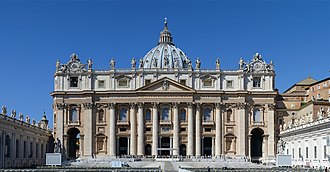
St. Peter's Basilica in the Vatican is believed to be built where the leader Simon Peter was buried. Excavations under the basilica have found old Roman mausoleums and a small structure called the aedicula, which looks like a tiny temple.
Greece
In Greece, many old pagan sites were taken over by Christian monasteries and churches. For example, the city of Aphrodisias was renamed Stauropolis, meaning "City of the Cross." Some temples in Athens, like the Askepieion and the Parthenon, were turned into churches later on, showing the changes that happened as Christianity grew stronger. During Byzantine times, the Parthenon became a church dedicated to the Mother of God.
Middle Ages
Cassiodorus, the court secretary to the Ostrogoth Theodoric the Great, wrote about a fair held at a former pagan shrine in south Italy. This shrine was changed into a baptistery.
Sulpicius Severus wrote about Martin of Tours building churches and monasteries where heathen temples once stood. When Benedict of Nursia took over the site at Monte Cassino, he removed statues and altars. Montmartre in France, once called Mons Martis or "Mount of Mars," later became a place for Christian worship.
In Francia, an abbey was built at the ruins of an old settlement. The place still had special thermal baths. The Notre-Dame du Taur cathedral in Toulouse may have been built on the site of an old temple.
In Britain, there was a tradition that old temples were changed into churches. Pope Gregory I advised that idols should be removed but the buildings kept. Some Roman temples in Britain were changed into Christian sites. Holy wells and springs were often linked to local saints after Christianity spread. Trees that were once considered sacred were sometimes cut down.
During the Reconquista in the Iberian Peninsula, many mosques were changed into Christian churches. The Great Mosque of Cordoba became a cathedral in 1236. Santiago de Compostela became an important Christian pilgrimage site.
New World
The Spanish built many churches in places where Native American temples once stood, similar to how they changed Muslim mosques into churches in Spain. For example, the Mexico City Metropolitan Cathedral was built on an Aztec temple in Mexico. In Central America, large pyramid temples were also changed into Christian places of worship. Some of these sites today look like normal churches, with no sign of their past as temples.
Balkans
During the Ottoman conquest of the Balkans in the 15th century, many churches were changed into mosques. Later, in the 19th century, many of these places were turned back into churches. For example, the Sveti Sedmochislenitsi Church in Sofia was an old mosque that became a church. After Christian Balkan states became independent from the Ottoman Empire, they sometimes destroyed mosques and turned them into churches. In Croatia, the few remaining mosques from that time are now Catholic churches.
South Asia
During times when many people were changing their religious beliefs, some important places that were once used for Hindu, Sikh, or other traditions were changed to be used for Christian worship. For example, many Hindu temples in areas like Goa were torn down, and their stones were sometimes used to build churches. In other places, such as Peshawar in Pakistan, tombs that were built for important leaders were turned into places for Christian services. Even in villages, shrines that were once used for Sikh traditions were adapted for Christian use. These changes happened as part of efforts to spread the Christian faith in new areas.
Today, some of these places have returned to their original purposes, while others still serve Christian communities.
Pictures
Keep exploring



This article is a child-friendly adaptation of the Wikipedia article on Christianized sites, available under CC BY-SA 4.0.
Images from Wikimedia Commons. Tap any image to view credits and license.