 Safekipedia
Cosmic ray
Adapted from Wikipedia · Discoverer experience
Cosmic rays, also called astroparticles, are tiny bits of matter zooming through space at nearly the speed of light. Most of these particles are protons or clusters of atoms that come from far beyond our Solar System. They travel from our own Milky Way galaxy, from other galaxies, and even from the Sun.
When cosmic rays reach Earth, they bump into our planet's atmosphere and create cascades of new particles. Some of these particles make it down to the ground, but many are pushed away by Earth's magnetic shield, called the magnetosphere.
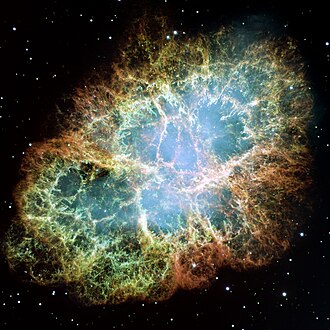
We have known about cosmic rays since 1912, when a scientist named Victor Hess discovered them while flying balloons high above the Earth. Today, we study them using special tools on satellites and space probes. Recent discoveries suggest that many cosmic rays might come from exploding stars called supernovas, as well as from powerful objects in distant galaxies known as active galactic nuclei.
Etymology
The word "ray" comes from an old idea that these particles were like light beams because they could go through things. We now know they are tiny bits of matter with weight, just like other particles we study, such as cathode rays, canal rays, alpha rays, and beta rays. Other types of light, like gamma rays or X-rays, are called by their special names because they don’t have weight.
Composition
Most cosmic rays that come from outside Earth are tiny parts of atoms, with about 99% being just the centers of atoms without their outer parts. About 90% of these centers are simple protons, which are like hydrogen atoms without their outer parts. Another 9% are like helium atoms, and 1% are centers of heavier atoms. These numbers can change depending on how much energy the cosmic rays have.
When cosmic rays hit Earth's air, they break atoms apart and create new particles, including things called pions and muons. Some of these muons can go all the way through the air and even underground. About one muon passes through a space the size of a person's head every second. These muons, along with natural radioactivity, help create the ionization in the air that scientists noticed long ago, which led them to discover cosmic rays coming from space.
Main article: beta particle
Main articles: HZE ions, antimatter, positrons, antiprotons, anti-alpha particles
Energy
Cosmic rays are very interesting because they can damage tiny parts in electronics and living things when they are not protected by Earth's air and magnetic field. Scientists study them because some cosmic rays have extremely high energy—so high that they can reach about 3 × 10²⁰ eV. This is millions of times more energy than particles created in the largest machine on Earth, called the Large Hadron Collider. These high-energy cosmic rays might get their energy from powerful objects in space called active galactic nuclei.
Most cosmic rays do not have such high energy. The most common ones have an energy of around 300 megaelectronvolts, which is much less than the highest-energy ones.
History
After discovering radioactivity in 1896, scientists thought that electricity in the air came only from radioactive materials on the ground or gases in the air. But measurements showed that ionization increased with height, suggesting another source.
Discovery
In 1909, Theodor Wulf created a tool to measure radiation and found more at the top of the Eiffel Tower than at the bottom. His work was not widely accepted. In 1911, Domenico Pacini found that ionization changed over water and land, suggesting sources beyond Earth.
In 1912, Victor Hess flew high in a balloon with tools to measure radiation. He found it increased with height, even during a solar eclipse, suggesting radiation came from space. In 1913–1914, Werner Kolhörster confirmed these results from even higher altitudes.
Hess won the Nobel Prize in Physics in 1936 for this discovery.
Identification
In the 1920s, the term cosmic ray was created by Robert Millikan, who measured ionization from deep underwater to high altitudes. He thought cosmic rays were gamma rays from space. But later finds showed they were charged particles.
In 1927, Jacob Clay found cosmic ray intensity changed with latitude, showing they were charged. In 1929, Bothe and Kolhörster found particles that could go through thick gold, proving they were not photons.
In 1930, Bruno Rossi predicted differences in cosmic ray intensity from east to west, which was later confirmed, showing most were positive. By 1948, it was found that most cosmic rays are protons, with some helium nuclei and heavier elements.
Energy distribution
In 1954, experiments measured the energy of cosmic rays, finding they could go beyond 1020 eV. The Auger Project in Argentina studies these high-energy rays to learn more about their origins and effects on our understanding of the universe.
Solar modulation
Solar modulation explains how the strength of cosmic rays changes as they move through the space around our Sun, called the heliosphere. This change happens because of the solar wind and the Sun's magnetic field. The Sun's activity goes through cycles, roughly every 11 to 22 years, which affects how many cosmic rays reach Earth. These cycles cause the number of cosmic rays to go up and down over time.
Main article: solar cycle
Main articles: solar wind
Parker transport equation
The Parker transport equation, named after Eugene Parker, is a special math rule used to study how energetic particles move in space. These particles can be found in places with lots of hot, moving gas, called astrophysical plasmas. The equation helps scientists understand how these particles speed up and travel, including how they get pushed around by big events like explosions from old stars or bursts of energy from the Sun.
The equation looks complicated, but it mainly talks about how particles spread out in space and change speed over time. It is used to learn more about how tiny bits of energy move around in space, helping us understand big cosmic events.
Images
Related articles


This article is a child-friendly adaptation of the Wikipedia article on Cosmic ray, available under CC BY-SA 4.0.
Images from Wikimedia Commons. Tap any image to view credits and license.