 Safekipedia
Cretaceous–Paleogene boundary
Adapted from Wikipedia · Discoverer experience
The Cretaceous–Paleogene (K–Pg) boundary is a special layer of rock that marks an important moment in Earth's history. This thin band of rock contains much more iridium than other layers, helping scientists study big changes that happened long ago. The K–Pg boundary shows the end of the Cretaceous Period and the start of the Paleogene Period.
This boundary is linked to a big event that changed life on Earth. Many plants and animals, including most dinosaurs, disappeared around this time. Scientists believe a huge meteorite hit Earth near what is now the Chicxulub crater, and this impact may have caused the changes we see in the rock layer.
The name "Cretaceous" comes from a Latin word for chalk, "creta," because this time period had lots of chalk-forming rocks. Today, the K–Pg boundary helps us learn about how Earth and its living things have changed over millions of years.
Proposed causes
Chicxulub crater
Main article: Chicxulub crater
In 1980, a group of scientists found that layers of rock from the end of the time when dinosaurs lived contain much more of a special element called iridium than usual. They thought this showed that a big object from space hit Earth, causing big changes to the climate and leading to many plants and animals, including dinosaurs, disappearing.
The place where this hit is called the Chicxulub crater and is buried under the ground in Mexico. It was made when a very large rock or piece of ice from space hit Earth about 66 million years ago. This crash would have caused huge waves in the ocean and clouds of dust that blocked sunlight, changing the world for many years.
Deccan Traps
Main article: Deccan Traps
Big volcanoes in what is now India were also active around the same time. These volcanoes could have sent up lots of dust and gases that blocked sunlight and changed the air, making it hard for plants to grow and for some animals to survive.
Multiple impact event
There are other places on Earth that look like they were also hit by objects from space around the same time as the big Chicxulub crash. This makes some scientists think that maybe more than one object hit Earth then.
Maastrichtian marine regression
The oceans also changed a lot at the end of the time when dinosaurs lived. The water levels went down, which changed where animals and plants could live and made some places much harder for sea creatures to survive in.
Supernova hypothesis
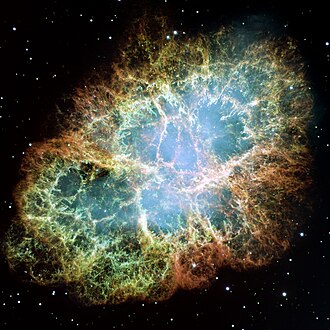
Some people thought that a big explosion of a star, called a supernova, might have caused changes on Earth. But more careful looking at the rocks did not find the special material that would show this happened, so this idea is not thought to be true anymore.
Verneshot
One idea is that the big volcanoes might have been so strong that they shot material high into the air, and it fell back down like a crash. But most scientists do not think this is likely.
Multiple causes
It is possible that both the big crash and the volcanoes, and maybe other things too, all worked together to cause the big changes that happened at the end of the time when dinosaurs lived.
Images
Related articles


This article is a child-friendly adaptation of the Wikipedia article on Cretaceous–Paleogene boundary, available under CC BY-SA 4.0.
Images from Wikimedia Commons. Tap any image to view credits and license.