 Safekipedia
Dust Bowl
Adapted from Wikipedia · Discoverer experience
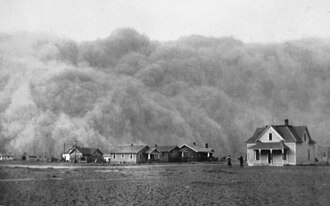
The Dust Bowl was a time of very bad dust storms that hurt the land and farming in parts of the United States and Canada in the 1930s. These storms happened because of both nature and people. There was a very dry time with little rain, called a drought, and people had removed the plants that normally held the soil in place. Without these plants, the dry soil was blown away by strong winds, creating huge dust storms.
The dry weather lasted for several years, making it very hard for farmers to grow food. Many people had to leave their homes and look for new places to live. The Dust Bowl is remembered in books, songs, and photographs. Famous stories and songs from that time show how difficult life was for many families. Photos taken by a woman named Dorothea Lange helped people understand what it was like to live through those hard years.
Geographic characteristics and early history
The Dust Bowl area is mainly west of the 100th meridian on the High Plains. It has flat to rolling land, with heights ranging from about 2,500 feet in the east to 6,000 feet near the Rocky Mountains. This area gets less than 20 inches of rain each year, which normally supports grasses that can survive with little water. However, the land can also go through long dry spells.
In the past, people thought this area was not good for farming because there was little water and few trees. But the government encouraged people to settle there, offering land through laws like the Homestead Act of 1862. Many people moved in, especially after a very wet period made them think the land would always be rainy enough for crops. Farmers began to plow the land deeply, removing the natural grasses that helped keep the soil in place. When a serious drought hit in the 1930s, the loose soil turned to dust and was blown away by strong winds, creating huge clouds that darkened the sky and made it hard to see. This event became known as the Dust Bowl, affecting millions of acres across several states and forcing many families to leave their farms.
Drought and dust storms
After the 1920s, when the weather was good and many people settled in the Great Plains, a very dry time began in the summer of 1930. For the next ten years, the northern plains had some of the driest years ever recorded, and places like Kansas and West Texas didn't get much rain until 1941. When the drought hit the Great Plains in the 1930s, the dry soil blew away because of how people were farming. The soil became very dry and loose, and without grass to hold it down, strong winds picked it up and created huge dust storms. These storms ruined crops and left the land bare.
The first big dust storm happened on September 14, 1930. It was unlike anything anyone had seen before. Later, in 1934, a terrible dust storm removed a lot of soil from the Great Plains and traveled all the way to cities like Chicago, Cleveland, Buffalo, Boston, New York City, and Washington, D.C.. On April 14, 1935, called "Black Sunday," a massive dust storm caused by a cold front from Canada covered the Great Plains in thick dust. The term "Dust Bowl" was first used by a reporter describing this event. Many people suffered from breathing problems because of the dust.
Human displacement
In 1935, many families had to leave their farms because of the severe dust storms. Over 350 houses were torn down after just one big storm. Many people lost their homes and had to look for work elsewhere.
A lot of Americans moved west to find jobs. Parents packed their families into old cars, called "jalopies", and traveled to places like California. Between 1930 and 1940, around 3.5 million people left the Plains states. In just one year, over 86,000 people moved to California, which was more than during the 1849 gold rush. People from many states, such as Oklahoma, Arkansas, and Texas, were often called names like "Okies" or "Arkies" because they had lost their farms and were struggling.
Many people did not travel far; they just moved to nearby areas that were less affected by the dust storms. So many families were moving that the number of people leaving and those staying was almost the same in the Great Plains states.
Studies showed that not all who moved were farmers. Some had other jobs before they left. Many farmers had to take new kinds of work when they moved, which sometimes led to better-paying jobs later. Others who were not farmers also changed jobs, but usually they did not become poor. By the time the Great Depression ended, some people moved back home, but many stayed where they had settled. Even today, a small part of California's population has roots from those who moved there during this difficult time.
Changes in agriculture and population on the Plains
During World War I, farming grew a lot, but it dropped during the Great Depression in the 1930s. The land most hurt by the Dust Bowl was 16 million acres in the Texas and Oklahoma panhandles. These areas had many people who moved during this time, known as the Great Plains migrants.
Although many people moved from the Southern Great Plains, the number of movers did not jump suddenly. The Dust Bowl and the Great Depression pushed these movers to keep going, while in other places, economic troubles made it hard for people to move. The population of the Great Plains went down, but this was mostly because fewer new people were coming in, not because many were leaving.
Government response
The government took many steps to help people during the Dust Bowl. They made maps and took photos to see where the land needed help. They planted trees to stop the soil from blowing away and helped farmers move to better land if needed.
President Franklin D. Roosevelt started programs to save the soil and help the land heal. The government paid farmers to use better farming methods and gave out food to people in need. They also planted a huge line of trees from Canada to Abilene, Texas, to block the wind and keep the soil in place. These efforts helped reduce the dust and protect the land when rain finally returned.
Long-term economic impact
This disaster made the Great Depression even harder for the region. Many people had to leave their homes, and they lost everything because the dirt from their land blew away. This caused a lot of hunger and poverty.
By the end of the 1930s, more than 75% of the topsoil in some places had been blown away. The value of farmland went down, especially in areas where the most soil was lost. Even many years later, the land was not as valuable as it was before. The number of people living in these areas also went down a lot. Some farmers did not change to better crops that could grow in the damaged land. This was partly because they did not know it was a good idea, and partly because banks had failed and they could not borrow money to change what they grew.
Influence on the arts and culture
The Dust Bowl inspired many artists, writers, and musicians during the Great Depression. The government hired photographers like Dorothea Lange to capture the struggles of families affected by the dust storms. One of her famous photos shows a tired woman named Florence Owens Thompson with three of her children, showing the hard times many people faced.
Famous writers and musicians also told stories about the Dust Bowl. John Steinbeck wrote The Grapes of Wrath, a book about families forced to leave their farms. Singer Woody Guthrie wrote songs about his time traveling with families who moved from Oklahoma to California. These stories and songs helped others understand the challenges people faced during this difficult time.
The Dust Bowl also influenced music in California, where country music mixed with other styles to create what is now called the "Bakersfield Sound". Even many years later, TV shows and movies like Carnivàle and Interstellar have drawn inspiration from the Dust Bowl. In 2017, artist Grant Maloy Smith released an album called Dust Bowl – American Stories, keeping the memory of this time alive through music.
Images
Related articles




This article is a child-friendly adaptation of the Wikipedia article on Dust Bowl, available under CC BY-SA 4.0.
Images from Wikimedia Commons. Tap any image to view credits and license.