 Safekipedia
Egyptian geometry
Adapted from Wikipedia · Discoverer experience
Egyptian geometry refers to the ways people in Ancient Egypt used math to measure and understand shapes and spaces. Their geometry grew out of a need to keep track of land, especially after the Nile river flooded every year and changed the shape of fields.
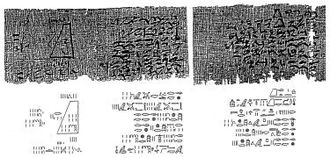
We know about Egyptian geometry mostly from two important papers: the Moscow Mathematical Papyrus and the Rhind Mathematical Papyrus. These papers show that Egyptians could calculate the area of different shapes and even figure out the space inside cylinders and pyramids. This knowledge helped them manage their farmland and build amazing structures.
Area
The ancient Egyptians solved problems about shapes and sizes. They wrote their problems in steps, showing how to find answers without using letters for numbers.
They measured lengths using a unit called a cubit, which was based on the length of an arm. Special rods helped them make sure everyone used the same sizes.
They knew how to find the size of triangles by using half the base times the height. For rectangles, they could find the area using the length times the width.
They also worked with circles, using special shapes to guess the area. For a circle, they often used the area of a square instead, which gave them a close answer. They even solved problems about the area of rounded halves.
| Object | Source | Formula (using modern notation) |
|---|---|---|
| triangle | Problem 51 in RMP and problems 4, 7 and 17 in MMP | A = 1 2 b h {\displaystyle A={\frac {1}{2}}bh} b = base, h = height |
| rectangles | Problem 49 in RMP and problems 6 in MMP and Lahun LV.4. problem 1 | A = b h {\displaystyle A=bh} b = base, h = height |
| circle | Problems 51 in RMP and problems 4, 7 and 17 in MMP | A = 1 4 ( 256 81 ) d 2 {\displaystyle A={\frac {1}{4}}({\frac {256}{81}})d^{2}} d= diameter. This uses the value 256/81 = 3.16049... for π = 3.14159... {\displaystyle \pi =3.14159...} |
| hemisphere | Problem 10 in MMP |
Volumes
Some problems figure out how much space is inside round grain stores, while problem 60 seems to be about a pillar or a cone, not a pyramid. It is small and has a steep slope.
One problem in the Lahun Mathematical Papyri works out the space inside a grain store with a round bottom. We see a similar way of doing this in the Rhind papyrus (problem 43). Problems in the Moscow Mathematical Papyrus (problem 14) and in the Rhind Mathematical Papyrus (numbers 44, 45, 46) work out the space inside a grain store with square or rectangular sides.
Problem 14 of the Moscow Mathematical Papyrus works out the space inside a cut-off pyramid.
| Object | Source | Formula (using modern notation) |
|---|---|---|
| Cylindrical granaries | RMP 41 | V = 256 81 r 2 h {\displaystyle V={\frac {256}{81}}r^{2}\ h} measured in cubic-cubits |
| Cylindrical granaries | RMP 42, Lahun IV.3 | V = 32 27 d 2 h = 128 27 r 2 h {\displaystyle V={\frac {32}{27}}d^{2}\ h={\frac {128}{27}}r^{2}\ h} (measured in khar). |
| Rectangular granaries | RMP 44-46 and MMP 14 | V = w l h {\displaystyle V=w\ l\ h} w = width, l = length, h = height |
| Truncated pyramid (frustum) | MMP 14 | V = 1 3 ( a 2 + a b + b 2 ) h {\displaystyle V={\frac {1}{3}}(a^{2}+ab+b^{2})h} |
Seked
Problem 56 of the RMP shows that ancient Egyptians understood the idea of geometric similarity. This problem talks about the ratio of run to rise, also called the seked. This formula was important for building pyramids. In the next problem, Problem 57, the height of a pyramid is found using the base length and the seked (which means slope in Egyptian). Problem 58 uses the base length and height to find the seked.
In Problem 59, part 1 finds the seked. The second part might check the answer: If you build a pyramid with a base side of 12 cubits and a seked of 5 palms and 1 finger, what is its height?
Related articles


This article is a child-friendly adaptation of the Wikipedia article on Egyptian geometry, available under CC BY-SA 4.0.
Images from Wikimedia Commons. Tap any image to view credits and license.