 Safekipedia
Egyptian pyramids
Adapted from Wikipedia · Discoverer experience
The Egyptian pyramids are ancient masonry structures located in Egypt. Most were built as tombs for the pharaohs and their consorts during the Old and Middle Kingdom periods. At least 138 identified pyramids have been discovered in Egypt. Approximately 80 pyramids were built within the Kingdom of Kush, now located in the modern country of Sudan.
The earliest known Egyptian pyramids are at Saqqara, west of Memphis. The Pyramid of Djoser built around 2630–2610 BCE during the Third Dynasty is considered to be the world's oldest monumental structures constructed of dressed masonry.
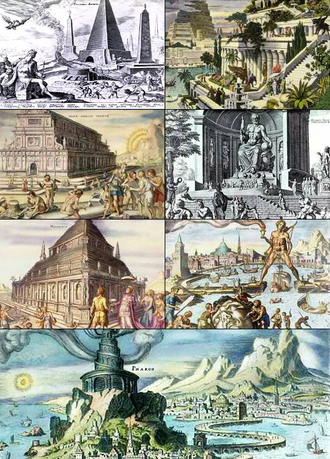
The most famous Egyptian pyramids are those found at Giza, on the outskirts of Cairo. Several of the Giza pyramids are counted among the largest structures ever built. The Pyramid of Khufu is the largest Egyptian pyramid and the last of the Seven Wonders of the Ancient World still in existence.
Recent archeological research at Giza suggests that Fourth Dynasty pyramid construction was heavily dependent on Nile-based transport. Evidence shows a Nile-connected harbor helped move large limestone blocks and other materials, showing the importance of waterways in building strategies.
Name
In ancient Egyptian, the word for a pyramid is mr, shown with a special symbol 𓉴 (O24 in Gardiner's sign list). The exact meaning of mr is not clear because it only describes the pyramid itself. It is different from other building words, which often combine several words together. For example, the word for "temple" joins the words for "house" and "god."
The sign used for mr is the same as the one for benben, which represents a sacred mound from ancient Egyptian stories. Pyramids also have a special top piece called benbenet, a feminine form of benben.
Historical development
Long ago, people in places like the Sahara and Niger built large stone structures that might have inspired later Egyptian pyramids. In early times, wealthy people in ancient Egypt were buried in bench-like tombs called mastabas.
The first known Egyptian pyramid was built for the pharaoh Djoser during the 3rd Dynasty. It began as a square mastaba and was added to many times, creating a stepped pyramid. This design was thought to help the pharaoh's spirit rise to the heavens.
Later, during the 4th Dynasty, true pyramids were built, including famous ones at Meidum, Dahshur, and Giza. After this, pyramids became smaller and less carefully built. Pyramid building slowed down until the Middle Kingdom, when mudbrick pyramids were made instead of stone.
Much later, after Egypt was ruled by the Kingdom of Kush, pyramids were built again in what is now Sudan. This happened during the time of the 25th Dynasty and continued into the Meroitic period, with about 180 pyramids built for kings and queens.
Pyramid symbolism
The shape of the Egyptian pyramids is thought to represent the first mound that Egyptians believed the earth came from. The pyramids were also made to look like the sun’s rays, with shiny white stone on the outside to make them sparkle from far away. Many pyramids even had names that connected them to the sun.
People still discuss why the pyramids were built the way they were. Some think they were meant to help the pharaoh’s spirit reach the heavens. The pyramids were placed on the west side of the Nile River, which was linked to the setting sun and the world of the dead in ancient Egyptian stories.
Number and location of pyramids
For a more comprehensive list, see List of Egyptian pyramids.
In 1842, a list of pyramids was made by Karl Richard Lepsius. He counted 67 pyramids, but many more have been found since then. Today, at least 118 Egyptian pyramids are known. The place where Pyramid 29 was located was lost for a time but was found again in 2008 during an excavation.
Many pyramids are in poor condition or hidden by sand. When they can be seen, they often look like small piles of rubble. Because of this, scientists are still working to find and study more pyramids that might be hidden.
The most recently found pyramid belongs to Neith, the wife of Teti.
All pyramids in Egypt, except for one small one at Zawyet el-Maiyitin, are on the west bank of the Nile. Most are grouped together in several places. The most important groups are listed from north to south below.
Abu Rawash
Main article: Abu Rawash
Abu Rawash is where the most northern pyramid in Egypt is located, except for the ruins of Lepsius pyramid number one. It is the mostly ruined Pyramid of Djedefre, who was the son and successor of Khufu. Originally, people thought this pyramid was never finished, but now experts believe it was completed and was once about the same size as the Pyramid of Menkaure.
Giza
Main article: Giza pyramid complex
The Giza Plateau is home to the Pyramid of Khufu (also called the "Great Pyramid" or the "Pyramid of Cheops"), the smaller Pyramid of Khafre (or Chephren), and the Pyramid of Menkaure (or Mykerinus). There are also smaller pyramids known as "Queen's pyramids" and the Great Sphinx of Giza. Of the three main pyramids, only Khafre's pyramid still has some of its original limestone covering near the top. This makes Khafre's pyramid look larger than Khufu's, even though it is smaller in height and size.
The Giza pyramid complex has been a popular tourist spot since ancient times and was known in the past as one of the Seven Wonders of the Ancient World. Today, it is the only one of these wonders that still exists.
Zawyet el-Aryan
See also: Zawyet el'Aryan
This area, between Giza and Abusir, has two unfinished pyramids from ancient times. The northern pyramid is thought to belong to the pharaoh Nebka, while the southern one, known as the Layer Pyramid, may have been built for the pharaoh Khaba. If this is true, Khaba's short rule may explain why this step pyramid was never finished. Today it stands about 17 meters high, but if it had been completed, it might have been over 40 meters tall.
Abusir
Main article: Abusir
There are fourteen pyramids at this site, which was the main burial place during the Fifth Dynasty. The pyramids here are smaller and not as well built as earlier ones, perhaps showing a time when rulers had less power or the economy was weaker. The three major pyramids are those of Niuserre, Neferirkare Kakai, and Sahure. The site also includes the unfinished Pyramid of Neferefre. Most of the big pyramids at Abusir were built with a core of rubble and steps of mudbricks covered with limestone. The largest, the Pyramid of Neferirkare Kakai, may have started as a step pyramid about 70 meters high and was later changed into a smooth-sided pyramid.
Saqqara
Main article: Saqqara
Important pyramids here include the Pyramid of Djoser—one of the oldest large stone buildings in the world—the Pyramid of Userkaf, the Pyramid of Teti, and the Pyramid of Merikare, all from the First Intermediate Period of Egypt. Saqqara is also home to the Pyramid of Unas, which has one of the best-preserved pathways next to it in Egypt. Together with the pyramid of Userkaf, this pyramid was part of an early restoration project led by Khaemweset, a son of Ramesses II. Saqqara is also where the unfinished step pyramid of Djoser's successor Sekhemkhet, called the Buried Pyramid, can be found. Scientists think that if this pyramid had been finished, it would have been larger than Djoser's.
South of the main group of pyramids at Saqqara is another group of smaller pyramids, including those of Pepi I, Djedkare Isesi, Merenre, Pepi II, and Ibi. Most of these are in poor condition.
The Fourth Dynasty pharaoh Shepseskaf did not build a pyramid like his predecessors. Instead, his tomb at south Saqqara was built as a large building called a mastaba with a temple. It is known as the Mastabat al-Fir’aun.
A new pyramid was found in north Saqqara in late 2008. It is believed to be the tomb of Teti's mother and is about 5 meters high now, though it was probably about 14 meters tall when first built.
Dahshur
Main article: Dahshur
This area is one of the most important pyramid sites in Egypt outside of Giza and Saqqara, though it was hard to reach until 1996 because it was inside a military area.
The southern Pyramid of Sneferu, known as the Bent Pyramid, is thought to be the first pyramid planned to have smooth sides from the start. An earlier pyramid at Meidum had smooth sides but was first built as a step pyramid before being changed. The Bent Pyramid was only partly successful but is still impressive to see. It is also the only large pyramid that still has much of its original smooth limestone covering. Several kilometers north of the Bent Pyramid is the Red Pyramid, the last and most successful of the three pyramids built by Sneferu. It is the world's first finished smooth-sided pyramid and the third largest in Egypt after the pyramids of Khufu and Khafra at Giza.
At Dahshur there is also the Black Pyramid built by Amenemhat III, along with several smaller, mostly ruined pyramids.
Mazghuna
Main article: Mazghuna
Located south of Dahshur, several mudbrick pyramids were built here in the late Middle Kingdom, perhaps for Amenemhat IV and Sobekneferu.
Lisht
Main article: Lisht
Two large pyramids were built at Lisht: those of Amenemhat I and his son, Senusret I. The latter is surrounded by the remains of ten smaller pyramids. One of these smaller pyramids belongs to Amenemhat's cousin, Khaba II. The site is near the oasis of the Faiyum, between Dahshur and Meidum, and about 100 kilometers south of Cairo. It is believed to be close to the ancient city of Itjtawy, which was the capital of Egypt during the Twelfth Dynasty, though the exact location of the city is still unknown.
Meidum
Main article: Meidum
The pyramid at Meidum is one of three built during the rule of Sneferu. Some think it may have been started by his father, Huni, but this is not certain because no record of Huni's name has been found there. It was first built as a step pyramid and later changed to have smooth sides by filling in the steps and adding an outer layer of stone. The pyramid has collapsed several times in the past, and today only three of its original steps remain, giving it an odd, tower-like shape. The hill under the pyramid is not natural—it is made from the debris of the pyramid's fallen lower parts and outer layer.
Hawara
Main article: Hawara
Amenemhat III was the last powerful ruler of the Twelfth Dynasty. The pyramid he built at Hawara, near the Faiyum, is thought to be where he was finally buried. This pyramid may have been built after the so-called "Black Pyramid" at Dahshur, also built by him.
El Lahun
Main article: El Lahun
The Pyramid of Senusret II at El Lahun or Al-Lāhūn is the southernmost royal tomb pyramid in Egypt. Its builders saved effort by using a natural limestone hill 12 meters high as the base and core of the pyramid.
El-Kurru
Main article: El-Kurru
Piye, the king of Kush who became the first ruler of the Twenty-fifth Dynasty, built a pyramid at El-Kurru. He was the first Egyptian pharaoh in centuries to be buried in a pyramid.
Nuri
Main article: Nuri
Taharqa, a Kushite ruler of the Twenty-fifth Dynasty, built his pyramid at Nuri. It was the largest in the area (North Sudan).
Construction dates and heights
The following table shows the timeline of when most of the major pyramids mentioned here were built. It includes the pharaoh who ordered the pyramid, the approximate time he ruled, and where the pyramid is located.
| Pyramid (Pharaoh) | Reign | Field | Height |
|---|---|---|---|
| Pyramid of Djoser (Djoser) | c. 2670 BCE | Saqqara | 62 meters (203 feet) |
| Red Pyramid (Sneferu) | c. 2612–2589 BCE | Dahshur | 104 meters (341 feet) |
| Meidum Pyramid (Sneferu) | c. 2612–2589 BCE | Meidum | 65 meters (213 feet) (ruined) Would have been 91.65 meters (301 feet) or 175 Egyptian Royal cubits. |
| Great Pyramid of Giza (Khufu) | c. 2589–2566 BCE | Giza | 146.7 meters (481 feet) or 280 Egyptian Royal cubits |
| Pyramid of Djedefre (Djedefre) | c. 2566–2558 BCE | Abu Rawash | 60 meters (197 feet) |
| Pyramid of Khafre (Khafre) | c. 2558–2532 BCE | Giza | 136.4 meters (448 feet) Originally: 143.5 m (471 ft) or 274 Egyptian Royal cubits |
| Pyramid of Menkaure (Menkaure) | c. 2532–2504 BCE | Giza | 65 meters (213 feet) or 125 Egyptian Royal cubits |
| Pyramid of Userkaf (Userkaf) | c. 2494–2487 BCE | Saqqara | 48 meters (161 feet) |
| Pyramid of Sahure (Sahure) | c. 2487–2477 BCE | Abusir | 47 meters (155 feet) |
| Pyramid of Neferirkare (Neferirkare Kakai) | c. 2477–2467 BCE | Abusir | 72.8 meters (239 feet) |
| Pyramid of Nyuserre (Nyuserre Ini) | c. 2416–2392 BCE | Abusir | 51.68 m (169.6 feet) or 99 Egyptian Royal cubits |
| Pyramid of Amenemhat I (Amenemhat I) | c. 1991–1962 BCE | Lisht | 55 meters (181 feet) |
| Pyramid of Senusret I (Senusret I) | c. 1971–1926 BCE | Lisht | 61.25 meters (201 feet) |
| Pyramid of Senusret II (Senusret II) | c. 1897–1878 BCE | el-Lahun | 48.65 m (159.6 ft; 93 Egyptian Royal cubits) or 47.6 m (156 ft; 91 Egyptian Royal cubits) |
| Black Pyramid (Amenemhat III) | c. 1860–1814 BCE | Dahshur | 75 meters (246 feet) |
| Pyramid of Khendjer (Khendjer) | c. 1764–1759 BCE | Saqqara | about 37 metres (121 ft), now completely ruined |
| Pyramid of Piye (Piye) | c. 721 BCE | El-Kurru | 20 meters (66 feet) or 30 meters (99 feet) |
| Pyramid of Taharqa (Taharqa) | c. 664 BCE | Nuri | 40 meters (132 feet) or 50 meters (164 feet) |
Construction techniques
Main article: Egyptian pyramid construction techniques
Further information: Diary of Merer
Building the pyramids required moving very large stones. Most stones came from nearby places, but some special stones, like white limestone from Tura and granite from Aswan, were brought by boat from far away.
In 2013, old papers called the Diary of Merer were found. These papers, written more than 4,500 years ago, tell us about how stones were moved from Tura to the Great Pyramid of Giza. Workers might have used wooden sleds with wet sand to help slide the heavy stones to where they were needed. They also cut stones near the building site and placed them on level ground to start building the pyramids.
Images
Related articles




This article is a child-friendly adaptation of the Wikipedia article on Egyptian pyramids, available under CC BY-SA 4.0.
Images from Wikimedia Commons. Tap any image to view credits and license.