Escargot de Quimper
The escargot de Quimper, known scientifically as Elona quimperiana and commonly as the "Quimper snail," is a species of air-breathing land snail. It is a terrestrial pulmonate gastropod mollusk in the family Elonidae. Its common name refers to the species it belongs to, which is a type of land animal that breathes air.
Elona is a monotypic genus, which means it contains only one species, Elona quimperiana. The specific name comes from the city of Quimper in Brittany, France.
This snail is mentioned in annexes II and IV of the Habitats Directive.
If you are looking for other uses of the name Elona, see Elona (disambiguation).
Original description
Elona quimperiana was first described in 1821 by André Étienne d'Audebert de Férussac, who named it Helix quimperiana. His original type description was written in French.
The description says the snail was found on the edge of Briec-de-l'Odet, near Quimper in Brittany. It was found by Messieurs De Kermovan and Bonnemaison.
Shell description
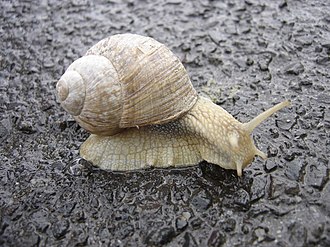
The shell is flat and wide, shaped like a disc with a hole in the middle. The spire is slightly hollowed in. The edge is broadly rounded and horn-like, with a few white stripes. The shell has five or six whorls, which are the turns of the shell.
The aperture, or opening, is moon-shaped and slightly tilted. Its lip is white, wider at the top, and bent back at the bottom. The shell is 20–30 mm wide and 10–12 mm high.
Anatomy
The jaw has 11 to 16 narrow ribs. Alfred Moquin-Tandon described the anatomy of this snail in detail in 1855-1856, and Gittenberger later described it in 1979.
The reproductive system has club-shaped mucous glands, which are shortened into somewhat rounded, triangular sacks. Glands like this are unusual in the Helicoidea, but they are typical of the Elonidae. The dart sack is attached at its base in a sort of cup-like opening. The love dart is curved at the end and has a lens-like cross-section.
Distribution
This species is found in France and Spain.
The Lusitanian snail Elona quimperiana lives in a scattered pattern, with separate groups found in northwestern France (Brittany), northwestern Spain and the Basque Country.
Habitat
This snail lives in temperate and humid deciduous forests.
Life cycle
Like other snails and slugs with lungs, the Quimper snail is hermaphrodite, meaning each snail has both male and female parts. It becomes adult at about two years of age. Mating happens in the middle of the season. The snail usually lays its eggs underground, in tiny natural tunnels in the soil. In Brittany, there are two breeding periods each year. Young snails hatch in the spring (April–May) and in the fall (September–October).
Feeding habits
This snail eats mycelia, which are thread-like growths found on rotten, dead tree stumps, mostly oak. Sometimes it is coprophagous (it eats animal waste) and necrophagous (it eats dead animals).
Like many land snails, Elona quimperiana cannot travel far. It probably survived the glaciations (ice ages) of the Quaternary period by changing the area where it lived, much as its deciduous forest home did.

Quiz time!
5 questions about Escargot de Quimper
Where does the snail's specific name come from?
Pictures
Keep exploring



This article is a child-friendly adaptation of the Wikipedia article on Escargot de Quimper, available under CC BY-SA 4.0.
Images from Wikimedia Commons. Tap any image to view credits and license.