 Safekipedia
Forced conversions of Muslims in Spain
Adapted from Wikipedia · Discoverer experience
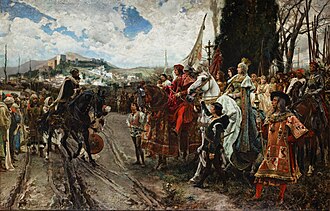
The forced conversions of Muslims in Spain happened in the early 16th century. These changes were made by three Spanish kingdoms: the Crown of Castile, Navarre, and the Crown of Aragon. After the Christian kingdoms finished taking over the land called Al-Andalus in 1492, there were between 500,000 and 600,000 Muslims living there. At first, these Muslims, called "Mudéjar", were allowed to practice their religion freely.
However, things changed when the Archbishop of Toledo, Cardinal Francisco Jiménez de Cisneros, started forcing people in Granada to follow Christianity. This led to a rebellion, which was stopped, and then the rules changed to ban Islam completely in some areas. By 1502, Queen Isabella I of Castile had made a law that no one could practice Islam in her lands. Later, similar laws were made in other parts of Spain.
Even though these people were forced to look and act like Christians, many still held onto their Muslim beliefs in secret. This secret practice of Islam continued until many of these people, known as the "Moriscos", were eventually forced to leave Spain between 1609 and 1614.
Background
Further information: Al-Andalus, Reconquista, and Mudejar
Islam has been part of the Iberian Peninsula since the Umayyad conquest of Hispania in the eighth century. By the early twelfth century, the Muslim population in the Iberian Peninsula – called "Al-Andalus" – was estimated to be as high as 5.5 million. This included Arabs, Berbers, and indigenous converts.
Over the next few centuries, as Christian kingdoms moved south in a process called the reconquista, the Muslim population decreased. By the end of the fifteenth century, after the fall of Granada, the Muslim population of Spain was estimated to be between 500,000 and 600,000 out of a total Spanish population of 7 to 8 million. About half of these Muslims lived in the former Emirate of Granada, the last independent Muslim state in the Iberian Peninsula, which had been taken over by the Crown of Castile. Around 20,000 Muslims lived in other parts of Castile, and most of the rest lived in the territories of the Crown of Aragon. These Muslims living under Christian rule were known as the Mudéjars.
In the early years after the conquest of Granada, Muslims in Granada and elsewhere were allowed to practice their religion freely. This right was protected by various legal agreements, including treaties and coronation oaths. For example, the Treaty of Granada in 1491 promised religious freedom for the Muslims of Granada. Kings of Aragon, including Ferdinand II and Charles I, promised to protect Muslims' religious freedom when they were crowned.
Three months after the conquest of Granada, in 1492, the Alhambra Decree ordered all Jews in Spain to leave or change their religion. In 1497, Portugal also expelled its Jewish and Muslim populations. Unlike the Jews, Portuguese Muslims were allowed to move to Spain, and most did.
Conversion process
After the Christian kingdoms took control of the lands called Al-Andalus in 1492, about 500,000 to 600,000 Muslims lived in Spain. Over the next few years, different parts of Spain made rules that forced Muslims to change their religion.
First, in the years 1500 to 1502, the Crown of Castile made these rules. Later, Navarre did the same from 1515 to 1516, and the Crown of Aragon from 1523 to 1526. These rules said that Muslims had to change their religion or leave their homes.
In some places, people were treated harshly to make them change their religion. This caused some people to fight back, but they were stopped by soldiers. After these events, most Muslims in Spain had changed their religion, and their old places of worship were torn down.
Muslim reaction
Further information: Morisco § Islam, and Crypto-Islam
For those who could not leave their homes, conversion was the only way to stay alive. However, many people who were forced to change their religion kept practicing their original beliefs in secret. Many of these people, known as "Moriscos," were born and lived their whole lives hiding their true faith. They were also pressured to follow the new religion publicly, like going to church services or eating foods that were not allowed in their old religion. This led to a unique way of practicing their faith, where their private beliefs were more important than following all the outer rules.
Some important Muslim leaders believed that Muslims should leave places where they could not freely practice their religion. However, Christian leaders made it very hard for people to leave. Only the wealthiest people near the coast could sometimes escape, and even then it was very difficult. Many people tried to leave but faced many obstacles, and most had to stay and convert.
The efforts to force people to change their religion led to some uprisings. In one area, people fought back but were eventually defeated and forced to convert. In another place, a longer fight happened in a mountainous region. After many months, the fighting ended with many people losing their lives, and the survivors either converted or fled to other lands.
Some people who converted did so because they truly believed in the new religion. For example, one man in a village refused to join the fighting against the new rulers and suffered losses as a result. In another town, the entire community decided to convert together, possibly because they wanted to live equally with their Christian neighbors after many years of contact.
Main article: Oran fatwa
The Oran fatwa was an important decision made in 1504 to help Muslims who were forced to change their religion. It provided guidance on how to survive while appearing to follow the new religion. This decision helped many people stay connected to their beliefs in secret.
Related articles



This article is a child-friendly adaptation of the Wikipedia article on Forced conversions of Muslims in Spain, available under CC BY-SA 4.0.
Images from Wikimedia Commons. Tap any image to view credits and license.