 Safekipedia
Geography of Pluto
Adapted from Wikipedia · Discoverer experience
Pluto is a small, distant world that orbits our Sun. It was once considered the ninth planet in our solar system, but it is now classified as a dwarf planet. Scientists study Pluto to learn more about objects in the outer solar system and how they formed.
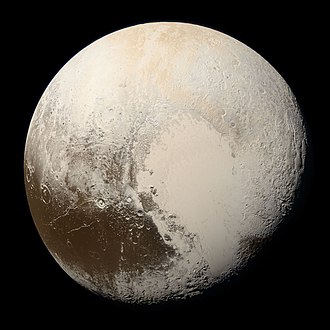
On 14 July 2015, a special spacecraft named New Horizons became the first to fly by Pluto. During this quick visit, New Horizons took many pictures and collected important data. These pictures showed Pluto's many different landscapes, including mountains, plains, and dark spots.
The geography of Pluto helps us understand what this distant world is like. By mapping its surface, scientists can see how Pluto changes over time and how it is similar to or different from other objects in space. The information from New Horizons has opened new doors to learning about Pluto and its moons.
Coordinate system orientation
Further information: Poles of astronomical bodies
Pluto can be described as having either a certain type of spin called retrograde rotation with an axial tilt of 60 degrees, or another type called prograde rotation with a tilt of 120 degrees. Scientists follow the latter convention, which means the northern side of Pluto is mostly lit by the sun while the southern side is dark. This is the way the International Astronomical Union (IAU) and the New Horizons team make their maps, with the lit side shown at the top. Older books might describe Pluto’s spin differently, calling it retrograde and saying the lit side is southern. The directions east and west can also appear swapped between these two ways of describing Pluto.
The main line of longitude, called the prime meridian, on Pluto points toward its moon, Charon.
Topographical features
See also: List of geological features on Pluto
The names of Pluto's features come from the team that discovered them using the New Horizons spacecraft. Some names are from famous explorers and others from myths and stories.
Tombaugh Regio
Main articles: Tombaugh Regio and Sputnik Planitia
Tombaugh Regio, called "The Heart," is a big light-colored area shaped like a heart. It is named after Clyde Tombaugh, who discovered Pluto. The heart's two parts are both bright, but the western part, Sputnik Planitia, is smoother. This area is about 1,590 km across and has tall peaks made of water ice. The surface looks young because it has few craters, suggesting Pluto might still be active. Near the western edge, there are signs of moving ice, possibly from glaciers.
The Brass Knuckles
The Brass Knuckles are dark spots along Pluto's equator between The Heart and The Whale. They are about 480 km wide and separated by tall mountains. There are deep canyons running through them. From west to east, they are:
- Safronov Regio, named after astronomer Viktor Safronov
- Sharaf Regio, named after astronomer Shafika Gil’mievna Sharaf
- Harrington Regio, named after astronomer Robert Sutton Harrington
- Vucub-Came Macula and Hun-Came Macula, named after Maya death gods
- Meng-p'o Macula, named after a Chinese goddess
Belton Regio
Main article: Belton Regio
Belton Regio, called The Whale, is a long dark area along Pluto's equator named after astronomer Michael J. Belton. It is 2,990 km long and the largest dark feature on Pluto. Its dark color may come from a special kind of material formed from Pluto's atmosphere. It has many craters, suggesting it is very old, unlike the nearby bright Sputnik Planitia, which may be much younger.
Dune fields
Near Al-Idrisi Montes in Sputnik Planitia, there are fields of sand dunes made by wind. These dunes are formed from tiny particles of methane ice that are lifted into the air and moved by gentle winds.
Nomenclature
Main article: Planetary nomenclature § Pluto
The Working Group for Planetary System Nomenclature of the International Astronomical Union (IAU) decides on official names for features on Pluto. On 7 September 2017, the first 14 names were approved.
Before the spacecraft arrived, the New Horizons team used informal names based on themes like explorers, space missions, scientists, and fictional adventures. They let people suggest and vote on names.
Images
Related articles



This article is a child-friendly adaptation of the Wikipedia article on Geography of Pluto, available under CC BY-SA 4.0.
Images from Wikimedia Commons. Tap any image to view credits and license.