 Safekipedia
Geography of Sierra Leone
Adapted from Wikipedia · Discoverer experience
Sierra Leone is a country in West Africa that has a coastline along the North Atlantic Ocean to the west. It rests on the African Plate and features wooded hills, an upland plateau, and mountains in the eastern part. The highest point in the country is Mount Bintumani, standing tall at 1,948 meters above sea level. Along the coast, you can find areas of mangrove swamps, and the capital city, Freetown, boasts one of the world's biggest natural harbours.
The largest river in Sierra Leone is the Rokel River, stretching for about 400 kilometres. It drains a wide area covering around 10,622 square kilometres. Sierra Leone lies between the 7th and 10th parallels north of the equator and shares borders with Guinea to the north and northeast and Liberia to the south and southeast. The whole country covers an area of 73,252 square kilometres, most of which is land with a small amount of water area.
Physical geography
Sierra Leone is a country on the west coast of Africa. It lies between the 7th and 10th parallels north of the equator. The country is bordered by Guinea to the north and northeast, Liberia to the south and southeast, and the Atlantic Ocean to the west. Sierra Leone has a total area of 73,253 km2 (28,283 sq mi).
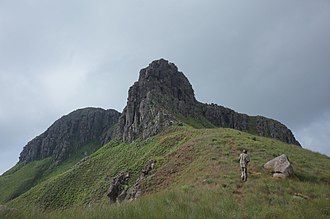
The country has four main geographical regions: coastal Guinean mangroves, wooded hill country, an upland plateau, and mountains in the east. In the eastern part of Sierra Leone, large plateaus and high mountains can be found, with Mount Bintumani reaching a height of 1,948 meters (6,391 ft).
Further information: Kambui Hills Forest Reserve
Geology
Sierra Leone can be divided into three geological areas. The eastern part is part of the West African craton. The western area consists of the Rokelides, an orogenic belt. There is also a 20- to 30-km coastal strip of sediments.
Extreme points
Here are the extreme points of Sierra Leone, the points that are farthest north, south, east, or west than any other location.
- Northernmost point – the northern section of the border with Guinea, Northern Province*
- Easternmost point – the tripoint with Guinea and Liberia, Eastern Province
- Southernmost point – unnamed peninsula south of the town of Mano Salija at the mouth of the Mano River, Southern Province
- Westernmost point – the point at which the border with Guinea enters the Atlantic Ocean, North West Province
- *Note: Sierra Leone does not have a northernmost point, the border being formed here by 10th parallel north
Climate
Sierra Leone has a tropical climate. It is like a mix between a wet rainforest climate and a savanna climate.
The country has two main seasons: a dry season from November to May and a rainy season from June to October. December and January are the coolest months, but temperatures can still get very warm. The sea temperature averages around 30 °C or 86 °F.
Rainfall is heaviest along the coast, with up to 5,000 millimetres or 200 inches each year. It decreases as you move inland toward the eastern border.
Environment issues
Main article: Environmental issues in Sierra Leone
Sierra Leone is growing quickly, which is putting pressure on its natural environment. Problems include cutting down too many trees for timber, letting cattle graze in new areas, and using farming methods that clear land quickly. These actions have led to loss of forests and tired soil. Also, people are taking too many fish from the sea.
Sierra Leone has agreed to protect its environment by joining several international agreements. These include efforts to protect plants and animals, fight climate change, stop land from becoming desert, help endangered species, protect the ocean, save marine life, ban nuclear tests, and protect important wetlands. However, one agreement about changing the environment has been signed but not fully approved yet.
General information
Sierra Leone is a country in West Africa with a coastline along the North Atlantic Ocean. It sits on the African Plate and has many different landscapes, including mangrove swamps along the coast, wooded hills, a plateau, and mountains in the east.
The country covers an area of 73,252 km², ranking 117th in the world. It shares land borders with Guinea (794 km) and Liberia (299 km), and has a coastline that stretches for 402 km. Sierra Leone has a tropical monsoon climate with a rainy season from May to December and a dry season from December to April. The land is rich in natural resources such as diamonds, titanium ore, bauxite, iron ore, gold, and chromite.
Images
Related articles




This article is a child-friendly adaptation of the Wikipedia article on Geography of Sierra Leone, available under CC BY-SA 4.0.
Images from Wikimedia Commons. Tap any image to view credits and license.