Greek mythology
Greek mythology is the collection of myths first told by the ancient Greeks. It is a kind of ancient Greek folklore, and today it is grouped with Roman mythology under the name classical mythology. These stories explain the origin and nature of the world. They also tell about the lives of deities and heroes, and they help explain the cult and ritual practices of the ancient Greeks. Modern scholars study these myths to learn about the religious and political institutions of ancient Greece and to better understand how myths are made.
The Greek myths were first spread through an oral-poetic tradition, most likely by Minoan and Mycenaean singers starting in the 18th century BC. Over time, the myths of the heroes of the Trojan War and its aftermath became part of the oral tradition of Homer's epic poems, the Iliad and the Odyssey. Two poems by Hesiod, who lived around the same time as Homer, the Theogony and the Works and Days, describe how the world began, how divine rulers followed one another, and where sacrificial practices came from.
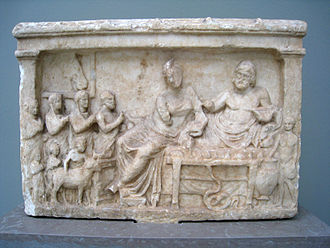
Myths were also kept in many other forms. They appear in the Homeric Hymns, in fragments of poems from the Epic Cycle, in lyric poems, and in the works of the tragedians and comedians of the fifth century BC. Scholars and poets of the Hellenistic Age wrote about them, and writers from the time of the Roman Empire, such as Plutarch and Pausanias, recorded them too. Besides these stories in ancient Greek literature, gods, heroes, and mythic scenes were also shown in pictures. They decorated vase paintings and votive gifts, as well as many other objects. Pottery from the eighth century BC shows scenes from the Epic Cycle and the adventures of Heracles. In the later Archaic, Classical, and Hellenistic periods, scenes from Homer and other myths continued to appear.
Greek mythology has had a large influence on the culture, arts, and literature of Western civilization. It remains part of Western heritage and language. Poets and artists from ancient times up to today have found inspiration in Greek myths and have found that their themes still matter in the modern world.

Quiz time!
5 questions about Greek mythology
What is Greek mythology?
Pictures
Keep exploring


This article is a child-friendly adaptation of the Wikipedia article on Greek mythology, available under CC BY-SA 4.0.
Images from Wikimedia Commons. Tap any image to view credits and license.