 Safekipedia
Hubble's law
Adapted from Wikipedia · Discoverer experience
Hubble's law, also called the Hubble–Lemaître law, tells us that galaxies are moving away from Earth. The farther a galaxy is, the faster it moves away. We can learn how fast a galaxy is moving by looking at a change in the color of its light, called redshift.
This idea was first shared by Edwin Hubble in 1929, but others had noticed similar patterns before him. Georges Lemaître studied this in 1927 and estimated how fast the universe might be expanding. Hubble used measurements of how bright galaxies looked and their redshifts to find a better value for this speed.
Hubble's law is important because it was the first proof that the universe is expanding. This idea helps us understand the Big Bang, the event that started the universe. The law is shown by a simple equation that connects how far a galaxy is from us to how fast it is moving away. By studying this law, scientists have learned more about the age and size of our universe.
Discovery
Main article: Friedmann–Lemaître–Robertson–Walker metric
Main article: Cosmological constant
Long before Edwin Hubble made his important discoveries, scientists had already started to think about whether the universe was growing or staying the same size. Some of them used special math created by Albert Einstein to show that the universe might be changing size over time.
In 1912, an astronomer named Vesto Slipher noticed something interesting: most distant objects called "spiral nebulae" (which we now call galaxies) seemed to be moving away from Earth. Ten years later, another scientist named Georges Lemaître used math to show how fast these galaxies might be moving apart. Finally, in the 1920s, Edwin Hubble used very powerful telescopes to measure how far away these galaxies were and found that the farther they were, the faster they seemed to move away — a discovery that changed how we understand the universe.
Interpretation
Hubble's law tells us that galaxies are moving away from Earth at speeds that depend on how far away they are. The farther a galaxy is, the faster it moves away. We figure out how fast a galaxy is moving by looking at how much its light has changed color, called redshift.
Scientists use a simple formula to describe this: the speed at which a galaxy moves away (called its recessional velocity) is equal to a constant number (called Hubble's constant) multiplied by the distance to the galaxy. This helps us understand how the universe is expanding. Even very faraway galaxies move away from us faster than the speed of light, which is possible because space itself is stretching.
The universe's expansion is actually speeding up over time, which surprises many scientists. This means that galaxies will keep moving farther away from each other as time goes on.
Derivation of the Hubble parameter
Start with the Friedmann equation:
H2 ≡ ( ȧ⁄a )2 = 8πG⁄3 ρ − kc2⁄a2 + Λc2⁄3,
where H is the Hubble parameter, a is the scale factor, G is the gravitational constant, k is the normalised spatial curvature of the universe and equal to −1, 0, or 1, and Λ is the cosmological constant.
If the universe is matter-dominated, then the mass density of the universe ρ should be taken to include just matter so
ρ = ρm0⁄a3,
where ρm0 is the density of matter today. From the Friedmann equation and thermodynamic principles we know for non-relativistic particles that their mass density decreases proportional to the inverse volume of the universe, so the equation above must be true. We can also define (see density parameter for Ωm)
ρc = 3H02⁄8πG; Ωm ≡ ρm0⁄ρc = 8πG⁄3H02 ρm0;
therefore:
ρ = ρc Ωm⁄a3.
Also, by definition, Ωk ≡ −kc2⁄(a0H0)2 ΩΛ ≡ Λc2⁄3H02,
where the subscript 0 refers to the values today, and a0 = 1. Substituting all of this into the Friedmann equation at the start of this section and replacing a with a = 1⁄(1+z) gives
H2(z) = H02 ( Ωm(1+z)3 + Ωk(1+z)2 + ΩΛ ) .
If the universe is both matter-dominated and dark energy-dominated, then the above equation for the Hubble parameter will also be a function of the equation of state of dark energy. So now:
ρ = ρm(a) + ρde(a),
where ρde is the mass density of the dark energy. If dark energy derives from a cosmological constant such as that introduced by Einstein, it can be shown that w = −1. The equation then reduces to the last equation in the matter-dominated universe section, with Ωk set to zero. In that case the initial dark energy density ρde0 is given by
ρde0 = Λc2⁄8πG, Ωde = ΩΛ.
Units derived from the Hubble constant
The Hubble constant has units that help us understand time in the universe. The Hubble time is the inverse of the Hubble constant, which gives an idea of how old the universe might be if its expansion had stayed the same. It is about 14.4 billion years, slightly more than the actual age of the universe, which is around 13.8 billion years.
Another important unit is the Hubble length, which is the distance light can travel during the Hubble time. This distance is about 14.4 billion light years. It tells us how far away galaxies are that are moving away from us at the speed of light. The Hubble volume refers to a part of the universe that has this size, though its exact meaning can vary among scientists.
Determining the Hubble constant
The Hubble constant, shown as H0, is a key number that helps us understand how fast the universe is expanding. We can't measure it directly, but scientists use observations of stars and other objects in space to estimate its value. Over time, these measurements have become very precise, but there are two different sets of numbers that don't quite match up. This difference is called the "Hubble tension."
In the past, scientists used bright stars called Cepheid variable stars to measure distances in space. One famous astronomer, Walter Baade, discovered that there were two types of these stars, which helped double the estimated size of the universe. Later, debates continued about the exact value of the Hubble constant, with some scientists arguing for higher numbers and others for lower ones. Today, even with better tools and methods, there is still a small but important difference between measurements made using different techniques. Scientists are working hard to understand why these differences exist and what they might tell us about the universe.
Measurements of the Hubble constant
The Hubble–Lemaître law tells us that galaxies move away from us, and the farther they are, the faster they go. Scientists measure how fast these galaxies are moving by looking at the light they give off, which changes color in a way that shows their speed.
Many careful measurements have been made to find the exact number, called the Hubble constant, which helps us understand how quickly the universe is growing. This number is important for learning about the age and size of our universe.
Main article: Hubble's law
| Date published | Hubble constant (km/s)/Mpc | Observer | Remarks / methodology |
|---|---|---|---|
| 2026-04-01 | 73.50±0.81 | H0DN Collaboration | The Local Distance Network: A community consensus report |
| 2025-05-27 | 70.39±1.94 | W. Freedman et al | Tip of the Red Giant Branch (TRGB) method (values from J-Region Asymptotic Giant Branch (JAGB) and Cepheids also reported)(JWST and HST data) |
| 2025-01-14 | 75.7+8.1 −5.5 | Pascale et al. | Timing delay of gravitationally lensed images of Supernova H0pe. Independent of cosmic distance ladder or the CMB. JWST data. (2023-05-11 cell and this one are the only 2 values with this method so far) |
| 2024-12-01 | 72.6±2.0 | SH0ES+CCHP JWST | JWST, 3 methods, Cepheids, TRGB, JAGB, 2 groups data |
| 2023-07-19 | 67.0±3.6 | Sneppen et al. | Due to the blackbody spectra of the optical counterpart of neutron-star mergers, these systems provide strongly constraining estimators of cosmic distance. |
| 2023-07-13 | 68.3±1.5 | SPT-3G | CMB TT/TE/EE power spectrum. Less than 1σ discrepancy with Planck. |
| 2023-05-11 | 66.6+4.1 −3.3 | P. L. Kelly et al. | Timing delay of gravitationally lensed images of Supernova Refsdal. Independent of cosmic distance ladder or the CMB. |
| 2022-12-14 | 67.3+10.0 −9.1 | S. Contarini et al. | Statistics of cosmic voids using BOSS DR12 data set. |
| 2022-02-08 | 73.4+0.99 −1.22 | Pantheon+ | SN Ia distance ladder (+SH0ES) |
| 2022-06-17 | 75.4+3.8 −3.7 | T. de Jaeger et al. | Use Type II supernovae as standardisable candles to obtain an independent measurement of the Hubble constant—13 SNe II with host-galaxy distances measured from Cepheid variables, the tip of the red giant branch, and geometric distance (NGC 4258). |
| 2021-12-08 | 73.04±1.04 | SH0ES | Cepheids-SN Ia distance ladder (HST+Gaia EDR3+"Pantheon+"). 5σ discrepancy with planck. |
| 2021-09-17 | 69.8±1.7 | W. Freedman | Tip of the red-giant branch (TRGB) distance indicator (HST+Gaia EDR3) |
| 2020-12-16 | 72.1±2.0 | Hubble Space Telescope and Gaia EDR3 | Combining earlier work on red giant stars, using the tip of the red-giant branch (TRGB) distance indicator, with parallax measurements of Omega Centauri from Gaia EDR3. |
| 2020-12-15 | 73.2±1.3 | Hubble Space Telescope and Gaia EDR3 | Combination of HST photometry and Gaia EDR3 parallaxes for Milky Way Cepheids, reducing the uncertainty in calibration of Cepheid luminosities to 1.0%. Overall uncertainty in the value for H0 is 1.8%, which is expected to be reduced to 1.3% with a larger sample of type Ia supernovae in galaxies that are known Cepheid hosts. Continuation of a collaboration known as Supernovae, H0, for the Equation of State of Dark Energy (SHoES). |
| 2020-12-04 | 73.5±5.3 | E. J. Baxter, B. D. Sherwin | Gravitational lensing in the CMB is used to estimate H0 without referring to the sound horizon scale, providing an alternative method to analyze the Planck data. |
| 2020-11-25 | 71.8+3.9 −3.3 | P. Denzel et al. | Eight quadruply lensed galaxy systems are used to determine H0 to a precision of 5%, in agreement with both "early" and "late" universe estimates. Independent of distance ladders and the cosmic microwave background. |
| 2020-11-07 | 67.4±1.0 | T. Sedgwick et al. | Derived from 88 0.02 H0 estimate is corrected for the effects of peculiar velocities in the supernova environments, as estimated from the galaxy density field. The result assumes Ωm = 0.3, ΩΛ = 0.7 and a sound horizon of 149.3 Mpc, a value taken from Anderson et al. (2014). |
| 2020-09-29 | 67.6+4.3 −4.2 | S. Mukherjee et al. | Gravitational waves, assuming that the transient ZTF19abanrh found by the Zwicky Transient Facility is the optical counterpart to GW190521. Independent of distance ladders and the cosmic microwave background. |
| 2020-06-18 | 75.8+5.2 −4.9 | T. de Jaeger et al. | Use Type II supernovae as standardisable candles to obtain an independent measurement of the Hubble constant—7 SNe II with host-galaxy distances measured from Cepheid variables or the tip of the red giant branch. |
| 2020-02-26 | 73.9±3.0 | Megamaser Cosmology Project | Geometric distance measurements to megamaser-hosting galaxies. Independent of distance ladders and the cosmic microwave background. |
| 2019-10-14 | 74.2+2.7 −3.0 | STRIDES | Modelling the mass distribution & time delay of the lensed quasar DES J0408-5354. |
| 2019-09-12 | 76.8±2.6 | SHARP/H0LiCOW | Modelling three galactically lensed objects and their lenses using ground-based adaptive optics and the Hubble Space Telescope. |
| 2019-08-20 | 73.3+1.36 −1.35 | K. Dutta et al. | This H 0 {\displaystyle H_{0}} is obtained analysing low-redshift cosmological data within ΛCDM model. The datasets used are type-Ia supernovae, baryon acoustic oscillations, time-delay measurements using strong-lensing, H(z) measurements using cosmic chronometers and growth measurements from large scale structure observations. |
| 2019-08-15 | 73.5±1.4 | M. J. Reid, D. W. Pesce, A. G. Riess | Measuring the distance to Messier 106 using its supermassive black hole, combined with measurements of eclipsing binaries in the Large Magellanic Cloud. |
| 2019-07-16 | 69.8±1.9 | Hubble Space Telescope | Distances to red giant stars are calculated using the tip of the red-giant branch (TRGB) distance indicator. |
| 2019-07-10 | 73.3+1.7 −1.8 | H0LiCOW collaboration | Updated observations of multiply imaged quasars, now using six quasars, independent of the cosmic distance ladder and independent of the cosmic microwave background measurements. |
| 2019-07-08 | 70.3+5.3 −5.0 | The LIGO Scientific Collaboration and The Virgo Collaboration | Uses radio counterpart of GW170817, combined with earlier gravitational wave (GW) and electromagnetic (EM) data. |
| 2019-03-28 | 68.0+4.2 −4.1 | Fermi-LAT | Gamma ray attenuation due to extragalactic light. Independent of the cosmic distance ladder and the cosmic microwave background. |
| 2019-03-18 | 74.03±1.42 | Hubble Space Telescope | Precision HST photometry of Cepheids in the Large Magellanic Cloud (LMC) reduce the uncertainty in the distance to the LMC from 2.5% to 1.3%. The revision increases the tension with CMB measurements to the 4.4σ level (P=99.999% for Gaussian errors), raising the discrepancy beyond a plausible level of chance. Continuation of a collaboration known as Supernovae, H0, for the Equation of State of Dark Energy (SHoES). |
| 2019-02-08 | 67.78+0.91 −0.87 | Joseph Ryan et al. | Quasar angular size and baryon acoustic oscillations, assuming a flat ΛCDM model. Alternative models result in different (generally lower) values for the Hubble constant. |
| 2018-11-06 | 67.77±1.30 | Dark Energy Survey | Supernova measurements using the inverse distance ladder method based on baryon acoustic oscillations. |
| 2018-09-05 | 72.5+2.1 −2.3 | H0LiCOW collaboration | Observations of multiply imaged quasars, independent of the cosmic distance ladder and independent of the cosmic microwave background measurements. |
| 2018-07-18 | 67.66±0.42 | Planck Mission | Final Planck 2018 results. |
| 2018-04-27 | 73.52±1.62 | Hubble Space Telescope and Gaia | Additional HST photometry of galactic Cepheids with early Gaia parallax measurements. The revised value increases tension with CMB measurements at the 3.8σ level. Continuation of the SHoES collaboration. |
| 2018-02-22 | 73.45±1.66 | Hubble Space Telescope | Parallax measurements of galactic Cepheids for enhanced calibration of the distance ladder; the value suggests a discrepancy with CMB measurements at the 3.7σ level. The uncertainty is expected to be reduced to below 1% with the final release of the Gaia catalog. SHoES collaboration. |
| 2017-10-16 | 70.0+12.0 −8.0 | The LIGO Scientific Collaboration and The Virgo Collaboration | Standard siren measurement independent of normal "standard candle" techniques; the gravitational wave analysis of a binary neutron star (BNS) merger GW170817 directly estimated the luminosity distance out to cosmological scales. An estimate of fifty similar detections in the next decade may arbitrate tension of other methodologies. Detection and analysis of a neutron star-black hole merger (NSBH) may provide greater precision than BNS could allow. |
| 2016-11-22 | 71.9+2.4 −3.0 | Hubble Space Telescope | Uses time delays between multiple images of distant variable sources produced by strong gravitational lensing. Collaboration known as H0 Lenses in COSMOGRAIL's Wellspring (H0LiCOW). |
| 2016-08-04 | 76.2+3.4 −2.7 | Cosmicflows-3 | Comparing redshift to other distance methods, including Tully–Fisher, Cepheid variable, and Type Ia supernovae. A restrictive estimate from the data implies a more precise value of 75±2. |
| 2016-07-13 | 67.6+0.7 −0.6 | SDSS-III Baryon Oscillation Spectroscopic Survey (BOSS) | Baryon acoustic oscillations. An extended survey (eBOSS) began in 2014 and is expected to run through 2020. The extended survey is designed to explore the time when the universe was transitioning away from the deceleration effects of gravity from 3 to 8 billion years after the Big Bang. |
| 2016-05-17 | 73.24±1.74 | Hubble Space Telescope | Type Ia supernova, the uncertainty is expected to go down by a factor of more than two with upcoming Gaia measurements and other improvements. SHoES collaboration. |
| 2015-02 | 67.74±0.46 | Planck Mission | Results from an analysis of Planck's full mission were made public on 1 December 2014 at a conference in Ferrara, Italy. A full set of papers detailing the mission results were released in February 2015. |
| 2013-10-01 | 74.4±3.0 | Cosmicflows-2 | Comparing redshift to other distance methods, including Tully–Fisher, Cepheid variable, and Type Ia supernovae. |
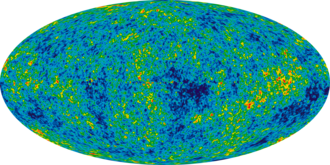
| 2013-03-21 | 67.80±0.77 | Planck Mission | The ESA Planck Surveyor was launched in May 2009. Over a four-year period, it performed a significantly more detailed investigation of cosmic microwave radiation than earlier investigations using HEMT radiometers and bolometer technology to measure the CMB at a smaller scale than WMAP. On 21 March 2013, the European-led research team behind the Planck cosmology probe released the mission's data including a new CMB all-sky map and their determination of the Hubble constant. |
| 2012-12-20 | 69.32±0.80 | WMAP (9 years), combined with other measurements | |
| 2010 | 70.4+1.3 −1.4 | WMAP (7 years), combined with other measurements | These values arise from fitting a combination of WMAP and other cosmological data to the simplest version of the ΛCDM model. If the data are fit with more general versions, H0 tends to be smaller and more uncertain: typically around 67±4 (km/s)/Mpc although some models allow values near 63 (km/s)/Mpc. |
| 2010 | 71.0±2.5 | WMAP only (7 years). | |
| 2009-02 | 70.5±1.3 | WMAP (5 years), combined with other measurements | |
| 2009-02 | 71.9+2.6 −2.7 | WMAP only (5 years) | |
| 2007 | 70.4+1.5 −1.6 | WMAP (3 years), combined with other measurements | |
| 2006-08 | 76.9+10.7 −8.7 | Chandra X-ray Observatory | Combined Sunyaev–Zeldovich effect and Chandra X-ray observations of galaxy clusters. Adjusted uncertainty in table from Planck Collaboration 2013. |
| 2003 | 72±5 | WMAP (First year) only | |
| 2001-05 | 72±8 | Hubble Space Telescope Key Project | This project established the most precise optical determination, consistent with a measurement of H0 based upon Sunyaev–Zel'dovich effect observations of many galaxy clusters having a similar accuracy. |
| before 1996 | 50 — 90 (est.) | ||
| 1994 | 67±7 | Supernova 1a Light Curve Shapes | Determined relationship between luminosity of SN 1a's and their Light Curve Shapes. Riess et al. used this ratio of the light curve of SN 1972E and the Cepheid distance to NGC 5253 to determine the constant. |
| mid 1970's | 100±10 | Gérard de Vaucouleurs | De Vaucouleurs believed he had improved the accuracy of Hubble's constant from Sandage's because he used 5x more primary indicators, 10× more calibration methods, 2× more secondary indicators, and 3× as many galaxy data points to derive his 100±10. |
| early 1970s | 55 (est.) | Allan Sandage and Gustav Tammann | |
| 1958 | 75 (est.) | Allan Sandage | This was the first good estimate of H0, but it would be decades before a consensus was achieved. |
| 1956 | 180 | Humason, Mayall and Sandage | |
| 1929 | 500 | Edwin Hubble, Hooker telescope | |
| 1927 | 625 | Georges Lemaître | First measurement and interpretation as a sign of the expansion of the universe. |
Images
Related articles



This article is a child-friendly adaptation of the Wikipedia article on Hubble's law, available under CC BY-SA 4.0.
Images from Wikimedia Commons. Tap any image to view credits and license.