
Human rights
Human rights are important ideas that help decide how people should be treated. These ideas are based on the belief that every person deserves to be treated with respect and fairness just because they are human. Human rights include things like the right to be safe, the freedom to speak your mind, and the right to go to school.
The idea of human rights became very important after World War II, especially because of the terrible events during the Holocaust. In 1948, countries around the world agreed on a document called the Universal Declaration of Human Rights. This document lists many rights that all people should have, no matter where they live or what they believe.
Even though most people agree that human rights are important, there are sometimes disagreements about which rights are most important or how they should be used in different places. Some cultures believe that group needs are more important than individual rights, which can cause debates about how human rights should be applied.
Today, many groups and organizations work to make sure human rights are protected. The United Nations and other groups help countries follow the rules about human rights and support people who are not being treated fairly.
History
Main article: History of human rights
Many ideas about human rights grew after the Second World War and events like the Holocaust. This led to the Universal Declaration of Human Rights in 1948 by the United Nations General Assembly.
Ancient people did not think about human rights the same way we do today, but ideas about rights existed long ago. In the West, Jewish, Christian, and Roman ideas helped shape early thoughts on rights.
The idea of natural rights began in the Middle Ages and grew during the time of the Enlightenment with thinkers like John Locke. These ideas were important during big changes like the American Revolution and the French Revolution. Modern human rights ideas grew strongly in the 20th century, partly because of tough times like war and unfair treatment.
The Kouroukan Fouga, created in the 13th century in West Africa, was one of the earliest documents about human rights. It included important ideas like the right to safety and fairness for women.
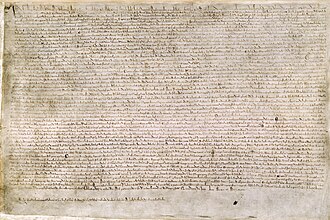
Important documents like Magna Carta in 1215 helped shape laws that protect people’s rights. Later, documents like the English Bill of Rights in 1689 and the United States Declaration of Independence in 1776 also talked about rights everyone should have.
1800 to World War I
Thinkers like Thomas Paine, John Stuart Mill, and Hegel kept talking about human rights in the 1800s. The word human rights started being used around this time. In the United States, leaders like William Lloyd Garrison spoke up for fairness for all.
Many groups worked hard for change, like labour unions fighting for better working conditions, and the women's rights movement working for the right to vote. Movements for freedom, like led by Mahatma Gandhi in India, also helped many people live better lives.
Between World War I and World War II
The League of Nations started in 1919 after World War I. It tried to keep peace and help countries talk out their problems. It also worked on supporting former colonies and protecting rights that later became part of the Universal Declaration of Human Rights.
After World War II
Universal Declaration of Human Rights
Main article: Universal Declaration of Human Rights
The Universal Declaration of Human Rights was created in 1948 by the United Nations. It says that everyone has important rights just because they are a person, like the right to be treated with respect and fairness.
The declaration was written by many experts from different parts of the world. It talks about many kinds of rights, like rights to speak freely and rights to a good life. Even though it isn’t a law by itself, it has become a very important guide for countries and courts around the world.
In recent years, courts have started saying that taking care of our planet is also a human right. This means countries need to work hard to protect the environment for everyone.
Promotion strategies
Different ways to support human rights include checking that countries follow their promises, offering help to those who need it, and using rewards or pressures to encourage better behavior. Sometimes, bigger groups can step in to help protect people from serious harm.
Economic actions, like sanctions, are used to influence countries that break human rights rules. However, these can sometimes hurt the people more than the leaders. Helping girls stay in school and supporting families financially can reduce harmful practices and protect children’s rights.
Groups like the United Nations and organizations such as Amnesty International work to watch for and report on human rights abuses. They use information to push for change and teach people about human rights to help prevent abuses from happening. Laws at many levels aim to protect these important rights.
Protection at the international level
Main article: International human rights instruments
United Nations
Main article: United Nations
The United Nations (UN) is the main group of countries working together to support human rights around the world. All parts of the UN give advice to important groups, like the United Nations Security Council and the United Nations Human Rights Council. The UN has a special office called the Office of the High Commissioner for Human Rights that leads work on human rights. The UN works to help countries work together on problems that affect everyone, like sharing respect for each person's rights no matter who they are.
Human Rights Council
Main article: United Nations Human Rights Council
The UN Human Rights Council was started in 2005 to look into cases where people’s rights might not be respected. It has 47 countries that are chosen by other UN members to join for up to six years. The council meets in Geneva three times a year and can call extra meetings when needed. Experts help the council by looking into problems and telling the council what they find. The council can ask the Security Council to send serious cases to a special court for judgment.
United Nations treaty bodies
Main article: Treaty body
The UN also has special groups made up of experts who watch how well countries are following important agreements about human rights. These groups check on things like how people are treated, how well schools and hospitals work, and how to protect people from unfair treatment. They talk to countries and give advice on how to do better. Some of these groups can also look at complaints from people if the country agrees to let them.
International courts
There are special courts that help when countries can’t solve human rights problems on their own. The International Court of Justice helps settle disagreements between countries. The International Criminal Court looks into very serious crimes, like attacks on many people, and tries to bring the people responsible to justice. These courts only step in when a country’s own courts cannot or will not act.
Regional human rights regimes
See also: National human rights institutions and Human rights commission
Many countries have groups called national human rights institutions to help protect important rights for people. These groups work to make sure everyone is treated fairly and with respect. They follow ideas set out in the Paris Principles, which were made in 1991 to guide these institutions.
Africa
The African Union is a group of fifty-five countries in Africa. It started in 2001 to help bring peace, support fair treatment for all people, and build a strong economy. The African Commission on Human and Peoples' Rights works to support and protect these rights across Africa. It helps by sharing information, organizing meetings, and giving advice to leaders when needed.
Americas
The Organization of American States is a group of countries in North and South America. It works to support democracy, peace, and fair treatment for everyone. The Inter-American Commission on Human Rights checks on how well countries are protecting these rights and helps when problems arise.
Asia
Different countries in Asia have different ways of protecting important rights. Some groups, like the Association of Southeast Asian Nations, have made their own rules to help protect these rights.
Europe
See also: Human rights in the Soviet Union
The Council of Europe is a group of European countries that work together to protect important rights for everyone. It created rules called the European Convention on Human Rights to make sure all people are treated fairly. Countries that join this group agree to follow these rules and can be checked by a special court to make sure they are doing so.
Philosophies of human rights
People have many ideas about why we have human rights. One old idea comes from natural law, which says that right and wrong come from a natural order, not just from rules made by people. Think of it like a rule that exists everywhere, no matter where you live or what you believe. Ancient thinkers like Socrates, Plato, and Aristotle talked about this kind of natural justice.
Other ideas say human rights grow from how humans live together. Some think our rights come from agreements people make to keep safe and fair societies. This is called a social contract. For example, John Locke believed that if leaders don’t protect our rights to life, freedom, and property, people can choose new leaders.
There are also theories that link human rights to what helps us live well together. Some say being kind and helping each other gives us an advantage. Others suggest that human rights should be tied to responsibilities we have to one another. All these ideas try to explain why we believe everyone deserves certain basic rights, no matter who they are.
Main articles: Natural law and Natural rights
Concepts in human rights
See also: Human Rights Law
The most common way people group human rights is into two main types: civil and political rights, and economic, social, and cultural rights. Civil and political rights are found in articles 3 to 21 of the Universal Declaration of Human Rights and in the ICCPR. Economic, social, and cultural rights are in articles 22 to 28 of the Universal Declaration of Human Rights and in the ICESCR. The Universal Declaration includes both types because it believes they all need to exist together for everyone to truly enjoy freedom.
Without civil and political rights, people cannot stand up for their economic, social, and cultural rights. Freedom from fear and want is important because it lets communities work toward their goals without outside interference. But without jobs and a working society, people cannot use or enjoy their civil or political rights.
Some people say certain rights are "inalienable," meaning they are basic rights that belong to everyone just because they are human and cannot be taken away.
There is also discussion about whether human rights should apply the same everywhere in the world or if they should change to fit different cultures. Some believe that human rights are universal and should be the same for everyone, no matter where they live. Others argue that cultures have their own ways and that human rights should respect these differences. This debate continues as countries work together to protect human rights for all people.
Main articles: Cultural relativism, Moral relativism, Moral universalism, and Universal ethic
Universal jurisdiction is a tricky idea in international law where countries might claim they can try people for serious crimes even if those crimes happened in another country. Some believe this is right because certain crimes hurt everyone, and the world has a duty to act. Others think it hurts the idea that each country has its own rules and powers.
See also: Universal jurisdiction and State sovereignty
Companies and other groups that are not governments can also harm people’s rights, even though they are not always ruled by the same laws as countries. Big companies sometimes have more power than some countries and can affect many people’s lives. There are talks about making rules to make sure these companies respect people’s rights, but these rules are not yet set in stone.
See also: Derogation, National security, and Anti-terrorism legislation
Criticism
Some people question whether human rights apply to everyone equally. They say that these ideas come mostly from Western cultures and may not fit well with other traditions. Others believe that human rights can be hard to uphold and may interfere with a country's independence.
Philosopher Simone Weil suggested focusing more on our responsibilities to others rather than just our own rights. She believed that while rights depend on others recognizing our needs, our duties to help others are always important, no matter where we are in the world.
Keep exploring



This article is a child-friendly adaptation of the Wikipedia article on Human rights, available under CC BY-SA 4.0.
Images from Wikimedia Commons. Tap any image to view credits and license.