 Safekipedia
Isabella I of Castile
Adapted from Wikipedia · Discoverer experience
Isabella I, also known as Isabella the Catholic, was Queen of Castile and León from 1474 until her death in 1504. She was also Queen of Aragon from 1479 as the wife of King Ferdinand II. Together, they are known as the Catholic Monarchs and ruled a unified Spain.
Her marriage to Ferdinand in 1469 helped bring the kingdoms of Spain together. With his help, Isabella secured her position as Queen of Castile during the War of the Castilian Succession. She worked hard to improve her kingdom, reducing crime and fixing the debts left by her brother, King Henry IV.
Isabella and Ferdinand finished the Reconquista and started the Spanish Empire. They supported explorers like Christopher Columbus, whose voyage in 1492 led to the discovery of the New World. Their actions made Spain very powerful and began what is called the Spanish Golden Age.
Life
Isabella was born in Madrigal de las Altas Torres to King John II of Castile and Isabella of Portugal on 22 April 1451. At the time, she was second in line to the throne after her older half-brother Henry. After her father died, Henry became king, and Isabella and her brother Alfonso lived under his care in Arévalo.
Isabella received a thorough education, learning many skills such as reading, writing, music, and religious studies. Though her early years were difficult due to poor living conditions and lack of money, she grew up to be strong and wise. Later, she moved to Segovia where she continued her education and lived comfortably in a grand castle.
Isabella faced many challenges, including several failed marriage plans that were meant to create political alliances. Eventually, she secretly married her cousin Ferdinand in 1469. This marriage later helped unite Spain and begin a new chapter in its history.
Coronation and the war with Portugal
See also: Battle of Toro, Battle of Guinea, and War of the Castilian Succession
On December 12, 1474, people learned that King Henry IV had passed away in Madrid. Isabella went to the Alcázar of Segovia for safety and was proclaimed Queen of Castile and León the next day.
Isabella’s rule began with challenges. Some people believed another woman, Joanna la Beltraneja, should be queen. In 1475, King Afonso V of Portugal and his army entered Spain to support Joanna. This began a long and hard war. The fighting continued until the Battle of Toro in 1476. Both sides claimed victory, but the battle helped Isabella keep her place as ruler.
The war lasted three more years. It ended with Spain winning on land and Portugal winning at sea. Peace treaties were signed at Alcáçovas in 1479. Portugal gave up its claim to the throne of Castile but kept control of many Atlantic areas, which made some people in Spain unhappy.
End of the war and consequences
The peace treaties let Isabella and her husband keep the throne of Castile. However, Portugal gained control of important Atlantic areas, which blocked Spain from expanding there and caused frustration in some parts of the country.
The Columbus gambit
Christopher Columbus helped change Spain’s situation. His discovery of the New World in 1492 opened new opportunities for Spain. This led to a new agreement at Tordesillas in 1494, balancing the sharing of the Atlantic between Spain and Portugal. With her rule now secure, Isabella could begin making changes to improve her kingdom.
Reign
On 13 December 1474, in Segovia's main square, Isabella pledged to uphold the Church's commandments, protect the integrity of Castile, and respect the rights of the nobility and towns. She was then formally proclaimed queen of Castile by the assembly.
When Isabella came to the throne in 1474, Castile was in a state of despair due to her brother Henry's reign. Henry IV was known for spending too much and not enforcing the laws well. Because of this, Isabella needed to find ways to improve her kingdom. She created a police force called La Santa Hermandad (the Holy Brotherhood) in 1476. This group was made up of local people who worked to keep order and punish wrongdoers. They were paid for by a special tax.
Isabella also worked to fix the kingdom's money problems. Henry IV had left Castile in debt by selling off royal lands for less than they were worth. Isabella made sure these lands were bought back, which helped the royal treasury grow. She also fixed the coinage system by shutting down many mints and setting a standard for the money.
Isabella and her husband Ferdinand worked together to govern effectively. They relied on professional administrators and made reforms to the Royal Council. They also set aside time each Friday to listen to people's complaints, which was a new way of justice in Castile.
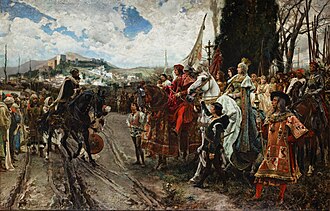
At the end of the Reconquista, only Granada was left to conquer. The war to take Granada began in 1482 and lasted ten years. In 1492, Isabella and Ferdinand entered Granada and the main mosque was turned into a church.
Just three months after entering Granada, Queen Isabella agreed to sponsor Christopher Columbus on an expedition to reach the East Indies by sailing west. Columbus's expedition departed in August 1492 and arrived in the New World in October. He returned the next year with his findings.
Isabella was not in favor of enslaving the American natives. She established rules on how they should be treated, following policies from the Canary Islands. She was upset by the enslavement of natives by Columbus and took steps to stop it.
Isabella and Ferdinand were given the title of Catholic Monarchs by Pope Alexander VI. They worked to unify Spain under their Catholic faith. They created an empire and were busy with administration and politics in later years.
Death
Isabella stopped taking part in government work on 14 September 1504 and passed away later that year on 26 November at the Medina del Campo Royal Palace. She had been feeling weaker since the passing of her son Prince John of Asturias in 1497, her mother Isabella of Portugal in 1496, and her daughter Princess Isabella of Asturias in 1498.
She is buried in Granada in the Capilla Real, a place built by her grandson, Charles V, Holy Roman Emperor. She is laid to rest there with her husband Ferdinand, her daughter Joanna, and other family members. The museum near the Capilla Real keeps her crown and sceptre.
Appearance and personality
Isabella had a strong build and very fair skin. Her hair was often described as being between strawberry-blonde and auburn, though some portraits show her with golden or dark hair. Her daughters Joanna and Catherine were said to look very much like her.
Isabella lived a simple and thoughtful life, with strong religious beliefs guiding her choices. Even though she had strong feelings about certain groups in Andalusia, she appreciated the beautiful styles and designs from their culture. People who knew her spoke highly of her, saying she was wise, fair, and always sought to do what was right, even when it was difficult.
Family
See also: Descendants of Ferdinand II of Aragon and Isabella I of Castile
Isabella and Ferdinand had seven children, but only five lived to become adults. Their children included:
- Isabella (1470–1498), who first married Afonso, Prince of Portugal and later Manuel I of Portugal. She had one child, Miguel da Paz, who passed away very young.
- John (1478–1497), who was the Prince of Asturias and married Archduchess Margaret of Austria, though they did not have any children who lived.
- Joanna (1479–1555), who became the Queen of Castile. She married Philip the Handsome and had children.
- Maria (1482–1517), who married Manuel I of Portugal, the same man her sister had married after her first husband passed away, and had children.
- Catherine of Aragon (1485–1536), who first married Arthur, Prince of Wales. After his passing, she married his younger brother, Henry VIII of England, and had two children: Henry, Duke of Cornwall and Mary I of England.
Veneration
In 1958, a special effort began to consider Isabella for being recognized as a holy person. Many documents about her life were collected for this purpose.
Later, in 1972, these documents were sent to a group at the Vatican. She was given a special title in 1974, but the process was stopped in 1991 because of decisions she made during her rule. Some people believe her reputation came from the way she presented herself.
Arms
As the Princess of Asturias, Isabella used the royal arms of Castile and added a special eagle symbol. When she became queen, she combined the arms of Castile and Aragon. She and her husband, Ferdinand, chose a yoke and arrows as their symbols, with the motto "Tanto Monta," meaning "They amount to the same." After capturing Granada in 1492, they added a pomegranate to represent that city.
Legacy and popular culture
Isabella is best known outside Europe for helping Christopher Columbus travel to the New World. This journey brought great wealth to Spain and Europe and helped shape the nations of the Americas.
In Europe, Isabella and her husband finished the Reconquista, ending Muslim rule in Western Europe and making Spain a strong Catholic country. Her time also saw the start of the Spanish Empire and the beginning of the Spanish Inquisition.
Portrayal in film
- Isabella is portrayed by Amparo Rivelles in the 1951 Spanish film, Dawn of America.
- Isabella is portrayed by Maribel Martín in the 1976 Spanish film, La espada negra.
- Isabella is portrayed by Sigourney Weaver in the 1992 film, 1492: Conquest of Paradise.
- Isabella is portrayed by Rachel Ward in the 1992 film, Christopher Columbus: The Discovery .
- Isabella is portrayed by June Whitfield in the 1992 film, Carry On Columbus.
- Isabella is portrayed by Rachel Weisz in the 2006 film, The Fountain.
- The award-winning Spanish television series, Isabel, covers the life of Isabella from 1472 until her death in 1504, with Isabella played by Michelle Jenner.
Portrayal in Video Games
- In the Sid Meier's Civilization series, Isabella is a playable leader.
Commemoration
The Spanish crown created the Order of Isabella the Catholic in 1815 to honor the queen.
Isabella was the first woman to appear on US postage stamps. She was featured on three stamps from the Columbian Issue, celebrating Columbus. She appears in different scenes on these stamps.
The $4 stamp is special because it was printed only 30,000 times, making it rare and valuable. Some copies have sold for over $20,000.
Isabella was also the first woman to have her name on a United States coin, the 1893 commemorative Isabella quarter, made to celebrate the 400th anniversary of Columbus’s first voyage.
Ancestry
| Ancestors of Isabella I of Castile |
|---|
Images
Related articles




This article is a child-friendly adaptation of the Wikipedia article on Isabella I of Castile, available under CC BY-SA 4.0.
Images from Wikimedia Commons. Tap any image to view credits and license.