 Safekipedia
James Webb Space Telescope
Adapted from Wikipedia · Discoverer experience
The James Webb Space Telescope (JWST) is a space telescope designed to conduct infrared astronomy. It is the largest telescope in space and can see objects that are too old, distant, or faint for the Hubble Space Telescope. This helps scientists study many parts of space, like the first stars and the formation of the first galaxies, as well as learning more about potentially habitable exoplanets.
Although the Webb's mirror is 2.7 times larger than Hubble's, it produces images of similar sharpness because it looks at infrared light, which has longer wavelengths than the visible light Hubble sees. The longer the wavelength, the bigger the mirror needs to be to get clear images.
The Webb was launched on December 25, 2021, on an Ariane 5 rocket from Kourou, French Guiana. By January 2022, it reached its special orbit near the Sun–Earth L2 Lagrange point, about 1.5 million kilometers from Earth. Its first picture was shown to the world on July 11, 2022.
The telescope’s primary mirror is made of 18 hexagonal mirror segments coated in gold and made from beryllium. Together, they make a mirror almost 6.5 meters across—much bigger than Hubble’s—allowing it to collect six times more light. To work well, the Webb must stay very cold, below 50 K, so a special five-layer sunshield keeps it shaded from the heat of the Sun, Earth, and Moon.
Features
The James Webb Space Telescope (JWST) is much larger than the Hubble Space Telescope. It has a 6.5-meter-diameter gold-coated primary mirror made of 18 separate hexagonal pieces. This mirror can collect over six times more light than Hubble’s mirror, allowing it to see objects that are very far away or very faint.
Webb is designed to look into the infrared, which helps it study very old objects in the universe, such as the first stars and galaxies. It can also look at objects in our Solar System and even detect faint objects like planets around distant stars.
The telescope orbits the Sun far from Earth, staying in a stable position that keeps it cool. This cold environment is important because it allows Webb to pick up very faint infrared signals without interference from its own heat. The telescope’s large sunshield protects it from the heat and light of the Sun, Earth, and Moon.
Webb’s mirror is made of many pieces that fold together for launch and then unfold in space. It has special tools to take pictures and measure light from stars and galaxies. These tools help scientists learn about the universe’s history and the planets around other stars.
Comparison with other telescopes
Space telescopes can see things that ground telescopes cannot because they are not blocked by Earth’s air. This lets scientists discover new objects in space.
Keeping a telescope cold is very important for infrared observations. If a telescope gets too warm, it cannot see clearly. Some telescopes use special icy liquids to stay cold, but these can run out after a little while. Others, like the James Webb Space Telescope, stay cold by design, using special shields and radiators to keep their instruments at the right temperature.
| Name | Launch year | Wavelength (μm) | Aperture (m) | Cooling |
|---|---|---|---|---|
| Spacelab Infrared Telescope (IRT) | 1985 | 1.7–118 | 0.15 | Helium |
| Infrared Space Observatory (ISO) | 1995 | 2.5–240 | 0.60 | Helium |
| Hubble Space Telescope Imaging Spectrograph (STIS) | 1997 | 0.115–1.03 | 2.4 | Passive |
| Hubble Near Infrared Camera and Multi-Object Spectrometer (NICMOS) | 1997 | 0.8–2.4 | 2.4 | Nitrogen, later cryocooler |
| Spitzer Space Telescope | 2003 | 3–180 | 0.85 | Helium |
| Hubble Wide Field Camera 3 (WFC3) | 2009 | 0.2–1.7 | 2.4 | Passive and thermo-electric |
| Herschel Space Observatory | 2009 | 55–672 | 3.5 | Helium |
| James Webb Space Telescope | 2021 | 0.6–28.5 | 6.5 | Passive and cryocooler (MIRI) |
Development history
For a chronological guide, see Timeline of the James Webb Space Telescope.
Background (development to 2003)
Discussions about building a telescope to follow the Hubble Space Telescope began in the 1980s. Serious planning started in the early 1990s. Early ideas included a telescope that could see far back in time to the first stars and galaxies. This was important because the Hubble Space Telescope could not see these very distant objects well.
The Hubble telescope had some problems early on, which helped push for a new, better telescope. By the mid-1990s, scientists and NASA were planning a large, cold telescope that could see infrared light. This would let them look back to the early universe. In 2002, the project was named after James E. Webb, a former NASA administrator who helped start the Apollo program.
Early development and replanning (2003–2007)
The project was managed by NASA's Goddard Space Flight Center, with help from companies like Northrop Grumman and Ball Aerospace. As the project grew more expensive, NASA had to adjust its plans. By 2005, the cost had grown so much that NASA delayed the launch and simplified some tests. Despite these changes, the main goals of the telescope stayed the same.
Detailed design and construction (2007–2021)
By 2007, the designs were ready to move forward. Over the next years, scientists built the telescope’s parts, including its huge mirror made of many small hexagons. Testing showed that some parts needed more work, which caused more delays. Finally, in 2021, the telescope was shipped to French Guiana, where it was launched into space at the end of that year.
Cost and schedule issues
The James Webb Space Telescope became much more expensive than first planned. What started as a project costing around $1 billion grew to nearly $10 billion by the time it launched in 2021. There were many reasons for the cost growth, including changes in design, unexpected problems, and delays. Despite these challenges, NASA and its partners continued to support the project.
Partnership
NASA worked with the European Space Agency (ESA) and the Canadian Space Agency (CSA) on the telescope. ESA provided some instruments and the rocket to launch the telescope, while CSA helped with the telescope’s guidance system. Thousands of people from many countries helped build and test the telescope.
Naming concerns
In 2015, some people worried that naming the telescope after James E. Webb was inappropriate because of his possible involvement in treating people unfairly during his time at NASA. NASA looked into this and found no evidence that Webb was directly involved in such actions.
| Year | Milestone |
|---|---|
| 1996 | Next Generation Space Telescope project first proposed (mirror size: 8 m) |
| 2001 | NEXUS Space Telescope, a precursor to the Next Generation Space Telescope, cancelled |
| 2002 | Proposed project renamed James Webb Space Telescope, (mirror size reduced to 6 m) |
| 2003 | Northrop Grumman awarded contract to build telescope |
| 2007 | Memorandum of Understanding signed between NASA and ESA |
| 2010 | Mission Critical Design Review (MCDR) passed |
| 2011 | Proposed cancellation |
| 2016 | Final assembly completed |
| 25 Dec 2021 | Launch |
| Year | Planned launch | Budget plan (billion USD) |
|---|---|---|
| 1998 | 2007 | 1 |
| 2000 | 2009 | 1.8 |
| 2002 | 2010 | 2.5 |
| 2003 | 2011 | 2.5 |
| 2005 | 2013 | 3 |
| 2006 | 2014 | 4.5 |
| 2008: Preliminary Design Review | ||
| 2008 | 2014 | 5.1 |
| 2010: Critical Design Review | ||
| 2010 | 2015 to 2016 | 6.5 |
| 2011 | 2018 | 8.7 |
| 2017 | 2019 | 8.8 |
| 2018 | 2020 | ≥8.8 |
| 2019 | March 2021 | 9.66 |
| 2021 | Dec 2021 | 9.70 |
Mission goals
The James Webb Space Telescope has four main goals. It wants to find light from the first stars and galaxies made after the Big Bang. It also wants to study how galaxies change over time, how stars and planets are born, and to learn about planets that might support life.
Because it looks at infrared light instead of visible light, the telescope can see older, farther, and dimmer objects than the Hubble Space Telescope. This helps scientists study the early universe and objects hidden by dust and gas. The telescope can even check if planets far away have gases like methane that might hint at life.
Ground support and operations
The Space Telescope Science Institute in Baltimore, Maryland helps run the James Webb Space Telescope. It receives data from the telescope and shares it with scientists around the world. Anyone can suggest ideas for what the telescope should look at, and a group of experts picks the best ideas each year.
The telescope sends lots of information to Earth every day. It stores data temporarily before sending it to the institute, where it is sorted and made ready for scientists to use. Even though the telescope sometimes faces tiny space particles, it continues to work well and send us amazing pictures of space.
Launch and commissioning
Main article: Launch and commissioning of the James Webb Space Telescope
The James Webb Space Telescope was launched on December 25, 2021, aboard an Ariane 5 rocket from French Guiana. After a smooth launch, the telescope began a two-week deployment phase, traveling to its destination in space. It reached its final position, called the L2 point, on January 24, 2022, after several planned adjustments to its speed and direction.
During its journey, the telescope unfolded its solar panels, antennas, sunshield, and mirrors. These steps were carefully controlled from the Space Telescope Science Institute in Baltimore, Maryland. The final step was to unfold the telescope's large primary mirror, which was done in early January 2022. After reaching its orbit, the telescope began aligning its mirrors to capture clear and focused images. This process involved moving the mirror segments and the secondary mirror to very precise positions. By February 2022, the telescope was ready to start its scientific mission, capturing detailed images of distant stars and galaxies.
Allocation of observation time
The James Webb Space Telescope has several ways to decide who gets to use it for their research. One way is through the General Observer program, where any astronomer can apply for time to use the telescope. Most of the telescope’s time is given out this way. Another way is the Guaranteed Time Observations program, which gives time to scientists who helped build parts of the telescope.
There is also a special program called the Director’s Discretionary Early Release Science program. This was used to pick 13 important science projects to observe right after the telescope finished its setup. These projects looked at many different things, like planets in our solar system, stars, and faraway galaxies. In the first round of applications, over a thousand ideas were sent in, and the telescope could only choose a fraction of them.
| Name | Principal Investigator | Category | Observation time (hours) |
|---|---|---|---|
| Radiative Feedback from Massive Stars as Traced by Multiband Imaging and Spectroscopic Mosaics | Olivier Berné | Stellar Physics | 8.3 |
| IceAge: Chemical Evolution of Ices during Star Formation | Melissa McClure | Stellar Physics | 13.4 |
| Through the Looking GLASS: A JWST Exploration of Galaxy Formation and Evolution from Cosmic Dawn to Present Day | Tommaso Treu | Galaxies and the IGM | 24.3 |
| A JWST Study of the Starburst-AGN Connection in Merging LIRGs | Lee Armus | Galaxies and the IGM | 8.7 |
| The Resolved Stellar Populations Early Release Science Program | Daniel Weisz | Stellar Populations | 20.3 |
| Q-3D: Imaging Spectroscopy of Quasar Hosts with JWST Analyzed with a Powerful New PSF Decomposition and Spectral Analysis Package | Dominika Wylezalek | Massive Black Holes and their Galaxies | 17.4 |
| The Cosmic Evolution Early Release Science (CEERS) Survey | Steven Finkelstein | Galaxies and the IGM | 36.6 |
| Establishing Extreme Dynamic Range with JWST: Decoding Smoke Signals in the Glare of a Wolf-Rayet Binary | Ryan Lau | Stellar Physics | 6.5 |
| TEMPLATES: Targeting Extremely Magnified Panchromatic Lensed Arcs and Their Extended Star Formation | Jane Rigby | Galaxies and the IGM | 26.0 |
| Nuclear Dynamics of a Nearby Seyfert with NIRSpec Integral Field Spectroscopy | Misty Bentz | Massive Black Holes and their Galaxies | 1.5 |
| The Transiting Exoplanet Community Early Release Science Program | Natalie Batalha | Planets and Planet Formation | 52.1 |
| ERS observations of the Jovian System as a Demonstration of JWST's Capabilities for Solar System Science | Imke de Pater | Solar System | 9.3 |
| High Contrast Imaging of Exoplanets and Exoplanetary Systems with JWST | Sasha Hinkley | Planets and Planet Formation | 18.4 |
Scientific results
The James Webb Space Telescope began full science work on July 11, 2022. Most data stays private for one year for the scientists who made the observations, then it is shared with everyone.
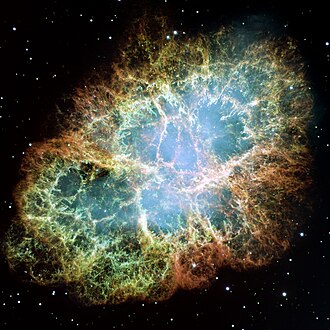
The telescope helped scientists learn more about planets outside our solar system, the very early universe, and many other space topics. On July 12, 2022, it shared its first colorful pictures, including views of stars being born, planets with water in their atmospheres, and faraway galaxies. These pictures showed how well the telescope can see distant and faint objects.
Later discoveries included very bright galaxies that appeared just a few hundred million years after the Big Bang. In May 2024, JWST found the farthest galaxy known, seen only 290 million years after the Big Bang. These findings help scientists understand how galaxies formed in the early universe.
Images
Related articles




This article is a child-friendly adaptation of the Wikipedia article on James Webb Space Telescope, available under CC BY-SA 4.0.
Images from Wikimedia Commons. Tap any image to view credits and license.