Katherine Johnson
Creola Katherine Johnson (née Coleman, previously Goble; August 26, 1918 – February 24, 2020) was an American mathematician and human computer. Her calculations of orbital mechanics as a NASA employee were critical to the success of the first and later U.S. crewed spaceflights. During her 33-year career at NASA and its predecessor, the National Advisory Committee for Aeronautics, she earned a reputation for mastering complex manual calculations. She also helped pioneer the use of computers to perform tasks that had previously required humans. The space agency noted her "historical role as one of the first African-American women to work as a NASA scientist".
Johnson calculated trajectories, launch windows, and emergency return paths for Project Mercury spaceflights. These included flights for astronauts Alan Shepard, the first American in space, and John Glenn, the first American in orbit. She also calculated rendezvous paths for the Apollo Lunar Module and command module on flights to the Moon. Her calculations were essential to the beginning of the Space Shuttle program, and she worked on plans for a human mission to Mars.
In 2015, President Barack Obama awarded Johnson the Presidential Medal of Freedom. In 2016, she received the Silver Snoopy Award from NASA astronaut Leland D. Melvin and a NASA Group Achievement Award. She was portrayed by Taraji P. Henson in the 2016 film Hidden Figures.
In 2019, the United States Congress awarded Johnson the Congressional Gold Medal. That same year, NASA announced the establishment of the Katherine Johnson Independent Verification and Validation Facility in her home state of West Virginia. In 2021, she was posthumously inducted into the National Women's Hall of Fame.
Early life
Katherine Johnson was born Creola Katherine Coleman on August 26, 1918, in White Sulphur Springs, West Virginia, to Joylette Roberta (née Lowe) and Joshua McKinley Coleman. She was the youngest of four children. Her mother was a teacher, and her father was a lumberman, farmer, and handyman who also worked at the Greenbrier Hotel. Johnson showed strong math ability from an early age. Because Greenbrier County did not offer public schooling for African-American students beyond eighth grade, the Colemans arranged for their children to attend a high school in Institute, West Virginia, on the West Virginia State College (WVSC) campus. Johnson enrolled when she was ten. The family split their time between Institute during the school year and White Sulphur Springs in the summer.
After graduating from high school at age 14, Johnson went to WVSC, a historically black college. She took every math course the college offered. Several professors mentored her, including the chemist and mathematician Angie Turner King, who had guided Coleman through high school, and W. W. Schieffelin Claytor, the third African-American to receive a doctorate in mathematics. Claytor even added new courses just for Johnson. In 1937, at age 18, she graduated summa cum laude with degrees in mathematics and French. Johnson was a member of Alpha Kappa Alpha and took a teaching job at a black public school in Marion, Virginia. In 1939, after marrying her first husband, James Goble, she left her teaching job and enrolled in a graduate math program. She quit at the end of the first session to focus on her family. She was the first African-American woman to attend graduate school at West Virginia University in Morgantown, West Virginia. Through WVSC's president, John W. Davis, she became one of three African-American students, and the only woman, chosen to join the graduate school after a 1938 United States Supreme Court ruling, Missouri ex rel. Gaines v. Canada, required states that offered public higher education to white students to offer it to black students as well.
Career
After her daughters grew up, Johnson returned to teaching. In 1952, a relative told her that the National Advisory Committee for Aeronautics (NACA) was hiring for its West Area computing section at the Langley Memorial Aeronautical Laboratory, in Hampton, Virginia, near Langley Field. Johnson accepted a job offer in June 1953, and her family moved to Newport News. At first she worked in a group of women who did calculations. Her knowledge of analytic geometry soon helped her work with the all-male flight research team. From 1953 to 1958 she worked as a computer, doing calculations for topics such as gust alleviation for aircraft. She was first assigned to the West Area Computers section, led by Dorothy Vaughan. Segregation rules, first introduced under President Woodrow Wilson, meant that she and the other African-American women had to use separate facilities, and their office was labeled "Colored Computers." Johnson later said she "didn't feel the segregation at NASA," though she knew it was there. Even after the workplace was desegregated, discrimination remained. Johnson had to be assertive, and she finished a report after a supervisor kept pushing a colleague to complete it. Her name went on the report, which was the first time a woman in her division had her name on one.
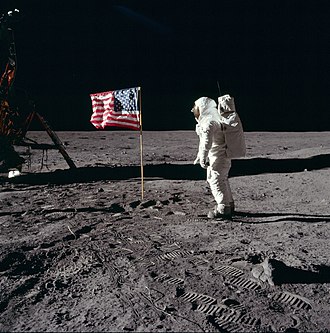
In 1958, NACA disbanded the colored computing pool when it was replaced by NASA, which adopted digital computers. From 1958 until she retired in 1986, Johnson worked as a computer for the Spacecraft Controls Branch. She calculated the trajectory for the May 5, 1961, space flight of Alan Shepard, the first American in space, and she worked on the launch window for his 1961 Mercury mission. She also plotted backup navigation charts for astronauts in case of electronic failures. When NASA used electronic computers for the first time to calculate John Glenn's orbit around Earth, officials asked Johnson to check the numbers, because Glenn had asked for her specifically. In 1961 her work helped ensure that Alan Shepard's Freedom 7 capsule was found quickly after landing. She also helped calculate the trajectory for the 1969 Apollo 11 flight to the Moon, and in 1970 she worked on the Apollo 13 mission, where her backup charts helped set a safe path for the crew's return to Earth. Later she worked on the Space Shuttle program, the Earth Resources Satellite, and plans for a human mission to Mars. In her later years, Johnson encouraged students to enter the fields of science, technology, engineering, and mathematics (STEM).
Personal life and death
Katherine and James Francis Goble had three daughters. The family lived in Newport News, Virginia, from 1953. James died of an inoperable brain tumor in 1956. In 1959, Katherine married James A. "Jim" Johnson, a United States Army officer and veteran of the Korean War. They were married for 60 years, until his death in 2019 at age 93. Johnson had six grandchildren and 11 great-grandchildren. She lived in Hampton, Virginia, and encouraged her grandchildren and students to pursue careers in science and technology.
For 50 years, Johnson was a member of Carver Memorial Presbyterian Church, where she sang as part of the choir.
Johnson died at a Newport News retirement home on February 24, 2020, at age 101. After her death, NASA administrator Jim Bridenstine called her "an American hero" and said "her pioneering legacy will never be forgotten."
Legacy and honors
Johnson coauthored 26 scientific papers. Her work in space science and computing and the honors she received show her influence as a role model for a life in science. In 1999 she was named West Virginia State College Outstanding Alumnus of the Year. On November 24, 2015, President Barack Obama presented her with the Presidential Medal of Freedom. She was cited as a pioneering example of African-American women in STEM. Obama said that she "refused to be limited by society's expectations of her gender and race while expanding the boundaries of humanity's reach." NASA noted her "historical role as one of the first African-American women to work as a NASA scientist."
Two NASA facilities are named for her. A building at the Langley Research Center in Hampton, Virginia, was named the "Katherine G. Johnson Computational Research Facility" in 2016 and opened in 2017. At the event, Johnson received a Silver Snoopy award, which NASA says is given to those "who have made outstanding contributions to flight safety and mission success." In 2019 a facility in Fairmont, West Virginia, was renamed the Katherine Johnson Independent Verification and Validation Facility. Johnson was named to the BBC's list of 100 Women in 2016, and science writer Maia Weinstock included her in a Lego prototype for Women of NASA. The College of William & Mary gave her an honorary doctorate in 2018, and Mattel announced a Barbie doll in her likeness that same year. In 2019, Government Executive included her in its Government Hall of Fame. Schools and places have also been named for her: the DeSoto Independent School District in DeSoto, Texas opened a technology academy in her name, George Mason University named a building for her, Bethel School District in Washington named a school after her, and Fairfax County Public Schools and the City of Fairfax, Virginia renamed a middle school that had been named for Confederate soldier, poet, and musician Sidney Lanier. The United States Space Force named a GPS satellite after her, and a satellite called ÑuSat 15 was launched in her honor. Northrop Grumman named its Cygnus NG-15 spacecraft, which was sent to supply the International Space Station, the SS Katherine Johnson. Baltimore County Public Schools also named one of its new schools Katherine Johnson Global Academy.
Depiction in media
The film Hidden Figures, released in December 2016, is based on Margot Lee Shetterly's nonfiction book of the same title, which was published earlier that year. It follows Johnson and the other African-American women, Mary Jackson and Dorothy Vaughan, who worked as computers at NASA. Taraji P. Henson plays Johnson.
Appearing alongside Henson at the 89th Academy Awards, Johnson received a standing ovation from the audience. In an earlier interview, Johnson said of the movie: "It was well done. The three leading ladies did an excellent job portraying us." In the 2016 episode "Space Race" of the NBC series Timeless, Johnson is portrayed by Nadine Ellis.
Awards
Katherine Johnson received many awards over her career. She earned NASA Langley Research Center Special Achievement awards in 1971, 1980, 1984, 1985, and 1986. In 1977, the Lunar Spacecraft and Operations team received a NASA Group Achievement Award for its pioneering work in navigation for spacecraft that orbited and mapped the Moon, in preparation for the Apollo program. On December 1, 2016, Johnson received the same NASA Group Achievement Award at a reception at the Virginia Air and Space Center, along with her colleagues Dorothy Vaughan and Mary Jackson. She also received honorary doctorates from several schools, including SUNY Farmingdale in 1998, Capitol College in Maryland in 2006, Old Dominion University in 2010, West Virginia University in 2016, Spelman College in 2017, and the College of William & Mary in Williamsburg, Virginia, in 2018. On April 29, 2019, the University of Johannesburg honored her for her pioneering role at NASA.
Johnson's other honors include the Presidential Medal of Freedom in 2015, a Silver Snoopy award from Leland Melvin in 2016, and the Astronomical Society of the Pacific's Arthur B.C. Walker II Award in 2016. In 2017, she received the Daughters of the American Revolution (DAR) Medal of Honor. On November 8, 2019, she was awarded the Congressional Gold Medal. She was also inducted into the National Women's Hall of Fame in 2021 and the National Aviation Hall of Fame in 2024.

Quiz time!
5 questions about Katherine Johnson
What was Katherine Johnson's main job at NASA?
Pictures
Keep exploring


This article is a child-friendly adaptation of the Wikipedia article on Katherine Johnson, available under CC BY-SA 4.0.
Images from Wikimedia Commons. Tap any image to view credits and license.