Kennedy Space Center
The John F. Kennedy Space Center (KSC, originally known as the NASA Launch Operations Center) is located on Merritt Island, Florida. It is one of the ten field centers of NASA. Since 1968, KSC has been NASA's primary launch center for American spaceflight, research, and technology. Launch operations for the Apollo, Skylab, Space Shuttle and Artemis programs were carried out from Kennedy Space Center Launch Complex 39 and managed by KSC.
KSC is located on the east coast of Florida, next to the Cape Canaveral Space Force Station (CCSFS). The two organizations work very closely together, share resources, and operate facilities on each other's property.
Though the first Apollo flights and all Project Mercury and Project Gemini flights took off from the Cape Canaveral Air Force Station, KSC and its earlier organization, the Launch Operations Directorate, managed the launches. Starting with the fourth Gemini mission, the Florida launch control center (Mercury Control Center, later the Launch Control Center) began handing control of the vehicle to the Mission Control Center in Houston shortly after liftoff. In earlier missions, it kept control throughout the entire flight.
The center also manages robotic and commercial crew missions and researches food production and in-situ resource utilization for exploration beyond Earth. Since 2010, it has worked to become a multi-user spaceport through partnerships with industry, and in 2015 it added a new launch pad, LC-39C.
About 700 facilities and buildings are spread across the center's 144,000 acres (580 km2). Among its unique facilities are the 525-foot (160 m) tall Vehicle Assembly Building, used for stacking NASA's largest rockets, and the Operations and Checkout Building, which houses the astronauts' dormitories and suit-up area. The center also has a Visitor Complex that is open to the public.
Formation
Since 1949, the military had been running launches at what would become Cape Canaveral Space Force Station. In December 1959, the Department of Defense gave 5,000 personnel and the Missile Firing Laboratory to NASA, where they became the Launch Operations Directorate under NASA's Marshall Space Flight Center. President John F. Kennedy wanted a crewed lunar landing by 1970, which required more launch operations. On July 1, 1962, the Directorate became the separate Launch Operations Center (LOC). Cape Canaveral was not suitable for the huge Saturn V rocket, so NASA decided to build a new site next to Cape Canaveral on Merritt Island.
NASA bought a large area of land along Florida's east coast, beginning in 1962. Much of the land was used for citrus farming, and many farmers were allowed to lease back their groves until summer 1964. The major buildings in the Industrial Area were designed by architect Charles Luckman, and construction began in November 1962. Kennedy visited the site several times, including a week before his assassination on November 22, 1963. On November 29, 1963, President Lyndon B. Johnson named the facility the "John F. Kennedy Space Center." NASA administrator James E. Webb then explained that this name applied only to the LOC, while the Air Force renamed the military station Cape Kennedy Air Force Station.
Location
The center is on Merritt Island, Florida. It lies north-northwest of Cape Canaveral on the Atlantic Ocean, about halfway between Miami and Jacksonville on Florida's Space Coast, and due east of Orlando. It is 34 miles (55 km) long, about six miles (9.7 km) wide, and covers 219 square miles (570 km2). It is a major tourist destination in central Florida and is about one hour's drive from the Orlando area. The Kennedy Space Center Visitor Complex offers public tours of the center and Cape Canaveral Space Force Station.
Before NASA took over the land, it had swamps, citrus groves, and coastal beaches, which are common on Florida's undeveloped east coast. Some land had to be dredged to build the center's facilities, and several small communities, including Shiloh and Allenhurst, were completely surrounded by NASA. Today, the center protects its nature. Its environmental team has rescued over 100 mangrove seedlings and replanted them to protect the shoreline. Within its 140,000-acre property, the center has habitats such as coastal dunes, marshes, and pine flatwoods, which are home to more than 1,500 species of plants and animals.
Historical programs
Main article: Apollo program
For a more comprehensive list, see List of Apollo missions.
Main article: Skylab
Main article: Space Shuttle program
For a more comprehensive list, see List of space shuttle missions.
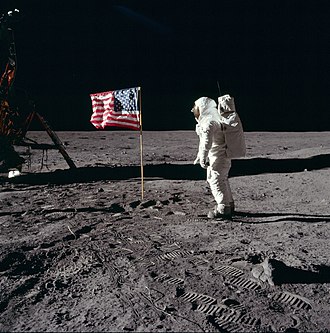
From 1967 to 1973, there were 13 Saturn V launches. The first uncrewed flight, Apollo 4, launched on November 9, 1967, and was the first rocket launch from KSC. Apollo 8 was the first crewed Saturn V launch, on December 21, 1968. Apollo 11 made the first Moon landing on July 20, 1969, with Neil Armstrong, Michael Collins, and Buzz Aldrin on board. Its launch was watched by a record-breaking 650 million television viewers. The Apollo program ended at KSC with missions 13 through 17, from 1970 to 1972. On May 14, 1973, a Saturn V put the Skylab space station in orbit. Later that year, KSC used a modified pad to launch three crewed missions to Skylab, and in 1975 it launched the final Apollo spacecraft for the Apollo–Soyuz Test Project.
While the Space Shuttle was being designed, NASA studied other possible launch sites. KSC had advantages, including its existing facilities and its southern location, but it also had drawbacks, such as salt air and frequent storms. NASA chose KSC in April 1972. The first shuttle flight, STS-1 with Columbia, launched on April 12, 1981. KSC's Shuttle Landing Facility was used for landings, though the first one there came on the tenth flight. Before that, the main landing site was Edwards Air Force Base in California. In 2009, the Ares I-X launch from Pad 39B was the first uncrewed launch from KSC since Skylab in 1973.
KSC also handled expendable launch vehicles for robotic missions. Most of these launched from the Cape Canaveral Space Force Station. The Launch Services Program formed at KSC in 1998 to manage NASA and NOAA robotic launches. Today, the Space Launch System launched from Complex 39B for the Artemis I mission on November 16, 2022, and again for Artemis II on April 1, 2026. KSC has also prepared International Space Station modules and processed Spacelab missions since the 1990s, using facilities such as the Space Station Processing Facility.
Current programs and initiatives
Kennedy Space Center runs several programs and initiatives today:
- Commercial Crew Program
- Exploration Ground Systems Program
- Launch Services Program
- Educational Launch of Nanosatellites (ELaNa)
- Research and Technology
- Artemis program
- Lunar Gateway
- International Space Station Payloads
- Camp KSC, which runs educational camps for schoolchildren in spring and summer. The camps focus on space, aviation and robotics.
Facilities
The KSC Industrial Area, where many of the center's support facilities are, is 5 miles (8 km) south of LC-39. It includes the Headquarters Building, the Operations and Checkout Building, and the Central Instrumentation Facility. Astronauts first stayed in crew quarters at Hangar S, at what is now Cape Canaveral Space Force Station. The center also had the Merritt Island Spaceflight Tracking and Data Network station (MILA), a key radio and spacecraft tracking complex. The Headquarters Building holds offices, a library, film and photo archives, and security. The library has over four million items about the history and work at Kennedy, and it is open only to employees who work on site. A new Headquarters Building was completed in 2019, after groundbreaking began in 2014. The center once ran its own 17-mile (27 km) short-line railroad, which was shut down in 2015.
The Neil Armstrong Operations and Checkout Building is a historic site on the U.S. National Register of Historic Places. It was used to prepare payloads for the Gemini and Apollo programs, Skylab, and early parts of the International Space Station, and astronauts boarded the astronaut transfer van there to travel to launch complex 39. The Space Station Processing Facility, opened in 1994, is the largest building in the KSC industrial area. The Multi-Payload Processing Facility is used for Orion spacecraft and payloads. Launch Complex 39 was built for the Saturn V rocket, the largest operational launch vehicle until the Space Launch System, for the Apollo crewed Moon landing program. It has been used for every NASA human spaceflight since 1972, including Skylab, the Apollo–Soyuz Test Project, and the Space Shuttle program. The complex includes the Vehicle Assembly Building (VAB), which was the largest structure in the world by volume when it was completed in 1965, plus a transporter, a crawlerway, a service structure, Mobile Launcher Platforms, the Launch Control Center, and a news media facility. Launch Complex 48 is under construction, between LC-39A and Space Launch Complex 41, for small launchers and spacecraft. KSC also leases land and buildings to companies such as Boeing for the CST-100 Starliner, SpaceX, Lockheed Martin for Orion processing, and Florida Power and Light, through partners like Space Florida. The Kennedy Space Center Visitor Complex, run by Delaware North since 1995, includes the Apollo/Saturn V Center and the United States Astronaut Hall of Fame near Titusville. Lunar Module 9 (LM-9) was moved to the Apollo/Saturn V Center in 2019. KSC's historic sites include the Space Shuttle Atlantis and one National Historic Landmark. The Rotation, Processing and Surge Facility prepares solid rocket booster segments for the VAB. KSC also operates the Wallops Flight Facility in Wallops Island, Virginia, one of the oldest launch sites in the world, which hosts the Mid-Atlantic Regional Spaceport for Northrop Grumman, Rocket Lab, and future launches by Firefly Aerospace.
Further information: John F. Kennedy Space Center MPS
Florida's shape and the temperature differences between land and ocean create ideal conditions for electrical storms, which is why Central Florida is called the "lightning capital of the United States". KSC needs extensive lightning protection and detection systems to keep employees, buildings and spacecraft on the launch pads safe. On November 14, 1969, Apollo 12 was struck by lightning just after lift-off from Pad 39A, but the flight continued safely. The most powerful lightning strike recorded at KSC happened on August 25, 2006, while the shuttle Atlantis was being prepared for STS-115. NASA managers were at first worried that the strike had damaged Atlantis, but no damage was found.
Storms have also caused harm to the center. On September 7, 2004, Hurricane Frances hit the area directly with winds of 70 miles per hour (110 km/h) and gusts up to 94 miles per hour (151 km/h), the most damaging storm so far. It tore off about 1,000 outer panels from the Vehicle Assembly Building, and several rockets on display were knocked over. Further damage to KSC was caused by Hurricane Wilma in October 2005. NASA estimates that the Space Center will experience 5 to 8 inches of sea level rise by the 2050s, and Launch Complex 39A, the site of the Apollo 11 launch, is the most vulnerable to flooding.
KSC directors
Since KSC was formed, 12 NASA officials have served as directors. Three of them were former astronauts: Crippen, Bridges and Cabana.
| No. | Image | Director | Start | End |
|---|---|---|---|---|
| 1 |  | Kurt H. Debus | July 1962 | November 1974 |
| acting | Miles Ross | November 1974 | January 18, 1975 | |
| 2 |  | Lee R. Scherer | January 19, 1975 | September 25, 1979 |
| 3 |  | Richard G. Smith | September 26, 1979 | August 2, 1986 |
| acting | Thomas E. Utsman | August 3, 1986 | September 30, 1986 | |
| 4 |  | Forrest S. McCartney | October 1, 1986 | August 31, 1987 |
| September 1, 1987 | December 31, 1991 | |||
| 5 |  | Robert L. Crippen | January 1, 1992 | January 21, 1995 |
| 6 |  | Jay F. Honeycutt | January 22, 1995 | March 2, 1997 |
| 7 |  | Roy D. Bridges, Jr. | March 2, 1997 | June 13, 2003 |
| acting |  | James W. Kennedy | June 13, 2003 | August 10, 2003 |
| 8 | August 10, 2003 | January 4, 2007 | ||
| 9 |  | William W. Parsons | January 4, 2007 | October 26, 2008 |
| 10 |  | Robert D. Cabana | October 26, 2008 | May 17, 2021 |
| acting |  | Janet E. Petro | May 17, 2021 | June 29, 2021 |
| 11 | June 30, 2021 | May 1, 2026 | ||
| acting | Kelvin Manning | May 1, 2026 | May 22, 2026 | |
| 12 |  | Brian Hughes | May 22, 2026 | present |
In popular culture
Kennedy Space Center is often featured in documentaries and has been shown in many films. Some studio movies have gained access and filmed scenes inside the space center's gates. When extras are needed for those scenes, space center employees are recruited and use their personal time to take part.
Films with scenes at KSC include:
- Moonraker
- Stowaway to the Moon
- SpaceCamp
- Apollo 13
- Contact
- Armageddon
- Space Cowboys
- Swades
- Transformers: Dark of the Moon
- Tomorrowland
- Sharknado 3: Oh Hell No!
- First Man
- Geostorm
- Men in Black 3
- Fly Me to the Moon
- Simon
The space center is a major part of the finale of Stone Ocean, the 6th part of the manga and anime series JoJo's Bizarre Adventure. KSC was also one of the two main settings of the 1965–1970 television series I Dream of Jeannie, along with a home in nearby Cocoa Beach. The show was filmed entirely in Los Angeles.

Quiz time!
5 questions about Kennedy Space Center
Why was a new launch site built on Merritt Island?
Pictures
Keep exploring


This article is a child-friendly adaptation of the Wikipedia article on Kennedy Space Center, available under CC BY-SA 4.0.
Images from Wikimedia Commons. Tap any image to view credits and license.