 Safekipedia
Kensiu language
Adapted from Wikipedia · Discoverer experience
The Kensiu language is a special and ancient way of speaking used by a very small group of people. It belongs to the Austroasiatic family of languages and is part of the Jahaic subbranch, which is a Northern group of Aslian languages.
Today, about 300 people in Yala Province in southern Thailand still speak Kensiu. There is also a similar group of about 300 speakers living in the states of Perak and Kedah in Western Malaysia. The people who speak Kensiu are part of the Maniq people, also known as the Mani of Thailand. In Malaysia, they are included among the Orang Asli, the original inhabitants of the land.
Because so few people still speak Kensiu, this language is very important for understanding the history and culture of these communities. It helps us learn about their traditions, stories, and connection to the land they have lived on for many generations.
History
The Thai Maniq and the Malaysian Semang are thought to be the first modern humans to live in the Malay Peninsula. After them, people speaking Mon–Khmer languages arrived, probably from southwestern China. Over many years, the Negrito people stopped using their original languages and began speaking the languages of their neighbors, which they still use today.
Geographic distribution
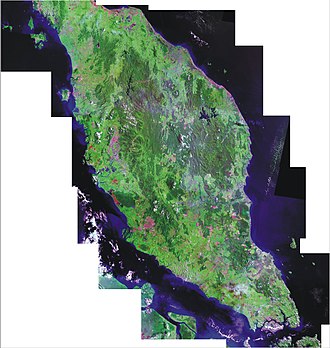
The Maniq people live in the mountainous jungle areas of Southern Thailand and Northern Malaysia. They are thought to be the original inhabitants of Peninsular Malaysia.
In Thailand, they are often called the Sakai, Khon Paa, or Ngok Paa, meaning "the forest people." They live near the border in Narathiwat and Yala provinces, and also in the Baantat Mountain Range in Satul, Trang, and Phatthalung provinces.
In Malaysia, the Maniq are found between Northern Kedah and the border with Thailand. Some have lived in villages near Baling, Kedah, since 1965. There are about 200 Maniq in Thailand and around 2,500 in Malaysia, though exact numbers are hard to know because they often move around.
Alternate names
The Kensiu language is also known by many other names, such as Belubn, Kense, Kenseu, Kensieu, Kensiw, Maniq, Mawas, Mendi, Mengo, Meni, Menik, Moni, Monik, Moniq, Mos, Ngok Pa, Orang Bukit, Orang Liar, Sakai, and Tiong. A related language variety called Tea-de, part of the Maniq-Kensiw language group, is spoken in Waeng District and Narathiwat Province in Thailand.
Phonology
The Kensiu language has 28 vowels. These include 14 oral vowels and 12 nasal vowels, along with one oral and one nasal diphthong. The language also has vowels at different heights in the mouth. There is no difference in voice register.
Nasality and tongue height
Each oral vowel has a nasal counterpart, except for two specific vowels. Nasal vowels are less common and often appear in certain word environments.
The vowels in Kensiu have five different heights for front and central vowels, and four for back vowels. Some vowels are slightly higher in the mouth than others.
Vowel description
The vowels listed do not include nasalized vowels. Nasalized vowels are marked with a tilde, like /ĩ/, which is the nasalized version of /i/. They differ from standard vowels described in vowel charts.
- /i/: Slightly lower and more backed than a standard vowel.
- /e̝/: Lower and further back than another standard vowel. It does not appear before certain sounds.
- /e/: Lower and more backed than /e̝/. It is unmarked because it is a common position for the tongue.
- /ɛ/: Slightly higher and more backed than a standard vowel. It appears as often as /e̝/.
- /ɯ/: More fronted than a standard vowel but not as much as another. It is also lower in the mouth.
- /ɚ/: A central unrounded vowel with a retroflexed quality, likely influenced by Malay. It is slightly higher than a schwa. It appears mainly in unstressed syllables.
- /ə/: A central unrounded vowel appearing midway between high and low positions. It rarely appears in stressed syllables.
- /ʌ/: Slightly higher than a standard vowel but more fronted. It is common in unstressed syllables and often appears in a specific syllable pattern.
- /a/: An open central unrounded vowel. It appears most often and can work with every initial single consonant and final consonant.
- /u/: Slightly lower and fronted than a standard vowel.
- /o̝/: Slightly lower and more fronted than a standard vowel.
- /o/: A mid back rounded vowel.
- /ɔ/: Slightly higher and more fronted than a standard vowel.
- /ie/: A close front unrounded lowering diphthong. It appears only in stressed syllables, always with a final stop. It has an allophone before a final glottal stop.
Vowel contrasts
The vowels do not appear in all word positions. Some central vowels do not appear in open syllables, and others do not appear with certain final sounds. Some vowels rarely appear with final nasal sounds. With regard to certain sounds, only specific vowels can appear with a final /w/. Two vowels do not appear with a final /j/. The diphthong cannot combine with a final approximant, likely due to the nature of approximants.
Consonant allophonic description and distribution
Unvoiced stops are typically unaspirated, but three of them can sometimes be aspirated, likely due to borrowings from other languages.
- /p/ is usually a voiceless unaspirated bilabial stop, but it can rarely be aspirated in certain borrowed words from Malay.
- /t/ is usually an unaspirated alveolar stop at the start and end of a syllable, but it can rarely be aspirated in borrowed words from Thai. It also has another occasional sound.
- /c/ is a voiceless palatal stop that appears at the start and end of a syllable, though not often.
- /k/ is a voiceless unaspirated velar stop at the start and end of a syllable. It can rarely be aspirated in certain borrowed words from Thai.
- /ʔ/ appears very often at the start and end of a syllable. At the end, it mainly appears in stressed syllables.
- /b, d, ɟ, ɡ/ are voiced stops at the start of a syllable, but they change to pre-oralized nasals at the end of a morpheme. They also have another sound at the end of a word.
- /m, n, ɲ, ŋ/, nasal stops at different points of articulation, are less common than oral stops. The palatal nasal is the least common. All four appear at the start and end of syllables.
- /ɸ/ is a voiceless bilabial fricative that only appears at the end of a syllable.
- /s/, a voiceless alveolar fricative, can have a palatal sound in both positions, appearing to be used interchangeably by speakers.
- /h/ is a voiceless glottal fricative that appears at the start and end of a syllable.
- /l/ has a palatal sound at the end of a syllable. At the start, it is a clear lateral approximant.
- /w/, a voiced labio-velar central approximant, appears at the start and end of a syllable. It can also appear as the second consonant in a cluster at the start of a stressed syllable.
- /ɻ/ is usually a voiced retroflexed central approximant at the start or end of a syllable. However, it is heard as a flap when it is the second consonant in a syllable initial cluster. There is one case where it is heard as a trill.
In addition to these pairs, there are a couple of other words that are spoken with a high pitch, but no matching mid-level pitch word has been found yet.
Nasality is a feature of Kensiu vowels. There are 13 nasal vowels.
Word and syllable structure
Kensiu has three types of syllables, like other Mon-Khmer languages:
- Major syllables with many vowels and consonants at the start and end. They can be single-syllable words or the end syllable of two-syllable words.
- Minor syllables with fewer vowels or fixed stress at the end. They only appear as non-final syllables. In Kensiu, they can also have a specific pattern.
- Presyllables with an epenthetic schwa or a few vowels, breaking up a consonant cluster. They only appear as pre-final syllables in two-syllable words.
Kensiu has all three types but also has words with three or four syllables, mostly from Malay borrowings.
Reduplication in Kensiu is a common process that changes syllable structure. Reduplicated words usually have a specific syllable structure. There are also occasional consonant clusters in the second syllable.
There are three main ways of reduplication in Kensiu:
- Identical consonants, changed vowel
- Identical final consonant and vowel, changed initial consonant
- Identical final consonant, changed initial consonant and vowel
All three methods copy the base word, with the first syllable as a new bound morpheme and the second as the base. The first method is the most common. The second copies the final consonant and vowel but changes the first consonant. The third copies only the final consonant and changes the first consonant and vowel. Reduplicated forms often include nasal vowels and a specific final sound.
| gūj 'language' | gúj 'head' |
| kēc 'to be stuck' | kéc 'to cut' |
| kāp 'to bite' | káp 'deaf and mute' |
Morphology and syntax
Kensiu is a SVO language, meaning the order of words in a sentence is subject, verb, and then object. For example, modifiers come after the main word.
The language has special words to show where things are, like inside something or outside of it. It also uses different words to show how close something is, like if it’s right next to you or far away.
Words
Kensiu doesn’t use many single-syllable words. Most words have a main part, a smaller part, and sometimes an extra beginning part.
Vocabulary
Kensiu uses many words borrowed from Malay. It also shares some words with other languages in the Austroasiatic family.
Terms of reference and address
The way people in the Kensiu language refer to family members is similar to the Hawaiian kinship system but has some differences. For example, cousins and siblings are told apart by who is older, not by gender. There are also special ways to talk about aunts, uncles, grandparents, and younger relatives.
Orthography
Writing system
The Kensiu language uses the Thai script for its writing system. The symbols were chosen to closely match their values in Thai, making the alphabet easier to learn and use for people familiar with Thai. This also helps readers transfer their skills between the two languages.
Vowels
Kensiu has more vowel sounds than Thai, including extra heights and nasal sounds. To show these differences, special marks were added to Thai symbols. A Pali dot helps show the different vowel heights. A special Thai symbol marks nasal sounds because Thai does not have these sounds.
Consonants
For consonants that are the same in Kensiu and Thai, the Thai symbols are used. For new sounds in Kensiu, similar Thai symbols were chosen based on how they are pronounced. This includes sounds like voiced plosives, a nasal sound, fricatives, and special nasal sounds.
Consonant clusters
Kensiu uses the same way as Thai to write consonant clusters, but it has a few more clusters ending in /w/.
Tone
Kensiu is not a tonal language, but some words have a high tone. This high tone is marked with a special symbol called a maitree.
Relationship with other languages
Kensiu is closely related to many indigenous dialects spoken in Southern Thailand. For example, Kensiu and Kintaq Bong, a Northern Aslian language, are actually dialects of the same language. Kensiu also shares many words with other languages such as Mendriq, Mintil, Bateg Nong, Jehai, and Che Wong. Interestingly, Che Wong, spoken about 200 miles away, seems to be more closely related to Kensiu than some languages that are closer by, like Mintil.
Endangerment
The Kensiu language is in danger because it is spoken by a very small group of people who sometimes feel shy to use it. As more people around them speak languages like Thai or Malay, many Kensiu speakers are switching to these languages instead. There also aren’t many books or writings in Kensiu, and government rules sometimes make it hard for the Kensiu community to live in their traditional areas. All of these reasons make it challenging to keep the Kensiu language alive.
Related articles


This article is a child-friendly adaptation of the Wikipedia article on Kensiu language, available under CC BY-SA 4.0.