 Safekipedia
Lan Na
Adapted from Wikipedia · Discoverer experience
The Lan Na kingdom was a kingdom that existed in what is now Northern Thailand from the 13th to the 18th centuries. It was also called the Kingdom of Lanna, meaning “Kingdom of a Million Rice Fields.” Lan Na grew out of earlier kingdoms and became strong enough in the 15th century to challenge the nearby Ayutthaya Kingdom.
Over time, Lan Na faced challenges from stronger powers. In 1558, it became a vassal state of the Toungoo dynasty from Burma. Although some local kings still ruled, Burmese influence grew. Later, in 1775, Lan Na leaders turned to Siam (now Thailand) for help, which led to conflict with Burma.
Eventually, Siam took control of Lan Na. By the late 1800s, the Siamese government absorbed Lan Na into its growing nation. By 1909, Lan Na was fully part of Siam and no longer existed as an independent kingdom.
Names
The Lan Na kingdom had many different names in nearby countries. In Burmese, it was called Zinme Pyi or Yun Pyi. In Lao, people called it Anachak Lan Na.
The Pali language called it Yonaraṭṭha or Bingaraṭṭha. In old Chinese records, it was known as Babai Xifu.
History
Further information: Shan States
Mangrai, the 25th king of Ngoenyang (modern Chiang Saen) from the Lavachakkaraj dynasty, united the mueangs of Ngoenyang into a strong kingdom and allied with the nearby Phayao Kingdom. In 1262, Mangrai moved the capital to the newly built Chiang Rai, naming it after himself. He later expanded south, taking over the Mon kingdom of Hariphunchai (centered on modern Lamphun) in 1281. Mangrai moved the capital several times before founding Chiang Mai in 1296, which became the heart of Lan Na.
Lan Na grew stronger under rulers like Tilokaraj (1441–1487). He defended against attacks and expanded the kingdom's influence. However, after Tilokaraj, the kingdom faced internal struggles and pressures from neighboring powers. Eventually, Lan Na was influenced by stronger kingdoms and changed hands several times over the centuries.
Lan Na language
Further information: Northern Thai language and Tai Tham alphabet
Kham Mueang, also called Phasa Mueang, is the modern version of the old Lan Na language. The name Kham Mueang means "language of the principalities." This language is used by people in the towns and kingdoms, unlike the languages spoken by many hill tribe peoples in the mountains around them. Kham Mueang can be written with an old script that looks a bit like the Thai script but has its own special spelling rules. Over time, this script has changed, and the way people say words today is different from how they were said in the past.
Historical writings on Lan Na
The Chiang Mai Chronicle likely began in the late 1500s and grew bigger each time it was copied onto palm leaves. The version we have today comes from 1828, and there is an English translation you can find.
Jinakālamāli was written by Ratanapañña in the 1600s. It tells the story of how Buddhism first started in Thailand and shares many important historical events.
There is also a Burmese chronicle called Zinme Yazawin, which focuses on Zinme, also known as Chiang Mai.
Modern Reconstruction and the "Lanna Renaissance"
During the 1980s and 1990s, Northern Thailand experienced a cultural movement called the "Lanna Renaissance." This time saw a growing pride in local traditions, with people bringing back the old Lanna script called Tham and using traditional styles of buildings and clothing again. Leaders of this movement were mostly teachers at Chiang Mai University, especially Professor Vithi Phanichphant, who wanted to bring back a local way of life that had been hidden during earlier government rules that focused only on Thailand as a whole.
Researchers looked to places like Luang Prabang for help in understanding old traditions. Luang Prabang kept many old styles alive, especially in special crafts like shiny decorations and fancy silk clothes. Because Chiang Mai and Luang Prabang were both part of the same big family of Tai cultures, the styles from Luang Prabang helped fill in gaps in what was lost in Chiang Mai.
Architecture and Textiles
Professor Phanichphant pointed out special areas where old styles were rediscovered:
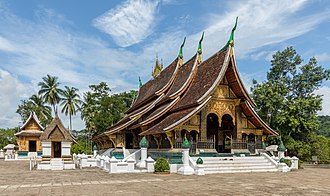
- Temple Architecture: Scholars studied temples like Wat Xieng Thong in Luang Prabang to learn about old building designs before they changed under influence from Bangkok.
- Textiles and Royalty: Phanichphant found that some beautiful silk clothes with gold edges and special ways to wear shoulder cloths used in modern festivals came from old Lao traditions. Bringing back these shiny silks helped people feel proud of their culture as something rich and royal.
Academic Critiques and "The Lanna Deception"
Even though this revival helped create a strong local identity, some teachers have talked about how true these new traditions really are. A report in 2009 called "The Lanna Deception" suggested that many modern "Lanna" styles are new mixes rather than old traditions that never changed.
Some points in this discussion include:
- Invented Traditions: Some traditions were changed to work better for business and looks. For example, the Khantoke dinner, now a famous part of Northern hospitality, mixes old Tai Lue customs with dinner shows like those from Hawaii called luau that came in the 1950s.
- Standardization of Ethnicity: Critics say the revival mixed many different cultures—like Tai Lue, Lao, Tai Khoen, and Tai Yuan—into one fancy "Lanna" style. This often replaced real history, such as people wearing less clothing or having teeth stained from a special nut, with a cleaner look that appeals to tourists and important people today.
Images
Related articles

This article is a child-friendly adaptation of the Wikipedia article on Lan Na, available under CC BY-SA 4.0.
Images from Wikimedia Commons. Tap any image to view credits and license.