Mushroom
A mushroom is the fleshy, spore-bearing fruiting body of a fungus, usually growing above ground on soil or another food source. A toadstool generally refers to a poisonous mushroom. For mushrooms used in cooking, see Edible mushroom. For other meanings of the word, see Mushroom (disambiguation). For other meanings of "toadstool," see Toadstool (disambiguation).
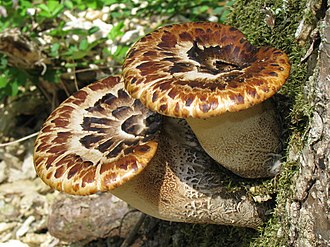
The standard for the name "mushroom" is the cultivated white button mushroom, Agaricus bisporus. So the word "mushroom" is most often used for fungi (Basidiomycota, Agaricomycetes) that have a stem (stipe), a cap (pileus), and gills (lamellae) on the underside of the cap. The name also describes other gilled fungi, with or without stems, and the fleshy fruiting bodies of some Ascomycota. The gills produce tiny spores that help the fungus spread across the ground or the surface where it lives.
Forms that differ from the standard morphology usually have more specific names, such as "bolete," "truffle," "puffball," "stinkhorn," and "morel." Gilled mushrooms are often called "agarics," after their similarity to Agaricus or their order Agaricales.
Mushrooms grow from underground mycelium and can expand rapidly under favorable conditions. They vary widely in how they are used. Some are edible and nutritious, while others are toxic or psychoactive. Many have roles in folk medicine, ecology, and industry.
Etymology
The words "mushroom" and "toadstool" have been used for centuries, but they were never precisely defined, and people did not agree on how to use them. During the 15th and 16th centuries, words such as mushrom, mushrum, muscheron, mousheroms, mussheron, or musserouns were used.
The word "mushroom" and its variations may have come from the French word mousseron, which is related to moss (mousse). It is not always clear whether a fungus is edible or poisonous, so a "mushroom" may be edible, poisonous, or unpalatable. The word toadstool first appeared in 14th-century England as a name for a "stool" for toads, possibly suggesting a poisonous fungus that is not safe to eat. This association is still part of the word's meaning today.
Identification
Knowing a mushroom's macroscopic structure helps people tell what is and is not a mushroom. Most are basidiomycetes with gills. Their tiny spores, called basidiospores, form on the gills and fall like a fine powder from under the cap. Each spore is shot off tiny structures called basidia and drops between the gills. If you cut off a cap and place it gill-side-down overnight, it leaves a powdery print that shows the shape of the gills. The color of this spore print helps people sort and name mushrooms. Most prints are white, but they can also be brown, black, purple-brown, pink, yellow, or cream. They are almost never blue, green, or red.
Experts still use methods that have been refined since medieval times and the Victorian era, along with examining mushrooms under a microscope. Amateur and professional mycologists look at juices, color changes when bruised, smells, tastes, color, habitat, and season. Tasting and smelling can be risky because of poisons and allergens. Chemical tests are also used for some groups. Identifying a mushroom's genus can often be done in the field with a local field guide. Identifying its species takes more effort. A mushroom must grow to full size to show the features needed, but very old mushrooms lose these features and stop producing spores. Beginners have often mistaken water marks on paper for white spore prints, or stains from liquid on lamella edges for colored ones.
Classification
Main articles: Sporocarp (fungus), Basidiocarp, and Ascocarp
Typical mushrooms are the fruit bodies of the order Agaricales. Its type genus is Agaricus, and its type species is the field mushroom, Agaricus campestris. In modern molecularly defined classifications, not all members of Agaricales produce mushroom fruit bodies. Many other gilled fungi, which are also called mushrooms, belong to other orders in the class Agaricomycetes. For example, chanterelles are in the Cantharellales, and false chanterelles such as Gomphus are in the Gomphales. The milk-cap mushrooms (Lactarius, Lactifluus) and the russulas (Russula), along with Lentinellus, are in the Russulales. The tough, leathery genera Lentinus and Panus are among the Polyporales, while Neolentinus is in the Gloeophyllales. The little pin-mushroom genus Rickenella, along with similar genera, is in the Hymenochaetales.
Within the main body of mushrooms in the Agaricales are common fungi such as the fairy-ring mushroom, shiitake, enoki, oyster mushrooms, fly agarics and other Amanitas, magic mushrooms like species of Psilocybe, paddy straw mushrooms, and shaggy manes. An unusual mushroom is the lobster mushroom. It is a fruit body of a Russula or Lactarius mushroom that has been changed in shape by the parasitic fungus Hypomyces lactifluorum, giving it a red color and shape that look like a boiled American lobster. Other mushrooms do not have gills, so the word "mushroom" is used loosely for them, and a full account of their classification is hard to give. Some have pores underneath, and others, like the hedgehog mushroom and other tooth fungi, have spines. The word has been used for polypores, puffballs, jelly fungi, coral fungi, bracket fungi, stinkhorns, and cup fungi. So "mushroom" is used more for the macroscopic fruiting bodies of fungi than for a precise taxonomic group. About 14,000 species of mushrooms have been described.
A mushroom grows from a tiny pinhead called a primordium, which is less than two millimeters wide and found on or near the substrate. It forms inside the mycelium, a mass of threadlike hyphae. The young mushroom looks like a small egg, called a "button," wrapped in a cottony layer called the universal veil. As the mushroom grows, this veil may leave a cup called a volva at the base of the stalk, or small warts on the cap. A second layer, the partial veil, covers the gills that hold the spores. It may leave a ring, or annulus, on the stalk, as in Amanita, Lepiota, and Cortinarius. The gills can attach to the stalk in different ways. In Agaricus, Amanita, Lepiota, and Pluteus, they do not reach the top of the stalk. In Omphalotus and Pleurotus, they run down the stalk, which is called decurrent.
The stalk, also called the stipe or stem, may sit in the middle of the cap or off to one side, as in Pleurotus and Panus. Some mushrooms have no stalk, such as the shelf-like polypores. Puffballs, truffles, jellies, earthstars, and bird's nests usually have no stalk either. A layer of tiny spore-bearing cells, the hymenium, covers the gills. It also lines the tubes of boletes. Mushroom spores are important for identifying a mushroom, since their color, shape, and size can help tell species apart. The cell walls of mushrooms are mostly made of glucans and chitin. Glucans help store energy and give the mushroom structure.
Growth
Many mushrooms seem to appear overnight, growing or spreading quickly. This is where some common English expressions come from, such as "to mushroom" or "mushrooming" (expanding rapidly in size or scope) and "to pop up like a mushroom" (to appear unexpectedly and quickly). In reality, all mushrooms take several days to form tiny early fruit bodies, called primordia, though they can grow rapidly by soaking up fluids.
The cultivated mushroom and the common field mushroom first form a tiny fruiting body, called the pin stage because of its small size. When it grows a little larger, it is called a button. Then the mushroom can quickly pull in water from its mycelium and expand by filling up cells that took several days to form in the primordia. Some mushrooms, like Parasola plicatilis (formerly Coprinus plicatlis), grow overnight and may disappear by late afternoon on a hot day after rain. Others grow slowly, adding material from the edges of the colony or by inserting hyphae. For example, Pleurotus nebrodensis grows slowly, and combined with human collection, it is now critically endangered. Although mushroom fruiting bodies do not last long, the mycelium underneath can live for a very long time. A colony of Armillaria solidipes (formerly known as Armillaria ostoyae) in Malheur National Forest in the United States is estimated to be 2,400 years old, possibly older, and covers an estimated 2,200 acres (8.9 km2).
Nutrition
Raw brown mushrooms are 92% water, 4% carbohydrates, 2% protein, and less than 1% fat. In a 100-gram (3.5 oz) serving, raw brown mushrooms provide 22 calories. They are a rich source (20% or more of the Daily Value, DV) of B vitamins, such as riboflavin, niacin and pantothenic acid, as well as selenium (47% DV) and copper (56% DV). They are a moderate source of phosphorus, zinc, and potassium (10–15% DV). They have little or no vitamin C or sodium.
The amount of vitamin D in a mushroom depends on postharvest handling, especially when mushrooms are accidentally exposed to sunlight. The US Department of Agriculture found that mushrooms exposed to UV light contain large amounts of vitamin D. When mushrooms are exposed to ultraviolet (UV) light, even after being picked, ergosterol in them is changed into vitamin D2. This process is now used on purpose to supply fresh mushrooms with vitamin D for the functional food grocery market. A safety study found that artificial UV light works just as well as sunlight for making vitamin D in mushrooms, and that UV light has a long record of safe use for this purpose in food.
Human use
Further information: Ethnomycology
Main article: Edible mushroom
Mushrooms are used a lot in cooking and in many cuisines, especially Chinese, Korean, European, and Japanese. People have valued them as food since ancient times. Most mushrooms sold in supermarkets are grown on mushroom farms. The most common, Agaricus bisporus, is considered safe for most people because it is grown in controlled, sterilized places. Other grown types include Hericium erinaceus, shiitake, maitake (hen-of-the-woods), Pleurotus, and enoki. China is a major producer and grows about half of all cultivated mushrooms. In 2014, Poland was the world's largest mushroom exporter.
Telling edible mushrooms from poisonous ones takes great care, because no single trait identifies all toxic mushrooms or all edible ones. People who collect mushrooms to eat are called mycophagists, and the activity is called mushroom hunting, or "mushrooming". Even edible mushrooms can cause allergic reactions, from a mild asthmatic response to severe anaphylactic shock. The cultivated A. bisporus contains small amounts of hydrazines, the most abundant being agaritine, which is a mycotoxin and carcinogen. Moderate heat during cooking destroys hydrazines. Some poisonous mushrooms look like edible ones, and eating them could be fatal, so wild mushrooms should only be eaten by people who know how to identify them. Common advice is that if a mushroom cannot be positively identified, it should not be eaten. In Jainism, eating mushrooms and other edible fungi is strictly prohibited. This rule is rooted in the religion's core principle of nonviolence (ahimsa). Classical Jain thinking classifies mushrooms as ananthkay, bodies that hold an infinite number of tiny souls or lifeforms (nigoda), and they are seen as breeding grounds for mobile microorganisms (trasa jiva).
Many mushroom species make secondary metabolites that can be toxic, mind-altering, antibiotic, antiviral, or bioluminescent. Only a small number are deadly species, but several others can cause severe and unpleasant symptoms. Toxicity may help protect the mushroom's spore-producing structure. Some chemicals make a mushroom inedible by causing the eater to vomit (see emetics) or to learn to avoid it. Because mushrooms can absorb heavy metals, European mushrooms may have carried toxicity from the 1986 Chernobyl disaster as late as 2008, and they have continued to be studied.
Mushrooms with psychoactive properties have long been part of native medicine traditions around the world. They have been used in rituals for healing and visionary states, such as the velada ceremony, led by a shaman or curandera (priest-healer).
Psilocybin mushrooms, also called psychedelic or "magic mushrooms", have psychedelic properties. They are sold openly in smart shops in many parts of the world, or on the black market where sale is banned. They have been reported to bring mystical experiences, and recent scientific work has supported these claims.
Psilocybin, found in psychedelic mushrooms such as Psilocybe cubensis, is being studied for helping people with conditions such as obsessive–compulsive disorder. Tiny amounts have been reported to stop cluster and migraine headaches. A double-blind study by Johns Hopkins Hospital showed that psychedelic mushrooms could provide an experience with substantial personal meaning. One third of the subjects reported that taking them was the single most spiritually significant event of their lives. Psilocybin mushrooms have also shown promise in treating addiction, specifically to alcohol and cigarettes. A few species of Amanita, most notably A. muscaria and A. pantherina, contain the psychoactive compound muscimol. These species contain no amatoxins or phallotoxins, so they are not hepatoxic, though if not properly cured they can be non-lethally neurotoxic due to ibotenic acid. In high doses, the effects can include dissociation and delirium. A third type is the hallucinogenic bolete mushrooms, such as Lanmaoa asiatica, which are said to cause Lilliputian hallucinations. Their active ingredients are unknown, and they are currently being researched.
Some mushrooms are used in folk medicine. Further information: Medicinal uses of fungi
In a few countries, extracts such as polysaccharide-K, schizophyllan, polysaccharide peptide, or lentinan are government-registered adjuvant cancer therapies, but clinical evidence that they are safe and work in humans has not been confirmed. The US Food and Drug Administration regards such use as a dietary supplement, which does not have government approval or common clinical use as a prescription drug.
Mushrooms can be used for dyeing wool and other natural fibers. The chromophores of mushroom dyes are organic compounds that produce strong, vivid colors, and before synthetic dyes were invented, mushrooms were the source of many textile dyes. Some polypores, loosely called mushrooms, have been used as fire starters, known as tinder fungi. Mushrooms and other fungi also help develop new cleanup methods, such as using mycorrhizae to spur plant growth, and filtration technologies. Research into genetic engineering aims to improve mushrooms for nutrition and medical use.

Quiz time!
5 questions about Mushroom
Why do people leave a cut mushroom cap gill-side-down overnight?
Pictures
Keep exploring




This article is a child-friendly adaptation of the Wikipedia article on Mushroom, available under CC BY-SA 4.0.
Images from Wikimedia Commons. Tap any image to view credits and license.