 Safekipedia
Outer space
Adapted from Wikipedia · Discoverer experience
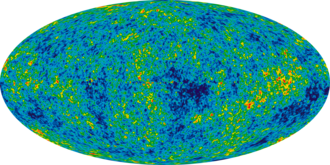
Outer space, or simply space, is the vast area beyond Earth's atmosphere and between celestial bodies. It is an almost empty area filled with very few particles, mostly hydrogen and helium, along with energy, particles from stars, and tiny bits of dust. The temperature in space is extremely cold, about 2.7 kelvins, which is leftover heat from the Big Bang.
Most of the matter in the universe is found in a mysterious form called dark matter and dark energy, while the space between galaxies holds a lot of hot plasma. Even inside galaxies and star systems, there is mostly empty space. The line that marks where space begins is called the Kármán line, about 100 kilometers above sea level.
Humans have explored space using balloons, rockets, and spacecraft. The first person to travel into space was Yuri Gagarin from the Soviet Union in 1961. While it is very difficult and expensive to send humans into space, uncrewed spacecraft have visited every known planet in our Solar System. Space is a tough place for humans because of its empty nature, radiation, and lack of gravity, which can affect our bodies.
Terminology
People have talked about "space" meaning the area above our sky for a long time. The word "space" was used in this way in a famous old poem by John Milton called Paradise Lost in 1667. Later, a writer named H. G. Wells helped make the term "outer space" well-known after 1901.
Scientists use special words to describe things in outer space. For example, "spaceborne" means something exists or travels in outer space, often on a spacecraft. Similarly, "space-based" means something is located in outer space or on a planet or moon.
Formation and state
Main article: Big Bang
The whole universe might be infinite in size. The Big Bang theory says the universe began about 13.8 billion years ago as a very hot and dense place that expanded quickly. After about 380,000 years, it cooled enough for tiny particles to form hydrogen. This let light travel freely through space. The matter left from this expansion formed stars, galaxies, and other objects, leaving a deep empty space we call outer space.
We know the shape of the universe from satellite measurements. These show the universe looks "flat," meaning light travels in straight lines over great distances. The universe is spreading apart and has something called dark energy, which affects how space behaves. The universe has very little matter on average, with most of it gathered in galaxies and even tighter in stars and black holes. There are also huge empty areas called voids with very little matter.
Environment
Main articles: Space environment, Space weather, and Space weathering
Outer space is almost like a perfect empty void. It has almost no friction, so stars, planets, and moons can move freely along their paths. Even in the deepest parts of space between galaxies, there are still a few hydrogen atoms, but they are very far apart. The air we breathe has many more molecules than the sparse atoms in space.
Space has very low amounts of matter, so light can travel far without being blocked. The temperature of space is very cold because of the energy left over from the Big Bang, which is about 2.7 kelvins. However, the temperature of gas in space can change a lot, from extremely cold to very hot.
Human access
Effect on biology and human bodies
Main articles: Effect of spaceflight on the human body, Space medicine, and Bioastronautics
See also: Astrobiology, Astrobotany, Plants in space, and Animals in space
Space is a very tough place for living things, but some can survive. For example, special types of lichen survived in space for ten days in 2007. Some plant seeds also grew after being in space for a year and a half. Even some tiny living things called bacteria can live for over 500 days in space.
When humans go into space, they face many challenges. Without the right equipment, the lack of air and pressure can be very dangerous. Special suits and sealed spaces are needed to keep astronauts safe. In space, there is no up or down, which can make astronauts feel sick at first. They also lose muscle and bone strength over time, but exercises help with this. Space radiation can also be harmful, so scientists are working on ways to protect astronauts.
Boundary
For the furthest reaches of space, see observable universe.
There isn’t a clear line that says where Earth’s atmosphere ends and space begins. The air gets thinner and thinner as you go higher until it mixes with the stream of particles from the Sun. Some people say space starts at 30 kilometers, while others say it’s much higher, like 1.6 million kilometers.
One common way to mark the boundary is the Kármán line, which is at 100 kilometers above Earth. Above this line, airplanes can’t fly and special spacecraft are needed. Between Earth and this line is called “near space,” and it’s where some balloons and very low orbits go.
Legal status
Main article: Space law
International rules help guide how countries use space. The Outer Space Treaty, made in 1967, says that space belongs to everyone and no one country can own it. This treaty was signed by many countries and helps make sure space is used for peaceful purposes. It also says that no one can put nuclear weapons in space.
There are other treaties and agreements too, but space law is still growing as more countries and companies use space. Some rules are needed to manage space junk and make sure everyone can use space safely. The Artemis Accords are a newer agreement that aims to guide future moon missions and exploration.
Participation
Earth orbit
Main articles: Geocentric orbit and Orbital decay
To get into orbit around Earth, a rocket needs to go very fast—about 7.8 kilometers per second for low Earth orbit. Once in orbit, the spacecraft follows a path that keeps it moving around Earth without falling back down.
Orbits can be at different heights. Low Earth orbit is from about 180 to 2,000 kilometers above Earth and is used for many satellites. Higher orbits, like medium and high Earth orbits, are used for different purposes such as navigation and weather tracking.
Some orbits are affected by Earth’s atmosphere, which can slowly pull satellites down. This is more of a problem for satellites in lower orbits. Radiation from the Sun and Earth can also be a danger to satellites and astronauts, especially in certain areas called the Van Allen radiation belts.
Regions
See also: Location of Earth
Overview of different scales of space as regions around Earth
Inner Solar System with Near-Earth objects
.png)
Local Interstellar Cloud and neighbouring interstellar medium
.png)
Star associations and interstellar medium map of the Local Bubble
.png)
Molecular clouds around the Sun inside the Orion-Cygnus Arm
Orion-Cygnus Arm and neighbouring arms
Orion-Cygnus Arm inside the Milky Way
The Sun within the structure of the Milky Way
.png)
Satellite galaxies of the Milky Way in Local Group
.png)
Laniakea SCl in Pisces–Cetus Supercluster Complex
Regions near the Earth
The outermost layer of the Earth's atmosphere is called the exosphere. It starts from the thermopause, which is about 250 to 500 kilometres above Earth. Beyond this, the air becomes very thin, and the area around Earth is filled with many satellites orbiting our planet.
Near-Earth space is the area from low orbits around Earth out to geostationary orbits. This is where most of our human space activities happen, like satellites. There is also space debris here, which can sometimes fall back to Earth. Even though it is space, there is still a little air in the lowest orbits that can slow down satellites.
Geospace includes Earth's upper atmosphere and magnetosphere. It has areas called the Van Allen radiation belts. The edge of geospace is called the magnetopause, which separates Earth's magnetic field from the Sun's wind. The inner part of geospace is the ionosphere.
The conditions in geospace change with the Sun. Big storms from the Sun can create bright lights in the sky called aurorae and can affect satellites and communication.
XGEO space is a term used for very high orbits around Earth. Cislunar space is the area around the Moon and Earth's orbits. Deep space starts beyond low Earth orbits and includes the Moon and farther areas.
Interplanetary space
Main article: Interplanetary medium
Interplanetary space is inside the bubble made by the Sun's magnetic field. The Sun sends out a stream of charged particles called the solar wind, creating a huge area called the heliosphere. This space has very few particles but includes cosmic rays and tiny bits of dust and gas.
Interstellar space
"Interstellar space" redirects here. For the album, see Interstellar Space.
Main article: Interstellar medium
Interstellar space is the area between stars. It has very thin matter and radiation. Most of it is single hydrogen atoms, with some helium and other heavier atoms made in stars.
Intergalactic space
Main articles: Warm–hot intergalactic medium, Intracluster medium, and Intergalactic dust
Intergalactic space is the area between galaxies. The universe looks like a foam, with galaxies in groups and clusters connected by thin lines, and big empty areas called cosmic voids in between. The space between galaxies is filled with very thin, hot gas.
History of discovery
Further information: Timeline of knowledge about galaxies, clusters of galaxies, and large-scale structure
Long ago, in 350 BCE, a Greek thinker named Aristotle believed that nature could not allow empty space, an idea called horror vacui. Many people for centuries thought space could not be empty.
In ancient China, astronomer Zhang Heng thought space was endless, stretching far beyond the Sun and stars. Later, Italian scientist Galileo Galilei showed that air has weight and mass, and his student Evangelista Torricelli created the first device to make a partial vacuum in 1643.
In 1650, German scientist Otto von Guericke built the first vacuum pump, proving that space could indeed be empty. He thought Earth's air surrounded the planet like a shell, getting thinner with height.
By the 15th century, some thinkers like German theologian Nicolaus Cusanus wondered if the universe had no center or edges. In the 16th century, Italian philosopher Giordano Bruno suggested the universe might be endless.
In 1887, an experiment tried to detect an invisible substance thought to fill space, called the luminiferous aether. The experiment failed, and later, Albert Einstein showed that light travels at a fixed speed in empty space.
The idea that space is very cold comes from many scientists over time. In 1896, one estimated space was about 5–6 K, and later estimates got closer to what we know today.
Exploration
Main articles: Space exploration, Timeline of Solar System exploration, and Human presence in space
See also: Astronautics, Space technology, Spaceflight, Timeline of spaceflight, and Human spaceflight
For most of human history, people studied space from the ground using their eyes and telescopes. Before rockets, the closest people came to space was by flying in balloons. In 1935, a balloon called Explorer II reached 22 kilometers above Earth. In 1942, a German A-4 rocket flew even higher, to about 80 kilometers.
In 1957, the satellite Sputnik 1 was launched into orbit around Earth by a Russian R-7 rocket. Then, in 1961, Yuri Gagarin became the first person to orbit Earth aboard Vostok 1. In 1968, Frank Borman, Jim Lovell, and William Anders traveled around the Moon on the American Apollo 8.
Uncrewed spacecraft have traveled to all the planets in our solar system, their moons, and many smaller objects. They help us learn about space and observe Earth. In 2012, Voyager 1 became the first human-made object to leave our solar system and enter interstellar space.
Application
See also: Space science, Benefits of space exploration, Commercialization of space, and Space habitation
Outer space is very important for our world. It helps us in many ways, like letting us send TV signals far away, helping us find our way with GPS, and watching the weather and Earth from above. Satellites orbiting Earth stay up there because there is no air to push them around, and they can see the whole planet.
Space is also a great place for looking at stars and other faraway objects because there is no air to block the light. This helps us see things that happened billions of years ago. Some places in space are better for telescopes than others, depending on what we want to see.
Right now, traveling to other stars with people is just an idea. The stars are so far away that we would need new technology to make such a journey. Scientists have thought about different ways to send spacecraft far into space, but it will take many years and a lot of new discoveries to make it happen.
In society
Further information: Human presence in outer space
See also: Space art
Outer space, or the heavens, has been a place people have imagined for a long time. With the start of the space age, it became a real place we could explore. Many fields study how humans see and think about space, like cultural astronomy, archaeoastronomy, history of astrology, ethnoastronomy, and history of astronomy. Scientists also study how humans living in space affect society with astrosociology and space archaeology.
People have dreamed about spaceflight for years. These dreams connect with ideas about better worlds and new places to live, leading to thoughts about space colonization and exploring extraterrestrial life. One early idea about living on the Moon was written in 1638 by John Wilkins. Seeing Earth from space has changed how we see our planet, inspiring many to care for the environment.
Images
Related articles


This article is a child-friendly adaptation of the Wikipedia article on Outer space, available under CC BY-SA 4.0.
Images from Wikimedia Commons. Tap any image to view credits and license.