
Pahang
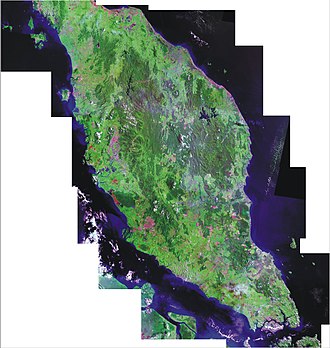
Pahang, officially called Pahang Darul Makmur, is a sultanate and a federal state of Malaysia. It is the third largest state in the country and the largest in Peninsular Malaysia. The state is shaped by the basin of the Pahang River and stretches along the east coast, reaching down to Endau. It shares borders with several other Malaysian states and is separated from the west coast by the Titiwangsa Mountains.
Pahang is home to many important places, including its capital Kuantan, the royal capital Pekan, and beautiful hill resorts like Genting Highlands and Cameron Highlands. The state's highest point is Mount Tahan, which stands at 2,187 metres tall.
For a long time, Pahang has been an important place for trade and settlement. Evidence shows that people lived there as far back as the Paleolithic age. Over the centuries, it developed into a trading state and later became part of various kingdoms, including the Malacca Sultanate and the Johor Sultanate. In modern times, Pahang has become a key area for manufacturing, agriculture, and mineral exports like iron ore and bauxite.
Etymology
The name Pahang might come from an old word for tin used by the Khmer people. Long ago, there were important tin mines in a place called Sungai Lembing. Because of this, some believe the state was named after the Khmer word for tin.
There are also many other ways people from different places wrote the name "Pahang" over time. For example, writers from China called it names like Phong-hong, Phenn-Khenn, or Pen-Heng. Travelers from Arab countries and Europe also had different ways to write the name, such as Pam, Pan, or Phang.
History
Pahang has a long and interesting history. Archaeological evidence shows that people lived in the area now known as Pahang as early as the Paleolithic period. Relics and tools from ancient times have been found in places like Sungai Lembing and Kuantan.
During the Hindu-Buddhist era, Pahang was an important region. Ancient settlements and ports were established along the Pahang River. The area was influenced by powerful kingdoms like Funan and Srivijaya. By the 14th century, Pahang had become an important kingdom in the southern part of the Malay Peninsula. It had strong ties with other regions and sent envoys to faraway lands.
The Old Pahang Sultanate was established in the 15th century. It became a major power in Southeast Asia, controlling much of the Pahang basin and parts of modern-day Selangor and Negeri Sembilan. The sultanate had a complex relationship with neighboring states and European powers like the Portuguese and Dutch.
In more recent times, Pahang became part of the Federated Malay States under British protection. During World War II, the state played a role in the resistance against Japanese occupation. After the war, Pahang joined the Federation of Malaya, which later became Malaysia in 1963.
Main article: Old Pahang Kingdom
Geography
Pahang is the third largest state in Malaysia and the largest in Peninsular Malaysia, covering an area of 35,965 km2. It features the vast Pahang River basin, surrounded by mountain ranges and highlands. The state includes dense jungles, central plains, and a long coastline with sandy beaches.
Pahang is rich in wildlife and natural beauty, home to two national parks, Taman Negara and Endau-Rompin, which shelter rare animals like tapirs, tigers, and elephants. The state also boasts high peaks such as Mount Tahan, the highest in Peninsular Malaysia, and popular hill resorts like Genting Highlands. Coastal areas include important towns and beautiful islands like Tioman Island.
Politics and government
See also: Malaysian State Assembly Representatives (2018-) § Pahang
Pahang is a constitutional monarchy, meaning its leader, the Sultan, shares power with elected leaders. The Sultan is also the head of Islam in the state. The current Sultan comes from a family that has ruled since the 1600s.
The state has its own government, led by a leader called the Menteri Besar, chosen from the group of elected representatives. People aged 21 and above can vote in elections every five years. The state works under Malaysia’s laws, which are based on English legal traditions. There are special courts for matters related to Islamic practices and family life for Muslims.
| Administrative divisions of Pahang | ||||||
|---|---|---|---|---|---|---|
| Number | Districts | Seat | Local government level | Mukim | Area (km2) | Population (2010) |
| 1 | Bera | Bandar Bera | District Council | Bera, Teriang | 2,214 | 93,084 |
| 2 | Bentong | Bentong | Municipality | Bentong, Sabai, Pelangai Autonomous sub-districts: Genting Highlands | 1,381 | 112,678 |
| 3 | Cameron Highlands | Tanah Rata | District Council | Hulu Telom, Ringlet, Tanah Rata | 712 | 37,147 |
| 4 | Jerantut | Jerantut | District Council | Bulau, Hulu Cheka, Hulu Tembeling, Kelola, Kuala Tembeling, Pedah, Pulau Tawar, Tebing Tinggi, Teh, Tembeling | 7,561 | 87,709 |
| 5 | Kuantan | Kuantan | City | Kuala Kuantan, Hulu Kuantan, Sungai Karang, Beserah, Hulu Lepar, Penor Autonomous sub-districts: Gebeng | 2,960 | 450,211 |
| 6 | Lipis | Kuala Lipis | District Council | Batu Yon, Budu, Cheka, Gua, Hulu Jelai, Kechau, Kuala Lipis, Penjom, Tanjung Besar, Telang Autonomous sub-districts: Jelai | 5,198 | 86,200 |
| 7 | Maran | Maran | District Council | Bukit Segumpal, Chenor, Kertau, Luit | 3,805 | 113,303 |
| 8 | Pekan | Pekan | Municipality | Bebar, Ganchong, Kuala Pahang, Langgar, Lepar, Pahang Tua, Pekan, Penyor, Pulau Manis, Pulau Rusa, Temai | 3,846 | 105,822 |
| 9 | Raub | Raub | District Council | Batu Talam, Dong, Gali, Hulu Dong, Sega, Semantan Hulu, Teras | 2,269 | 91,169 |
| 10 | Rompin | Kuala Rompin | District Council | Endau, Keratong, Pontian, Rompin, Tioman, Bebar Autonomous sub-districts: Bandar Muadzam Shah | 5,296 | 110,286 |
| 11 | Temerloh | Temerloh | Municipality | Bangau, Jenderak, Kerdau, Lebak, Lipat Kajang, Mentakab, Perak, Sanggang, Semantan, Songsang | 2,251 | 155,756 |
Economy
Pahang has a market-based economy that is growing and changing. The state government and the federal government work together to help the economy grow by attracting investments and creating new businesses and towns. From 1971 to 2000, the economy grew by about 5.6% each year. In 2016, the economy was worth about $12.4 billion, making up 4.5% of Malaysia's total economy.
Historically, Pahang was known for its gold and tin mines. Today, the economy is driven by three main areas: services, agriculture, and manufacturing. Services, like shopping and tourism, make up almost half of the economy. Agriculture includes farming products such as rubber, palm oil, and fish. Manufacturing involves making things like cars, wood products, and food items. Many new industrial areas are being built to help create jobs and attract businesses from around the world.
Main article: East Coast Economic Region
Gold mines
Bera
Jelai River
Raub
tin ore
Sungai Lembing
mining industry
quarrying
bauxite
ecotourism
agrarian economy
FELDA
FELCRA
Bandar Tun Razak
Maran District
sandalwood
damar
rattans
sustainable forestry
Fishery
Aquaculture
East Coast Economic Region
petrochemicals
automotive industry
Pekan
DefTech
Isuzu HICOM Malaysia
Mercedes-Benz
Suzuki
Kerteh
Infrastructure
Pahang's infrastructure is still developing compared to the west coast of Peninsular Malaysia. The government is investing a lot to improve roads, water, electricity, and internet access, especially in rural areas. In 2017, about $24.82 million was given to the state for development, and $958 million was allocated nationwide for public infrastructure improvements.
The state has almost full electricity coverage, with power coming mainly from a hydroelectric plant in Cameron Highlands. Water supply is managed by Pahang Water Management Berhad, with water coming from rivers and streams. There are many water treatment plants across the state.
Internet and mobile services are available, though they are less advanced than in other parts of Malaysia. The government has been working to improve broadband and mobile coverage, especially in rural and suburban areas. There are many Wi-Fi hotspots and community internet centers to help people get online.
Pahang has about 19,000 kilometers of roads, including highways that connect it to other states. The East Coast Expressway links the east coast to the west coast, and there is a new railway project called the East Coast Rail Link to improve travel and transport of goods. The main bus and airport hub is in Kuantan, which also has a seaport that is growing to support more trade.
Demography
Pahang is the third largest state in Malaysia and the largest in Peninsular Malaysia. As of the 2010 census, it had a population of about 1.5 million people, making it the ninth most populous state. The population is spread out, so it has fewer people per square kilometer compared to other states.
Most people in Pahang are young, with many children and teenagers. The state has more males than females. The majority of people are Malaysian citizens, and most are Malays, who play an important role in the state's culture and politics. There are also people of Chinese, Indian, and indigenous Orang Asli backgrounds living in Pahang. The main cities include Kuantan, Temerloh, Bentong, and Pekan.
| Year | Pop. | ±% |
|---|---|---|
| 1970 | 504,945 | — |
| 1980 | 768,801 | +52.3% |
| 1991 | 1,045,003 | +35.9% |
| 2000 | 1,229,104 | +17.6% |
| 2010 | 1,440,741 | +17.2% |
| 2020 | 2,064,384 | +43.3% |
| Source: | ||
| Ethnic Group | Population | |||
|---|---|---|---|---|
| 2010 | 2015 | |||
| Malay | 1,052,774 | 70.15% | 1,146,000 | 70.60% |
| Other Bumiputras | 73,413 | 4.89% | 83,800 | 5.16% |
| Bumiputra total | 1,126,187 | 75.04% | 1,229,800 | 75.76% |
| Chinese | 230,798 | 15.38% | 241,600 | 14.88% |
| Indian | 63,065 | 4.20% | 66,300 | 4.08% |
| Others | 6,159 | 0.41% | 7,800 | 0.480% |
| Malaysian total | 1,426,209 | 95,03% | 1,545,500 | 95.21% |
| Non-Malaysian | 74,608 | 4.97% | 77,700 | 4.79% |
| Total | 1,500,817 | 100.00% | 1,623,200 | 100.00% |
Culture
The culture of Pahang is shaped by its people, mainly the indigenous Malays and Orang Asli tribes. These groups have lived in the area for centuries, bringing their own traditions and languages. The region was influenced by Buddhism early on, and later became part of a Malay-Muslim Sultanate in 1470. This led many people to adopt Malay culture, including the language, dress, and religion.
Pahang is known for its traditional arts, such as carving, weaving, and silversmithing. The Malays created beautiful items like ornamental kris swords, beetle nut sets, and colorful batik and songket fabrics. A special style of silk weaving called Tenun Pahang is famous, and the state also has its own version of the long gown dress called Baju Kurung Pahang. Traditional music in Pahang uses drums and other percussion instruments, with many types of songs and dances performed for healing, storytelling, and celebration. Famous dances include Main Puteri, Saba, and Ugam, and the state also has its own style of gamelan music.
Pahang’s cuisine is rich and features a lot of seafood. Popular dishes include Gulai Tempoyak Patin, made from patin fish cooked in a special curry, and Laksa Pahang, a spicy noodle soup. Rice is the main staple, often served with gulai, ulam, and sambal. Other well-known dishes are Nasi Kebuli, Opor Daging, and Paceri Nenas.
The people of Pahang celebrate many holidays and festivals throughout the year. National holidays like Hari Merdeka (Independence Day) and Malaysia Day are observed, along with the birthdays of the Sultan of Pahang and the King. Muslim holidays such as Hari Raya Puasa and Hari Raya Haji are widely celebrated. Other groups also enjoy their own festivals, like Chinese New Year, Wesak Day, Deepavali, and Christmas. A special tradition called “open house” allows everyone to join in the celebrations of others.
Sports
Main article: Sport in Malaysia
Pahang has many sports activities thanks to its special committees and departments. The state works hard to create more athletes and improve sports skills. Popular sports in Pahang include football, badminton, and field hockey. The Royal Family supports polo, and the Royal Pahang Polo Club, founded in 1926, is one of the oldest in the country.
The state has several sports complexes and stadiums. Traditional martial arts like Silat Melayu are also practiced. With its long coastline and rivers, Pahang is great for water sports such as rafting, sailing, jet skiing, scuba diving, and surfing. Cherating beach is a famous spot for surfing, especially during the surf season from October to March.
Tourism
Further information: List of tourist attractions in Pahang
Tourism is very important for Pahang, making up about 26% of the state’s economy. In 2016, almost 13 million people visited Pahang, bringing in over RM7 billion. Many visitors came from Singapore, China, and Indonesia. Popular spots include Genting Highlands and Kuantan. Local Malaysians also enjoy places like Cameron Highlands, Genting Highlands, Teluk Cempedak, Gambang Water Park, and Cherating.
Pahang has many beautiful natural places to explore. You can visit beach towns such as Cherating, Batu Hitam, and Beserah. Tioman Island is a wonderful island with clear waters. For nature lovers, Mount Tahan is the highest peak in Peninsular Malaysia. Other great spots are Cameron Highlands with its tea plantations, Fraser's Hill for bird-watching, and Genting Highlands with its cool weather and fun parks. Taman Negara has one of the oldest rainforests in the world, and there are many lakes, waterfalls, and wildlife reserves to discover.
- Tourist attractions in Pahang
[Cameron Highlands](/wiki/Cameron_Highlands)
Salang Bay, [Tioman Island](/wiki/Tioman_Island)
[Sungai Pandan Waterfall](/wiki/Sungai_Pandan_Waterfall)
[Genting Highlands](/wiki/Genting_Highlands)
Pictures
Keep exploring


This article is a child-friendly adaptation of the Wikipedia article on Pahang, available under CC BY-SA 4.0.
Images from Wikimedia Commons. Tap any image to view credits and license.