 Safekipedia
Religion in Italy
Adapted from Wikipedia · Discoverer experience
Religion in Italy has a rich and long history, shaped mostly by the Catholic Church, which is the biggest part of Christianity. This connection dates back many years and is strong because of Rome's special role. The Vatican, where the Pope lives, is located inside Italy, making the country very important to many Christians around the world.
In recent years, Italy has seen more kinds of religions because of people moving in from other places. Today, besides Catholics, there are communities of Muslims, Eastern Orthodox Christians, Protestants, Buddhists, Hindus, and Jews. This mixing of beliefs makes the religious life in Italy more varied and interesting. Even though many people still identify as Catholic, a growing number say they have no religion, showing how views are changing over time.
Overview
The 2012 Global Religious Landscape survey by the Pew Forum on Religion and Public Life found that most people in Italy were Christians, with many also not having any religious beliefs. By 2016, around 82% of Italy’s people were linked to the Catholic Church. More recent surveys show this number has dropped a bit, with about 68% of people in Italy identifying as Christian today.
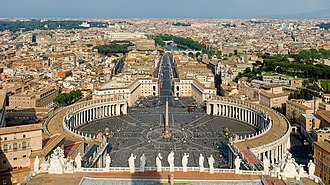
Italy has a special connection to the Catholic Church because the Pope, its leader, lives in Vatican City, a small area inside Rome. Many important Catholic groups also have their main offices in Rome. Besides Catholics, Italy has many other religious groups now, including Muslims, Orthodox Christians, Protestants, Buddhists, and Hindus, mostly because of people moving to Italy from other countries.
Demography
The religious makeup of Italy's people in 2023 shows that most Italians are Catholic Christians. This number comes from surveys and data from groups that study religion.
Because it's hard to get exact numbers, these figures are just estimates. The table below includes many groups, even some without complete data.
Religious practice
In Italy, many people still go to church compared to other countries in Western Europe. A survey in 2017 found that 58% of Italians think religion is important to them. Italy had more people who practice their religion than those who do not, which is unusual for Europe. However, the number of people who practice their religion has been going down since 2001.
Only about 19% of Italians say they regularly practice their religion, according to official data. This means fewer people are going to church as often as before. In 2015, about 29% of people went to a place of worship every week. Some parts of Italy, like Southern Italy, had more people going to church than others. Places such as Sicily and Campania had higher numbers, while areas like Liguria and Tuscany had fewer people attending services.
Religion and politics
Further information: List of Italian religious minority politicians
After Italy became one country, most Catholics stayed out of politics. The main political groups were not based on religion until the early 1900s.
In 1905, a group called the Italian Catholic Electoral Union was created to help Catholic voters. In 1913, it joined with the Liberal party. After World War I, Catholics started the Italian People's Party.
During the time of Fascist rule in Italy, an agreement called the Lateran Treaty was made in 1929 between the Italian government and the Vatican. This created Vatican City as its own country.
After World War II, a new party called Christian Democracy was formed. It was inspired by Catholic ideas but was not officially a religious party. This party was very important in Italian politics for many years. Different religious groups, including Waldensians and Jews, have also been active in various political parties in Italy.
Freedom of religion
See also: Freedom of religion in Italy
Italy's laws allow people to follow any religion they choose. The Constitution of Italy says that the Catholic Church and the government are separate but both important. Even though Catholicism is no longer the official religion of Italy, it still has special agreements with the government.
Many other religions, like Jewish, Buddhist, Hindu, and Christian groups, also have agreements with Italy. These agreements help these groups organize and get some support from the government. People in Italy can choose to give a small part of their taxes to support a religion or to help government programs instead. In 2021, most people chose to support the Catholic Church, but many also supported other groups. Italy is known for having strong religious freedom.
Images
Related articles




This article is a child-friendly adaptation of the Wikipedia article on Religion in Italy, available under CC BY-SA 4.0.
Images from Wikimedia Commons. Tap any image to view credits and license.