 Safekipedia
Richard Dedekind
Adapted from Wikipedia · Discoverer experience
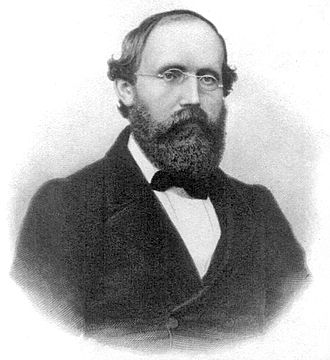
Julius Wilhelm Richard Dedekind was a German mathematician who lived from 1831 to 1916. He made big steps in understanding numbers and math rules. One of his most famous ideas was a new way to define real numbers using something called a Dedekind cut.
Dedekind helped shape number theory, a part of math about numbers and their properties. He also worked on abstract algebra, especially an area called ring theory, and helped lay the groundwork for set theory, which studies collections of objects.
His work touched on the basic ideas behind arithmetic, helping to build a strong foundation for how we understand math today. Because of these contributions, Dedekind is remembered as an important thinker in the history of mathematics.
Life
Richard Dedekind was born on October 6, 1831, in Braunschweig, a city in Germany. His father worked at a school called Collegium Carolinum, and his mother was the daughter of a professor at the same school. Richard grew up with three older siblings and spent most of his life in Braunschweig, where he eventually passed away.
Dedekind started his education at Collegium Carolinum and later went to the University of Göttingen. There, he studied number theory with a professor named Moritz Stern and was the last student of the famous mathematician Gauss. He finished his studies in 1852 with a thesis about Eulerian integrals. He then studied in Berlin for two years with another famous mathematician, Bernhard Riemann. Dedekind returned to Göttingen to teach and became a close friend of Peter Gustav Lejeune Dirichlet. He also began teaching at a school in Zürich before returning to Braunschweig to teach at a technical institute. He retired in 1894 but kept publishing work for many years. Dedekind never married and lived with his sister Julia. He was honored by many academies and universities for his contributions to mathematics.
Collegium Carolinum Braunschweig Main Cemetery University of Göttingen number theory Moritz Stern Gauss Eulerian integrals University of Berlin Bernhard Riemann habilitation Privatdozent probability geometry Peter Gustav Lejeune Dirichlet elliptic abelian functions Galois theory groups algebra arithmetic Polytechnic Zürich Technische Hochschule French Academy of Sciences Oslo Zurich
Work
While teaching calculus, Richard Dedekind created a way to define real numbers using a method called the Dedekind cut. This method shows that every number, whether it is a simple counting number or a more complex number, fits perfectly on the number line with no gaps.
Dedekind also helped define what makes a set of numbers infinite. He showed that a set is infinite if it can match up perfectly with a smaller part of itself. His ideas were important for later work in math, especially in areas studied by Georg Cantor. Dedekind also worked on organizing the writings of other famous mathematicians and made key contributions to the study of number theory and algebra.
Related articles



This article is a child-friendly adaptation of the Wikipedia article on Richard Dedekind, available under CC BY-SA 4.0.
Images from Wikimedia Commons. Tap any image to view credits and license.