 Safekipedia
Sagittarius A*
Adapted from Wikipedia · Discoverer experience
Sagittarius A*, abbreviated as Sgr A*, is the supermassive black hole at the center of the Milky Way. It is located near the border of the constellations Sagittarius and Scorpius, close to the Butterfly Cluster and Lambda Scorpii. This black hole is a bright and very compact astronomical radio source.
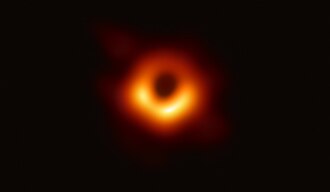
In May 2022, astronomers released the first image of the accretion disk around the event horizon of Sagittarius A* using the Event Horizon Telescope, a worldwide network of radio observatories. This was the second confirmed image of a black hole, after Messier 87's supermassive black hole in 2019. The black hole itself cannot be seen because light cannot escape its strong gravity, but we can observe nearby objects affected by it.
Sgr A* was discovered in 1974 by Bruce Balick and Robert L. Brown. The asterisk in its name was added in 1982 to show that the strongest radio emission from the galaxy's center comes from a compact object within a larger radio source called Sagittarius A.
By watching stars orbit Sagittarius A*, especially star S2, scientists have calculated the black hole's mass. The best estimate is about 4.3 million times the mass of the Sun.
Reinhard Genzel and Andrea Ghez won a share of the 2020 Nobel Prize in Physics for proving that Sagittarius A* is a supermassive compact object, which can only be explained by a black hole. Sir Roger Penrose also shared the prize for showing that black holes are a natural prediction of the general theory of relativity.
Observation and description
On May 12, 2022, the first picture of Sagittarius A* was shared by the Event Horizon Telescope Collaboration. This picture shows that the object is a black hole. It was the second black hole ever pictured and took five years to prepare. Data for the picture came from eight radio telescopes in different places around the world.
The picture shows that Sagittarius A* is very small, about 51.8 million kilometers wide. For comparison, Earth is about 150 million kilometers from the Sun. The picture also helped scientists check a famous theory about space and time, and the results matched perfectly.
In 2019, special tools on an airplane found that magnetic forces pull gas and dust around Sagittarius A*, which helps keep its brightness low. We cannot see Sagittarius A* with normal light because dust and gas block the view from Earth.
History
In April 1933, Karl Jansky discovered that radio signals were coming from the direction of the constellation Sagittarius, towards the center of the Milky Way. This radio source was later named Sagittarius A.
Further observations showed that Sagittarius A has several parts. In February 1974, astronomers found a very bright and compact part called Sgr A*. Since the 1980s, scientists have believed that the central part of Sgr A* is likely a black hole. Studies of stars moving around Sgr A* have provided strong evidence for this.
In 2002, scientists observed the motion of a star named S2 near Sgr A* over ten years. This helped confirm that Sgr A* is a massive black hole. More recent observations continue to study the area around Sgr A* and its mysterious features.
Central black hole
In October 2018, scientists announced they had found strong proof that Sagittarius A* is a black hole. They used special tools to watch gas moving very fast near the black hole. The gas moved at about 30% of the speed of light, and they saw bright flashes of light that match what we expect from a black hole.
Astronomers also watched a star called S2 as it zoomed around the black hole at amazing speeds. The star’s movement matched what Einstein’s theories predict, showing that black holes really do bend space and time.
Orbiting stars
There are several stars that move very close to Sagittarius A*, called "S stars". We can see these stars best using infrared light because dust in space blocks regular visible light. These stars move very fast and very close to the black hole, which helps scientists learn more about its size and how space behaves near it.
As of 2020, a star named S4714 gets closer to Sagittarius A* than any other known star, coming about as close as Saturn gets to the Sun. It travels at about 8% of the speed of light and takes 12 years to complete its orbit around the black hole.
| id1 | id2 | a | e | i (°) | Ω (°) | ω (°) | Tp (yr) | P (yr) | Kmag | q (AU) | v (%c) |
|---|---|---|---|---|---|---|---|---|---|---|---|
| S1 | S0-1 | 0.5950 | 0.5560 | 119.14 | 342.04 | 122.30 | 2001.800 | 166.0 | 14.70 | 2160.7 | 0.55 |
| S2 | S0-2 | 0.1251 | 0.8843 | 133.91 | 228.07 | 66.25 | 2018.379 | 16.1 | 13.95 | 118.4 | 2.56 |
| S8 | S0-4 | 0.4047 | 0.8031 | 74.37 | 315.43 | 346.70 | 1983.640 | 92.9 | 14.50 | 651.7 | 1.07 |
| S12 | S0-19 | 0.2987 | 0.8883 | 33.56 | 230.10 | 317.90 | 1995.590 | 58.9 | 15.50 | 272.9 | 1.69 |
| S13 | S0-20 | 0.2641 | 0.4250 | 24.70 | 74.50 | 245.20 | 2004.860 | 49.0 | 15.80 | 1242.0 | 0.69 |
| S14 | S0-16 | 0.2863 | 0.9761 | 100.59 | 226.38 | 334.59 | 2000.120 | 55.3 | 15.70 | 56.0 | 3.83 |
| S4714 | 0.102 | 0.985 | 127.7 | 129.28 | 357.25 | 2017.29 | 12.0 | 17.7 | 12.6 | 8.0 |
Discovery of G2 gas cloud on an accretion course
In 2002, astronomers noticed something unusual near the center of the Milky Way. This was a cloud of gas, named G2, about three times the size of Earth. In 2012, scientists shared their idea that G2 might be moving toward a giant black hole called Sagittarius A*.
They thought G2 would get very close to the black hole in early 2014. Some believed the black hole might break the cloud apart, making it glow very brightly. Others thought G2 might actually be a star or two stars stuck together, which would keep it safe.
Many telescopes watched what would happen. But when G2 got close to the black hole, nothing big happened. The cloud stayed whole, and scientists realized it might be part of a larger stream of gas, not just a single cloud. Some even thought G2 could be two stars that merged together.
Images
Related articles


This article is a child-friendly adaptation of the Wikipedia article on Sagittarius A*, available under CC BY-SA 4.0.
Images from Wikimedia Commons. Tap any image to view credits and license.