
Space Race
The Space Race was an exciting competition between the United States and the Soviet Union during the Cold War. It began as both countries tried to show they had better technology for launching rockets and exploring space. This race started when the United States said it would launch satellites for a special year of science, and the Soviet Union quickly said they would do the same.
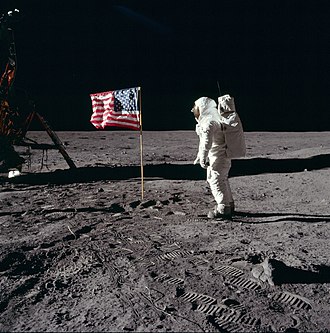
The competition grew when the Soviet Union launched the first satellite, Sputnik 1, in 1957, and then sent the first human, Yuri Gagarin, into space in 1961. In response, the United States set a big goal to land a person on the Moon. This happened in 1969 when the Apollo 11 astronauts walked on the Moon. Even though the Soviet Union tried to reach the Moon first, they focused on other projects like building space stations and exploring other planets.
Over time, the two countries began working together more. They met in space in 1975 and later joined forces to build the International Space Station. The Space Race showed how much people wanted to explore the stars and pushed technology to new heights.
Origins
Before World War II, scientists in Germany, the Americans, and the Soviets tested small rockets that used liquid fuel. But to send people and satellites into space, much bigger rockets were needed. These bigger rockets were based on missiles designed during the war to carry bombs very far.
After the war, both the United States and the Soviet Union took control of German rocket technology and used it to build their own powerful missiles.
Interest in space travel grew in October 1951 when a Soviet engineer named Mikhail Tikhonravov wrote an article for young readers called "Flight to the Moon." He talked about future spaceships and the technology needed to build them. In 1952, a U.S. magazine called Collier's published a series of articles about plans for space travel. In 1955, a TV show called "Man in Space" from Disneyland excited millions of viewers about the idea of space travel.
Missile race
Main article: Intercontinental ballistic missile
After World War II, the United States and the Soviet Union became rivals in a conflict called the Cold War. In 1949, the Soviet Union tested its first nuclear bomb. In 1957, they tested the world's first intercontinental ballistic missile (ICBM), which could carry a nuclear bomb across the ocean to the United States. This caused worry in the U.S., who called it the 'missile gap'. The U.S. tested its first ICBM, the Atlas missile, in 1958.
ICBMs could strike targets across the world very quickly and could not be stopped by air defenses. This made them very important in the nuclear arms race.
Soviet rocket development
Further information: Soviet rocketry and Soviet space program
In the 1920s, the Soviet Union began experimenting with rockets. In the 1930s, a group of Soviet scientists started building liquid-fuel rockets. But progress slowed during a tough time in the 1930s.
After World War II, the Soviets captured German rocket technology and scientists. They built their own version of a German rocket called the R-1, which entered service in 1950. They continued to improve their rockets, creating new versions with longer ranges. In 1957, they built the R-7 Semyorka, the world's first intercontinental ballistic missile. Two months later, this same rocket launched Sputnik 1, the first artificial satellite into space.
American rocket development
Although an American scientist named Robert H. Goddard built small rockets as early as 1914, the United States did not have its own rocket program during World War II. After the war, the U.S. brought German scientists and rockets to America. They tested these rockets and began building their own.
In 1950, the German rocket team moved to Huntsville, Alabama, where they developed the Redstone rocket. This rocket was used to launch America's first satellite and the first Mercury space missions. The U.S. Air Force also developed the Atlas missile, which became America's first successful ICBM. A version of the Atlas rocket was used to launch Project Mercury and Project Gemini missions.
ICBM capability, satellites, lunar probes (1955–1960)
The years from 1955 to 1960 marked important first steps in space exploration. Both the United States and the Soviet Union launched the first artificial satellites into orbit around Earth. They also sent animals into space and launched the first robotic probes toward the Moon.
During this time, both countries were building missiles that could launch objects into space. This created competition between them. In 1955, the United States announced plans to launch small satellites as part of an international science project. Soon after, the Soviet Union also announced its plans to launch a satellite.
The Soviet Union kept many details about its space program secret. They did not reveal who built their satellites or exactly when they would launch. This secrecy made it hard for others to know exactly what the Soviet Union was doing in space.
When the Soviet Union launched its first satellite, Sputnik 1, on October 4, 1957, it surprised the world. The United States responded with concern and quickly tried to catch up. The United States launched its first successful satellite, Explorer 1, in January 1958. This satellite helped discover a radiation belt around Earth, now called the Van Allen belt.
Both countries also sent animals into space to test if it was safe for humans. The Soviet Union sent the first animal, a dog named Laika, into orbit in 1957. The United States sent monkeys and apes on earlier suborbital flights.
The Soviet Union also began sending probes to the Moon. Their Luna program achieved the first impact on the Moon in 1959 and the first pictures of the Moon’s far side later that same year. The United States started its Pioneer program around the same time, with mixed results in early attempts to reach the Moon.
Human spaceflight, space treaties, interplanetary probes (1961–1968)
The period from 1961 to 1968 began with the first people sent to space and the first robotic explorations of other planets. Missions to Venus and Mars were conducted by both the Soviet Union and the United States, along with robotic landings on the Moon. The 1960s saw big advances in trips into space by both Cold War competitors, as well as the first nuclear explosion in space, research into ways to stop satellites, and the signing of important international treaties about space.
First humans in space
Vostok
The Soviets built their first human space capsule using the same design as their spy satellite, keeping the details secret until after the Vostok program ended. On April 12, 1961, the USSR surprised the world by launching Yuri Gagarin into a single orbit around the Earth in a craft called Vostok 1. Gagarin became a hero in the Soviet Union and around the world. The USSR later launched two piloted spacecraft, Vostok 3 and Vostok 4, in 1962, and the first woman, Valentina Tereshkova, in 1963.
Mercury
The US developed a program to launch the first man in space, called Project Mercury. The Mercury spacecraft was designed for single astronauts and made its first suborbital flight with Alan Shepard in 1961. John Glenn became the first American to orbit the Earth in 1962. The United States launched three more Mercury flights after Glenn’s mission.
Kennedy aims for a crewed Moon landing
Before Gagarin’s flight, US President John F. Kennedy’s support for America’s space program was not strong. However, Gagarin’s flight changed this. Kennedy decided the United States should commit to landing a man on the Moon before the end of the 1960s. He asked Congress for support and made speeches to rally the country behind this goal.
Lunar probes and robotic landers
The Ranger program, started in 1959 by NASA, aimed to crash into the Moon and send back data. The first successful mission was Ranger 7 in 1964. The Soviet Union’s Luna program had successes too, with Luna 9 achieving the first soft landing on the Moon in 1966. NASA also conducted the Surveyor program, which made successful soft landings on the Moon from 1966 to 1968.
First interplanetary probes
Both the United States and the Soviet Union began programs to reach other planets, especially Venus and Mars, in the early 1960s. NASA’s Mariner program had its first success with Mariner 2 flying by Venus in 1962. The Soviet Union’s Venera program also had early attempts to reach Venus.
First crewed spacecraft
The United States announced Project Gemini in 1962, a two-person spacecraft to support the later three-person Apollo mission. The Soviet Union planned to use the Vostok spacecraft for longer missions but faced challenges. They converted some Vostok capsules into Voskhod spacecraft, which allowed for the first spaceflight with a three-person crew and the first spacewalk in 1964 and 1965 respectively.
Outer space treaties
The US and USSR began discussions on the peaceful uses of space as early as 1958, presenting issues for debate to the United Nations, which created a Committee on the Peaceful Uses of Outer Space in 1959.
On May 10, 1962, Vice President Johnson revealed that the United States and the USSR both supported a resolution passed by the Political Committee of the UN General Assembly in December 1962, which not only urged member nations to "extend the rules of international law to outer space," but to also cooperate in its exploration.
In 1963, the Partial Nuclear Test Ban Treaty was signed by more than 100 signatories, including both the United States and the Soviet Union.
The UN ultimately created a Treaty on Principles Governing the Activities of States in the Exploration and Use of Outer Space, including the Moon and Other Celestial Bodies, which was signed by the United States, the USSR, and the United Kingdom on January 27, 1967, and came into force the following October 10.
This treaty:
- bars party States from placing weapons of mass destruction in Earth orbit, on the Moon, or any other celestial body;
- exclusively limits the use of the Moon and other celestial bodies to peaceful purposes;
- declares that the exploration of outer space shall be done to benefit all countries;
- explicitly forbids any government from claiming a celestial resource such as the Moon or a planet;
- holds any State liable for damages caused by their space object; and
- declares that activities of non-governmental entities in outer space shall require authorization and continuing supervision by the appropriate State Party to the Treaty.
The treaty remains in force, signed by 107 member states.
Disaster strikes both sides
In 1967, both nations’ space programs faced serious challenges that brought them to temporary halts.
Apollo 1
On January 27, 1967, the crew of the first crewed Apollo mission were killed in a fire that swept through their spacecraft cabin during a ground test, less than a month before the planned February 21 launch.
Soyuz 1
On April 24, 1967, the single pilot of Soyuz 1 became the first in-flight spaceflight fatality. The mission was aborted, Soyuz 1 fired its retrorockets and reentered the Earth's atmosphere. During the emergency re-entry, a fault in the landing parachute system caused the primary chute to fail, and the reserve chute became tangled with the drogue chute. Shortly thereafter, Soyuz 1 impacted the ground west of Karabutak, and was found on fire.
Both programs recover
The United States recovered from the Apollo 1 fire, fixing the fatal flaws in an improved version of the Block II command module. The US proceeded with unpiloted test launches of the Saturn V launch vehicle and the Lunar Module during the latter half of 1967 and early 1968.
The Soviet Union also fixed the parachute and control problems with Soyuz, and the next piloted mission Soyuz 3 was launched on October 26, 1968.
The Soviet Zond spacecraft was not yet ready for piloted circumlunar missions in 1968, after six unsuccessful automated test launches. Zond 4 was launched on March 2, 1968, and successfully made a circumlunar flight, but encountered problems with its Earth reentry on March 9, and was ordered destroyed by an explosive charge over the Gulf of Guinea.
During the summer of 1968, the Apollo program hit another snag: the first pilot-rated Lunar Module (LM) was not ready for orbital tests in time for a December 1968 launch. NASA planners overcame this challenge by changing the mission flight order, delaying the first LM flight until March 1969, and sending Apollo 8 into lunar orbit without the LM in December. This mission was in part motivated by intelligence rumors the Soviet Union might be ready for a piloted Zond flight in late 1968. In September 1968, Zond 5 made a circumlunar flight with tortoises on board and returned safely to Earth, accomplishing the first successful water landing of the Soviet space program in the Indian Ocean.
On December 21, 1968, Frank Borman, James Lovell, and William Anders became the first humans to ride the Saturn V rocket into space, on Apollo 8. They also became the first to leave low-Earth orbit and go to another celestial body, entering lunar orbit on December 24. Apollo 8 safely landed in the Pacific Ocean on December 27, in NASA's first dawn splashdown and recovery.
The American Lunar Module was finally ready for a successful piloted test flight in low Earth orbit on Apollo 9 in March 1969. The next mission, Apollo 10, conducted a "dress rehearsal" for the first landing in May 1969, flying the LM in lunar orbit as close as 47,400 feet above the surface.
Men on the Moon, space stations, space shuttles (1969–1991)
The space race between the United States and the Soviet Union included many big achievements. The United States landed the first people on the Moon. The Soviet Union created the first space stations and sent the first robots to land on Venus and Mars. The United States developed space shuttles, which were the first reusable spacecraft. There was also a time when a Soviet and an American spaceship connected in space, marking a moment of cooperation.
First humans on the Moon
Apollo 11 was the mission that first landed humans on the Moon. The crew included Neil Armstrong, Michael Collins, and Edwin "Buzz" Aldrin. They launched on July 16, 1969. After traveling for three days, Armstrong and Aldrin landed on the Moon while Collins stayed in orbit. Armstrong became the first person to step onto the Moon, followed by Aldrin. They spent about two hours on the surface before returning to Earth. Their successful mission showed that the United States had won the race to the Moon.
Post-Apollo NASA: Shifting goals and budget cuts
After the Moon landings, NASA had big plans for future space missions, but money became a problem. They had to cut back on some projects. The space station plans were changed, and some Moon landings that were planned did not happen. The Apollo program ended in 1972 after the last Moon landing. The Soviet Union also tried to build a big rocket for Moon missions but stopped trying in 1974.
Soviet Lunar sample return and robotic rovers
The Soviet Union sent robots to the Moon that brought back samples of Moon rock. They also landed the first robotic rover on the Moon in 1970, which drove around and sent back information.
Salyut and Skylab
The Soviet Union focused on building space stations after the Moon race. They launched several stations called Salyut. The United States launched one station called Skylab. These stations helped scientists learn about living and working in space for longer periods.
Venus and Mars robotic landings
The Soviet Union sent many robots to Venus and Mars. One robot, Venera 7, was the first to send data back from the surface of Venus. For Mars, the Soviet Union tried to land robots, but most of them had problems. NASA later sent successful robots to Mars that took many pictures and tested the soil.
Apollo–Soyuz Test Project
In 1975, the United States and the Soviet Union worked together on a mission called the Apollo–Soyuz Test Project. An American Apollo spaceship and a Soviet Soyuz spaceship connected in space. The astronauts and cosmonauts visited each other's ships and did experiments together.
Space Shuttles
NASA developed the Space Shuttle, which could fly into space and land like a plane. The first test flight was in 1981. The shuttles made many trips into space but had some accidents. The Soviet Union tried to make their own shuttle called Buran but only tested it once before stopping.
First women in space
The first woman to fly in space was from the Soviet Union, Valentina Tereshkova. NASA started including women astronauts in 1978, with Sally Ride becoming the first American woman in space in 1983.
First modular space station
The Soviet Union built a big space station called Mir, which was put together in pieces over several years. It stayed in orbit from 1986 to 2001 and was home to many astronauts from different countries.
Analysis and reception
"Winner" of the Space Race
There has been much discussion about who won the Space Race. Many believe the United States won because of the Apollo missions, where astronauts landed on the Moon and returned safely to Earth in 1969. This big achievement was the goal set by President John F. Kennedy and was seen as the top moment of the Space Race.
Some historians think the Soviet Union did very well in many smaller but important firsts, like being the first to send a craft to hit the Moon, take pictures of the Moon’s far side, land softly on the Moon, and orbit the Moon. Even though the United States is remembered for the Moon landing, the Soviet Union was ahead in these early steps of space exploration.
Historians' analysis
The Space Race was tied to the rivalry between the United States and the Soviet Union during the Cold War. It showed off each country’s technology and ideas. The United States focused on openness and democratic values, while the Soviet Union showed what its government-led system could do. The rivalry was more than just one big event; it included many achievements by both sides in exploring space.
Legacy
After the Cold War ended in 1991, the space program of the Soviet Union was taken over by Russia. Since then, the United States and Russia have worked together in space, such as through the Shuttle-Mir Program and the International Space Station. Russia still uses its R-7 rocket family to launch crew and cargo to the space station.
In 2023, Russia restarted missions to the Moon with Luna 25, 47 years after Luna 24. The United States also showed new interest in the Moon with its Artemis program, starting with Artemis I in 2022. This renewed interest is part of what some call the New Space Race.
Pictures
Keep exploring




This article is a child-friendly adaptation of the Wikipedia article on Space Race, available under CC BY-SA 4.0.
Images from Wikimedia Commons. Tap any image to view credits and license.