Starlink
Starlink is a telecommunications company owned by the American spaceflight company SpaceX. It provides internet service in about 160 countries and territories, and it also aims to offer mobile broadband around the world. This article is about the SpaceX satellite internet service. For other uses, see Starlink (disambiguation).
SpaceX began launching Starlink satellites in 2019. As of June 2026, the network had about 10,413 satellites, and 10,397 of them were working. They orbit in low Earth orbit (LEO), close to the Earth. They send signals to user devices and to ground stations, which connect the satellites to the internet on the ground. Starlink also offers in-flight internet access for many airlines. It makes up about 75% of all active satellites in Earth orbit that can move and steer themselves, and it had more than 12 million subscribers as of June 2026.
In May 2018, SpaceX estimated that building and launching the network would cost at least US$10 billion. By the end of 2025, Starlink had become SpaceX's largest business, earning $11.4 billion in revenue and $4.4 billion in operating income.
Starlink is used for more than home and travel internet. Governments and militaries also use it for communication, including notably in the Russo-Ukrainian war. Some astronomers have criticized its large group of satellites for adding to light pollution and making it more crowded in orbit.
History
Ideas for groups of low Earth orbit (LEO) satellites began in the mid-1980s as part of the United States Strategic Defense Initiative, which led to Brilliant Pebbles, a plan to place weapons in low orbits to hit ballistic missiles quickly. In the 1990s, the idea of low-latency communication led to commercial systems such as Celestri, Iridium, and Globalstar, which used fewer than 100 satellites. Teledesic planned an "Internet in the Sky" with 840 satellites, but Iridium and Globalstar went bankrupt, and Teledesic shut down voluntarily after money problems following the dot-com bubble burst. In 2004, SpaceX bought a 10% stake in Surrey Satellite Technology (SSTL), which was sold back to EADS Astrium in 2008. In 2014, Elon Musk and Greg Wyler discussed a constellation called WorldVu, but those talks ended in June 2014. SpaceX then filed with the International Telecommunication Union (ITU) through the Norwegian Communications Authority under the name STEAM, and confirmed the connection in a 2016 application to the Federal Communications Commission (FCC). The name Starlink was inspired by the novel The Fault in Our Stars.
Starlink was announced in January 2015 when a satellite development facility opened in Redmond, Washington. Musk said there was strong demand for low-cost broadband, and that Starlink would aim to carry bandwidth for up to 50% of backhaul traffic and up to 10% of local Internet traffic in crowded cities. He also said income from satellite internet would help pay for SpaceX's Mars plans. The company's work spread to research and development space in Irvine, California, which included signal processing, radio-frequency integrated circuit (RFIC), and application-specific integrated circuit (ASIC) work. In November 2016, SpaceX applied to the FCC for a "non-geostationary orbit (NGSO) satellite system in the fixed-satellite service using the Ku- and Ka- frequency bands," and the FCC granted a license in September 2017. SpaceX also planned to manage space debris by moving satellites to a safe orbit at the end of their lives, a process called de-orbit. In March 2018, the FCC approved the first 4,425 satellites, and it supported a request from NASA for even higher de-orbiting reliability. The first 60 operational satellites launched on May 24, 2019. By October 2020, a wider public beta test had begun, with testers reporting speeds over 150 Mbit/s. Earlier, invitees had to sign non-disclosure agreements. Pre-orders opened in the United States and Canada in early 2021. The FCC later revoked $885.5 million in RDOF subsidies in 2022, and SpaceX announced the Starlink Business service that year. Production was delayed by the 2020–2023 global chip shortage. In December 2022, the FCC approved 7,500 second-generation satellites in orbital shells at a set altitude, and SpaceX stopped planning certain V-band satellites. Later designs used a smaller form factor, and the larger satellites needed Starship to launch. In November 2024, SpaceX proposed a Mars network called "Marslink." Political concerns also arose, including a 2025 White House terminal installed by DOGE that raised conflict of interest questions, and a protest in the U.K. over Musk's involvement in politics.
Brazil's telecom regulator Anatel threatened to sanction Starlink in 2024, after Brazil's top court upheld a ban on X, and a judge, Alexandre de Moraes, froze Starlink's accounts. In 2024, The Wall Street Journal reported that Musk had been in regular contact with Vladimir Putin since late 2022. In 2024, SpaceX also asked its Taiwanese suppliers to move production abroad, which caused anger in Taiwan. Starting in July 2024, SpaceX ran tests with the Ministry of National Defense in Romania and ANCOM to see whether a rule set by the International Telecommunication Union in the 1990s could be changed. In February 2025, Starlink was part of an investigation by USAID. In May 2025, after the Trump administration... tariffs were launched, the State Department pushed countries to approve American satellite companies, including Starlink.
Services
Starlink sends internet from satellites to remote areas and also competes with other internet providers in towns and cities. It offers mobile service for recreational vehicles, ships, and aircraft. Speed and delay depend on how busy the network is, the location, and the service plan. Starlink's satellites orbit close to Earth, so delays are usually shorter than with older satellite internet. Prices differ by country and plan. Since 2023, non-business users have had a monthly 1 TB data cap, and throttling allegedly began after 5 TB of use in September 2026. A subscriber is one active service line, which is usually one internet account linked to one terminal, even if several people use it.
Starlink also offers direct-to-cell service, which connects to ordinary mobile phones without special equipment. The service has limited capacity. In the United States, T-Mobile US and SpaceX launched the first version, starting with SMS text messages. Other companies have also made agreements, including Rogers Communications in Canada, One NZ in New Zealand, Optus in Australia, and Kyivstar in Ukraine. In December 2022, SpaceX announced Starshield, a separate Starlink-based service for government and military customers, including the U.S. Department of Defense.
Main article: SpaceX Starshield
| Year | Approx. Subscribers | ARPU |
|---|---|---|
| February 2021 | 10,000 | |
| June 2021 | 100,000 | |
| November 2021 | 140,000 | |
| February 2022 | 250,000 | |
| June 2022 | 500,000 | |
| September 2022 | 700,000 | |
| December 2022 | 1,000,000 | |
| May 2023 | 1,500,000 | |
| September 2023 | 2,000,000 | |
| December 2023 | 2,300,000 | $99 |
| March 2024 | 2,600,000 | |
| May 2024 | 3,000,000 | |
| September 2024 | 4,000,000 | |
| December 2024 | 4,400,000 | $91 |
| March 2025 | 5,000,000 | $86 |
| June 2025 | 6,000,000 | |
| August 2025 | 7,000,000 | |
| November 2025 | 8,000,000 | |
| December 2025 | 8,900,000 | $81 |
| March 2026 | 10,300,000 | $66 |
| June 2026 | 12,000,000 |
Applications
SpaceX also designs, builds, and launches customized military satellites based on variants of the Starlink satellite bus. Its largest publicly known customer is the Space Development Agency, which works on missile defense using low-cost low Earth orbit satellites. In 2020, SpaceX received an initial $150 million dual-use contract, and its first satellites launched in April 2023 as part of the National Defense Space Architecture of the U.S. Space Force. That year, SpaceX also hired retired general Terrence J. O'Shaughnessy, who had earlier spoken to the United States Senate Committee on Armed Services about using machine learning and artificial intelligence. Starlink has been tested for military communication by the Air Force Research Laboratory on a Beechcraft C-12 Huron, by the United States Air Force on an AC-130 Gunship, and in 2020 with a connection to the Boeing KC-135 Stratotanker. Some experts say its narrow beams make it harder to jam than satellites in higher orbits. In 2022, Chinese military researchers wrote about destroying Starlink if it threatened national security, pointing to Starlink military capabilities, and Russian officials including Dmitry Rogozin criticized it. After Ukraine used Starlink to guide drones and missiles toward targets in Russia, Russia developed a system called Volna Kupol Garant to temporarily block Starlink signals. Starlink was activated during the Russian invasion of Ukraine after a request from the Ukrainian government, and Ukraine's military and government quickly came to depend on it for Internet access. It is used for combat drones, naval drones, and artillery coordination, and the United States Department of Defense later signed a contract to finance its use in Ukraine.
After the Gaza war began in October 2023, users asked Elon Musk on X (formerly Twitter) to activate Starlink there. Musk said it would be provided for aid groups in Gaza, but later said it would only be provided with the approval of Israel's government. The Global Initiative Against Transnational Organized Crime reported that jihadist groups such as Jama'at Nasr al-Islam wal-Muslimin and Islamic State – West Africa Province used an illicit supply chain to get Starlink devices, making it harder for governments to intercept their plans. In response, Niger and Chad moved to legalize Starlink and require device registration. Starlink has also been used by the Azawad Liberation Front (FLA) and the armed forces of Mali, and it helped the FLA keep secure communication during the Battle of Tinzaouaten (2024). During the 2026 Iran conflict, SpaceX and the Pentagon disagreed over the price of Starlink services used with LUCAS drones, and the Pentagon later agreed to higher prices. Brazilian organized criminal groups made heavy use of Starlink in remote parts of the Amazon rainforest in 2023. In February 2025, Wired and the BBC reported that Starlink was a key connectivity option for scam centers in Southeast Asia, and Wired found more than one hundred devices at KK Park in Myanmar. In October 2025, SpaceX said at least 2,500 devices used in Myanmar scam centers had been cut off. In Iran, Elon Musk announced Starlink's activation in 2022 after the Iranian government blocked the internet during anti-government protests. During the internet blackout amid the 2025–2026 Iranian protests, Starlink was activated, but the government shut it down on January 11, and censorship and seizures of satellite dishes followed. The State Department gave SpaceX a sanctions exemption, ASL19 helped smuggle terminals in, and The New York Times reported that GPS spoofing stopped many of about 50,000 terminals from working. Airlines use Starlink for in-flight internet access. Hawaiian Airlines became the first airline to adopt it in 2022, United Airlines planned to equip its fleet, and the Federal Aviation Administration approved installation in March 2025. Other airlines include Qatar Airways, International Airlines Group with Aer Lingus, British Airways, Iberia, Level and Vueling, Emirates, Hanjin Group with Korean Air, Asiana Airlines, Air Busan, Air Seoul and Jin Air, and Lufthansa Group with Austrian Airlines, Brussels Airlines, ITA Airways, Swiss International Air Lines, Air Dolomiti, Edelweiss Air, Eurowings and Discover Airlines. Others with deals include Zipair Tokyo, Air France, WestJet, Air New Zealand, airBaltic, SAS, Virgin Atlantic, Alaska Airlines, Air Canada, FlyDubai, Gulf Air, Southwest Airlines, Singapore Airlines, American Airlines, Wizz Air, El Al, Frontier Airlines, Cebu Pacific, Volaris, Copa Airlines, JetSmart, VietJet Air, Royal Air Maroc and KLM. Starlink also gives sailors access to telecommunications wherever they are. Cargo lines Maersk, Hapag-Lloyd, Hyundai Glovis, Korea Line, SK Shipping and Pan Ocean have installed it. Royal Caribbean Group added it to its liner Freedom of the Seas in 2022 and had installed it on all its vessels by November 2025. Carnival Corporation & plc added it in 2024, Viking, Disney Cruise Line and Norwegian Cruise Line Holdings in 2023, and MSC Cruises, Virgin Voyages and TUI Cruises in 2024.
Internet availability and regulatory approval
Starlink's network can reach nearly the whole world, including the polar caps. As of July 2025, it was licensed to provide broadband services in 115 countries. Canada was the first foreign country to approve the service, in November 2020, and Starlink began service there in January 2021. By September 2022, Starlink was offered in 40 countries. Starlink entered the Philippines in May 2022, its first deployment in Asia. In June 2026, India froze final approvals for Starlink to begin commercial operations, citing security concerns linked to the use of Starlink terminals during the Iran conflict.
Hawaiian Airlines became the first airline to use Starlink in April 2022, when it agreed to provide free Internet access on its aircraft. In September 2024, United Airlines announced plans to install Starlink on its entire fleet. Starlink trials began at McMurdo Station in Antarctica in September 2022.
Iran
Main articles: 2019 Internet blackout in Iran, 2025 Internet blackout in Iran, and 2026 Internet blackout in Iran
In 2022, U.S. rules were updated to allow Starlink to be exported to Iran to support the Iranian protests against compulsory hijab, and Starlink service was activated there soon after. Iran's government complained to the ITU, and the ITU ruled in Iran's favor in 2023 and 2024. Iranian officials have acknowledged 30,000 terminals in the country, providing access to about 100,000 users. In early 2026, Iranian authorities used jammers that largely disrupted the Starlink signal.
Facilities
Starlink operates a satellite manufacturing facility in Redmond, Washington, and a user-terminal manufacturing facility in Bastrop, Texas. The satellite campus in Redmond covers more than 314,000 square feet (29,200 m2) across several buildings, east of Seattle. The first facility opened in 2015, and the company later expanded into more buildings within the Redmond Ridge Corporate Center.
Starlink opened its user-terminal factory in Bastrop, east of Austin, in December 2023. During its first nine months, the one-million-square-foot (93,000 m2) factory produced one million user terminals. According to company statements reported by PCMag, the factory was expected to become the largest printed circuit board manufacturing site in the United States.
Technology
The first Starlink satellites weighed about 227 kg (500 lb) each and were placed in low Earth orbit at 550 km (340 mi). This lower height helped reduce concerns about space debris. The satellites use optical inter-satellite links and phased array technology, and they are mass-produced, which keeps the cost per unit low. Because they orbit much closer to Earth than geostationary satellites, they offer much faster connections, with delays similar to cable and fiber networks. Starlink satellites use Hall-effect thrusters with krypton or argon gas to move and stay in their orbits. Second-generation V2 Mini satellites, deployed since February 2023, have two solar arrays. Future V2 satellites are planned to be launched on Starship.
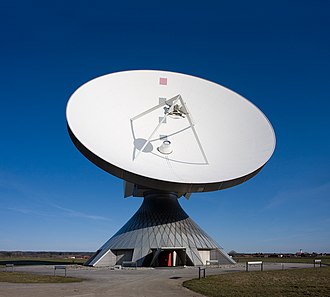
Starlink offers several types of connection, including direct-to-cell service for regular cellular phones. Its home internet service uses flat user terminals about the size of a pizza box. These have phased array antennas that track the satellites and can be placed anywhere with a clear view of the sky, including on trains and airplanes. A smaller portable terminal, "Starlink Mini," was announced in June 2024. SpaceX has also applied to the FCC for at least 32 ground stations in the United States, and each typical ground station has nine antennas inside a fenced area.
| Name | Component | Length (m) | Width (m) | Number | Area (m2) | Debris Assessment Software (DAS) area (m2) | DAS mass (kg) |
|---|---|---|---|---|---|---|---|
| F9-1 (v1.5) | Solar Array | 8.1 | 2.8 | 1 | 22.68 | ||
| Bus | 2.8 | 1.3 | 1 | 3.64 | |||
| Total | 26.32 | 30 | 303 | ||||
| F9-2 (v2 mini) | Solar Array | 12.8 | 4.1 | 2 | 104.96 | ||
| Bus | 4.1 | 2.7 | 1 | 11.07 | |||
| Total | 116.03 | 120 | 800 | ||||
| F9-3 (v2 mini with DtC) | Solar Array | 12.8 | 4.1 | 2 | 105 | ||
| Bus | 7.4 | 2.7 | 1 | 20 | |||
| Total | 125 | 130 | 970 | ||||
| Starship-1 (v2) | Solar Array | 20.2 | 6.36 | 2 | 256.94 | ||
| Bus | 6.4 | 2.7 | 1 | 17.28 | |||
| Total | 274.22 | 294 | 2000 | ||||
| Starship-2 (v2 with DtC) | Solar Array | 20.2 | 6.36 | 2 | 256.94 | ||
| Bus | 10.1 | 2.7 | 1 | 27.27 | |||
| Total | 284.21 | 294 | 2000 |
Launches
Further information: List of Starlink launches
Between February 2018 and May 2024, SpaceX successfully launched over 6,000 Starlink satellites into orbit. This count includes prototypes and satellites that later failed or were brought back down before they began regular service. In March 2020, SpaceX reported that it was producing six satellites per day.
The first 1,440 satellites were planned to fly in 72 orbital planes with 20 satellites in each. In May 2019, SpaceX launched the first 60 satellites into an orbit about 550 km (340 mi) high. Newer Starlink v3 satellites are launched on Starship, a SpaceX rocket that can carry a much heavier load. After a test flight that only reached a suborbital path on Starship flight 13 in July 2026, the first 26 working v3 satellites were placed into orbit on Starship flight 14 in September 2026.
| Group designation | Orbital shells | Orbital planes | Committed completion date | Deployed satellites July 12, 2025 | ||||||
|---|---|---|---|---|---|---|---|---|---|---|
| Altitude (km) | Authorized satellites | Inclination | Count | Satellites per | Half | Full | Total active | Decaying/ deorbited | To be disposed of/out of constellation | |
| Group 1 | 550 km (340 mi) | 1,584 | 53.05° | 72 | 22 | March 2024 (goal) August 1, 2022 (achieved) | March 2027 | 919 | 746 | 167 |
| Group 2 | 570 km (350 mi) | 720 | 70° | 36 | 20 | 368 | 40 | 17 | ||
| Group 3 | 560 km (350 mi) | 348 | 97.6° | 6 | 58 | 221 | 22 | 11 | ||
| Group 4 | 540 km (340 mi) | 1,584 | 53.22° | 72 | 22 | 1,459 | 178 | 32 | ||
| 560 km (350 mi) | 172 | 97.6° | 4 | 43 | 0 | 0 | 0 | |||
Impact on astronomy
Many astronomers are worried that the large number of planned satellites will cause light pollution. They say the satellites are bright enough to seriously affect scientific observations, and that this is getting harder to manage as more satellites are launched. The International Astronomical Union (IAU), the National Radio Astronomy Observatory (NRAO), and the Square Kilometre Array Organization (SKAO) have all shared official concerns. In 2019, the Blanco telescope at the Cerro Tololo Inter-American Observatory recorded strong signal loss and bright white lines in a DECam image, which matched a group of Starlink satellites that had been launched a week earlier.
SpaceX and Musk said the satellites would have little effect and could be handled with image stacking. Professional astronomers disagreed. Musk said SpaceX would work to reduce the albedo (how much light the satellites reflect), and one satellite was launched with a special coating. Astronomers still found it too bright. SpaceX later added sunshades to many satellites, which made them somewhat fainter. In 2022, the IAU set up a center and a website to help astronomers deal with satellites. In 2023, a study reported that Starlink satellites were "leaking radio signals" that could be brighter than any natural source in the sky at the future Square Kilometer Array site.
Increased risk of satellite collision
Having so many satellites in orbit may cause long-term problems with space debris. With thousands of satellites in orbit, there is a risk of a satellite collision, which could start a chain reaction known as Kessler syndrome. SpaceX has said that most of its satellites fly at a lower height and that failed satellites are expected to fall out of orbit within five years without using their own engines. SpaceX reported about 50,000 collision-avoidance moves between December 2023 and May 2024, about double the number from the six months before. Other problems included a close call with a European satellite, which led the ESA to plan new technology that can move satellites out of the way automatically. In 2021, China complained that its Tiangong space station had to dodge Starlink satellites. The destruction of the Russian satellite Kosmos 1408 in 2021 also created debris that Starlink satellites had to avoid. In 2022, the National Telecommunications and Information Administration (NTIA), acting for NASA and the US NSF, sent a letter to the FCC warning about risks to low Earth orbit.
See also: Satellite constellation § Communications satellite constellations, and Satellite internet constellation
Main articles: Satellite internet constellation and Satellite constellation § Two-way communication
Other companies have also planned satellite internet systems. The OneWeb satellite constellation was announced at nearly the same time as SpaceX's plan. In 2015, Samsung proposed a system of 4,600 satellites, but by 2020 no more public information had been released about it. Telesat announced a smaller system of 117 satellites that same year. In April 2019, Amazon announced a large system called "Project Kuiper." Other systems include Amazon Leo, Globalstar, Iridium, Hughes Network Systems, and Viasat, Inc.. Two Chinese systems, Guowang and Qianfan, are being launched.
In 2015, financial analysts asked established satellite companies how they planned to respond to the competition from SpaceX and OneWeb. By October 2017, the expected growth in satellite internet capacity had led some companies to cancel planned investments in new communications satellites in geosynchronous orbit. In February 2021, the National Rural Electric Cooperative Association asked the Federal Communications Commission to carefully check the subsidy applications of SpaceX and other providers. The group said some Starlink funding would go to non-rural places such as Harlem, and that Starlink was still being tested and used unproven technology. Starlink has also had trademark conflicts in some countries, including Mexico and Ukraine.

Quiz time!
5 questions about Starlink
Why does Starlink offer faster internet connections than older satellite internet?
Pictures
Keep exploring




This article is a child-friendly adaptation of the Wikipedia article on Starlink, available under CC BY-SA 4.0.
Images from Wikimedia Commons. Tap any image to view credits and license.