
Steady-state model
In cosmology, the steady-state model was an idea about how the universe works. It was an alternative to the Big Bang theory. In this model, the universe was always expanding, but the amount of matter stayed the same. This happened because new matter was being made all the time.
The steady-state model followed a rule called the perfect cosmological principle. This rule said that the observable universe looks mostly the same at any time and in any place. A static universe, where space does not expand, also followed this rule, but it could not explain what we see in space.
From the 1940s to the 1960s, many scientists argued about whether the Big Bang theory or the steady-state theory was right. Today, most cosmologists, astrophysicists, and astronomers think the steady-state model is not correct. They believe the universe began with a hot Big Bang and has a specific age of the universe, which the steady-state model did not explain.
History
Cosmological expansion was first noticed by Edwin Hubble through his observations. Theoretical work by Albert Einstein in 1917 showed that a static universe, where everything stays the same, would not stay stable on its own.
The steady-state model suggests that while the universe is growing, it always looks the same because new matter is made to keep the density balanced. This idea means the universe has no real beginning or end. Important papers about this idea were written by Hermann Bondi, Thomas Gold, and Fred Hoyle in 1948. Even Albert Einstein thought about this model in 1931 but decided not to use it.
Observational tests
Observations from the 1950s and 1960s showed that the universe was changing, which caused problems for the steady-state model. Bright objects like quasars and radio galaxies were found far away, meaning they existed in the distant past. The steady-state model predicted these objects would be found everywhere, including near our own galaxy, but this was not what astronomers saw. By 1961, studies of these objects provided strong evidence against the steady-state model.
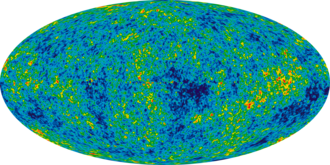
In 1964, the cosmic microwave background radiation was discovered, which matched predictions of the Big Bang theory. The steady-state model tried to explain this radiation as light from ancient stars scattered by dust, but this did not fit the observations. The radiation was very even in all directions and had a specific pattern that made it hard to explain with the steady-state idea. Since this discovery, the Big Bang theory has been widely accepted as the best explanation for the universe's origin.
Quasi-steady state
Quasi-steady-state cosmology was suggested in 1993 by Fred Hoyle, Geoffrey Burbidge, and Jayant V. Narlikar as a new version of the steady-state theory. This model talks about small pockets of creation happening over time in the universe, called minibangs or mini-creation events. After we learned that the universe is speeding up, the model was changed a bit. The idea of a Planck particle, a special kind of black hole that could turn into light elements, was also suggested.
Ned Wright, an astrophysicist and cosmologist, found problems with this model. Other scientists also saw issues, but the people who support the model replied to these comments.
Pictures
Keep exploring


This article is a child-friendly adaptation of the Wikipedia article on Steady-state model, available under CC BY-SA 4.0.
Images from Wikimedia Commons. Tap any image to view credits and license.