
Timeline of Alexandria
The city of Alexandria in Egypt has a rich and fascinating history that stretches back thousands of years. Founded by the famous explorer Alexander the Great around 331 BCE, Alexandria quickly became an important center for trade, learning, and culture. Over time, the city saw many changes and events that shaped its story.
Alexandria was known for its great Library of Alexandria, one of the most famous libraries of the ancient world. Scholars and thinkers from many places came to study there, making the city a hub of knowledge. Though the library no longer exists, its legacy continues to inspire people today.
Throughout its history, Alexandria has been ruled by different groups, including the Ptolemaic dynasty and later the Roman Empire. Each of these periods left its mark on the city, influencing its architecture, culture, and way of life. Today, Alexandria remains a vibrant and important city, remembered for its amazing past and continuing influence on the world.
Greek era (331–30 BC)
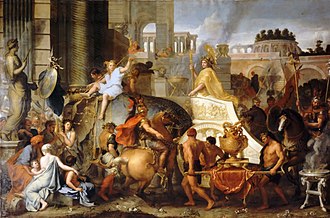
In 331 BC, the place called Rhacotis was renamed Alexandria by Alexander the Great. Around 330 BC, Cleomenes of Naucratis was made the ruler of Egypt by Alexander and started to grow the small village into the country's capital.
After Alexander died in 323 BC, Ptolemy I Soter became the leader of Egypt. In 305 BC, Ptolemy I declared himself king. The famous Library of Alexandria likely opened around 283 BC, and the Lighthouse of Alexandria was built around 247 BC. In 170 BC, a ruler named Antiochus IV Epiphanes from a different country took control of Egypt for a short time. The Romans intervened and briefly entered the city in 168 BC. Also, during the 1st century BC, a grand building called the Caesareum was constructed.
Main article: Ptolemaic dynasty
48 BC–365 AD Romans in power
In the years between 48 BC and 365 AD, Alexandria saw many important events. Julius Caesar conquered the city in 48 BC, and the Great Royal Library of Alexandria burned the same year. After Caesar's victory, he was later assassinated in Rome in 44 BC. In 30 BC, the Battle of Alexandria took place, leading to the deaths of Mark Antony and Cleopatra VII. Augustus took control of the city and made Cornelius Gallus the first leader of Egypt.
Over the years, many notable figures visited Alexandria, including the Greek geographer Strabo in 25 BC and Germanicus in 19 AD. The city faced difficult times, such as a violent uprising against Jewish people in 38 AD and a revolt in 115 AD. Emperor Hadrian helped rebuild the city in 122 AD, and the very first school for teaching Christian beliefs, the Catechetical School of Alexandria, was founded around this time. A major earthquake struck in 365 AD, causing a tsunami that greatly affected the coasts of Libya and Egypt, including Alexandria.
Byzantine rule 390–650
During this time, many important events shaped Alexandria. In 391, the ruler Theodosius I commanded the tearing down of temples used for old religions. By 395, the Roman Empire divided into two parts, marking the start of what we call the Byzantine Empire. In 415, a respected teacher named Hypatia was sadly harmed by an angry group, and many Jewish families were forced to leave the city. Later, in 619, the city faced a tough time when Persian forces took control. Between 641 and 642, Arab forces took over, and the capital of Egypt moved to a new city called Fustat. There were more changes in power over the next few years, with Byzantines and Arabs controlling the city at different times.
Main article: Byzantine Empire
Muslim Rule 700–1800
Alexandria saw many changes from 700 to 1800. Important buildings like Saint Mark's Coptic Orthodox Cathedral and the Eliyahu Hanavi Synagogue were built during this time. The famous Pharos lighthouse fell down in 1323 after an earthquake. In 1798, French forces led by Napoleon Bonaparte took control of the city. By 1800, Alexandria had grown very small, with only about 8,000 people living there.
19th century
In the 1800s, Alexandria saw many important events. In 1801, there was a battle between French and British forces, and later that year, British forces surrounded the city. By 1807, British troops had taken control of the city.
Many buildings and important places were created during this time. The Mahmoudiyah Canal was built in 1819, and by 1821, the city's population was about 12,528. Over the years, new docks, a palace, synagogues, and theaters were built. The population grew quickly, reaching about 170,000 by 1863. New transportation like horse-drawn trams and railways began operating, and gas lighting was introduced. In 1882, there were riots against Europeans, and the city was bombed by British ships. By the end of the century, the first cinema showed films in Alexandria.
20th century
In the 1900s, Alexandria grew and changed a lot. Important buildings and schools opened, such as the Green Synagogue, Victoria College, and the Alexandria Opera House. Trams started running on electric power, and new sports clubs like the Hellenic Football Club Alexandria and Al Ittihad Alexandria Club were formed.
The city’s population rose from around 330,000 in 1907 to nearly 3.4 million by 1992. New places like the Alexandria Aquarium and the Alexandria Zoo opened, and important events took place, including a meeting of the Arab League in 1964. Leaders such as Siddiq Abdul-Latif and Ismail El-Gawsaqi served as mayors during this time.
21st century
The 21st century brought many changes to Alexandria. In 2001, the Alexandria Center of Arts opened, followed by the grand opening of the Bibliotheca Alexandrina in 2002. That same year, Alexandria was named the World Book Capital by UNESCO. In 2003, Harras El-Hedoud Stadium and the Alexandria National Museum opened to the public.
More buildings were added in the following years, including Borg El Arab Stadium in 2007 and San Stefano Grand Plaza the same year. The Sadat Museum opened its doors in 2009. The city saw big events like the Africa Cup of Nations in early 2006 and felt the impact of the Egyptian revolution in 2011. By 2017, the urban population had grown to about 5 million people.
Pictures
Keep exploring



This article is a child-friendly adaptation of the Wikipedia article on Timeline of Alexandria, available under CC BY-SA 4.0.
Images from Wikimedia Commons. Tap any image to view credits and license.