 Safekipedia
Timeline of Queens
Adapted from Wikipedia · Discoverer experience
The following is a timeline of the history of the borough of Queens in New York City, New York, USA. Queens is one of the five main parts of New York City and is known for its diverse communities and many neighborhoods.
This timeline shows important events and changes that helped shape Queens over time. From its early days as a quiet area to its growth into a busy part of the city, Queens has played a big role in the story of New York.
Because history is always growing, this list may never be fully complete. Anyone can help by adding missing events, as long as they use trustworthy sources to make sure the information is accurate.
Prior to 20th century
Queens has a long history that began long before the 20th century. In 1683, Queens County was created, and by 1790, the population had grown to 16,014 people. Over the years, important events took place, such as the opening of a horse racing track in 1821 and the first all-star baseball game in 1858 in Corona. In 1889, the BMT Myrtle Avenue Line began operating, and in 1898, Queens officially became a borough in the City of Greater New York, with Nassau County forming from the remaining area.
20th century
In the early 1900s, Queens grew quickly. Important places like the King Manor Museum opened in 1900, and the Queensboro Bridge opened in 1909, helping people travel easily. By 1915, the famous US Open tennis tournament moved to Queens.
Queens kept changing throughout the 20th century. In 1964, Shea Stadium opened, bringing baseball and football teams to the area. The 1964 and 1939 World's Fairs also brought excitement to Queens. Population numbers rose from about 153,000 in 1900 to nearly 2 million by 1990. New schools, hospitals, and cultural groups helped the borough thrive.
21st century
2000s–2010s
In 2000, Queens had a population of 2,229,379 people. In November 2001, American Airlines Flight 587 crashed. The Astoria Performing Arts Center was established that same year. In 2007, the Newtown Historical Society was formed. By 2010, the population grew to 2,230,722, and the Queens Memory Project began. In 2013, Grace Meng became a U.S. representative for New York's 6th congressional district. The famous graffiti wall called 5 Pointz was torn down in 2013. Melinda Katz became borough president in 2014. In 2017, Donald Trump, who was born in Jamaica, Queens, became the 45th President of the United States. In 2019, Amazon planned to build a new headquarters in Long Island City but later decided not to.
2020s
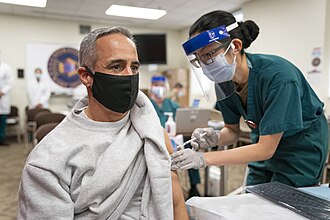
In December 2020, Sandra Lindsay, a nurse at Long Island Jewish Medical Center, was the first person to receive the COVID-19 vaccine approved for emergency use. By 2020, the population of Queens had grown to 2,405,464. In early 2021, she received her second dose of the vaccine. Citi Field was turned into a large vaccination site to help many people get their shots.
Images
Related articles


This article is a child-friendly adaptation of the Wikipedia article on Timeline of Queens, available under CC BY-SA 4.0.
Images from Wikimedia Commons. Tap any image to view credits and license.