 Safekipedia
Uniform tiling
Adapted from Wikipedia · Discoverer experience
In geometry, a uniform tiling is a special way of covering a flat surface completely with regular polygon shapes, such as squares or equilateral triangles. The key feature of a uniform tiling is that every point where the shapes meet, called a vertex, looks exactly the same. This means that if you were to move the pattern to any other vertex, it would look identical.
Uniform tilings can exist not only on flat surfaces, called the Euclidean plane, but also on curved surfaces like the sphere and the hyperbolic plane. These tilings are closely related to special 3D shapes known as uniform polyhedra. They can be created using a method called the Wythoff construction, which starts with a symmetry group and a single point inside a basic shape called a fundamental domain.
There are different ways to describe these tilings using symbols. For example, the Schläfli symbol uses pairs of numbers, the Coxeter-Dynkin diagram uses a triangle graph, and the Wythoff symbol uses three numbers separated by a vertical bar. Another way is by looking at the vertex configuration, which shows the sequence of shapes that meet at each vertex. These tilings can also be made by changing regular tilings through operations like truncation, rectification, and cantellation, as described by mathematician Norman Johnson.
Coxeter groups
Coxeter groups for the plane help define a special way to build patterns called the Wythoff construction. They can be shown using diagrams known as Coxeter-Dynkin diagrams. These groups include those with whole-number reflection orders, which means they repeat in exact steps.
| Orbifold symmetry | Coxeter group | Coxeter diagram | |||
|---|---|---|---|---|---|
| Compact | |||||
| *333 | (3 3 3) | A ~ 2 {\displaystyle {\tilde {A}}_{2}} | [3] |    | |
| *442 | (4 4 2) | B ~ 2 {\displaystyle {\tilde {B}}_{2}} | [4,4] |  | |
| *632 | (6 3 2) | G ~ 2 {\displaystyle {\tilde {G}}_{2}} | [6,3] |   | |
| *2222 | (∞ 2 ∞ 2) | I ~ 1 {\displaystyle {\tilde {I}}_{1}} × I ~ 1 {\displaystyle {\tilde {I}}_{1}} | [∞,2,∞] |   | |
| Noncompact (Frieze) | |||||
| *∞∞ | (∞) | I ~ 1 {\displaystyle {\tilde {I}}_{1}} | [∞] | | |
| *22∞ | (2 2 ∞) | I ~ 1 {\displaystyle {\tilde {I}}_{1}} × A ~ 2 {\displaystyle {\tilde {A}}_{2}} | [∞,2] | | |
| Orbifold symmetry | Coxeter group | Coxeter diagram | ||
|---|---|---|---|---|
| Compact | ||||
| *pq2 | (p q 2) | [p,q] |   | |
| *pqr | (p q r) | [(p,q,r)] |  | |
| Paracompact | ||||
| *∞p2 | (p ∞ 2) | [p,∞] | | |
| *∞pq | (p q ∞) | [(p,q,∞)] | | |
| *∞∞p | (p ∞ ∞) | [(p,∞,∞)] | | |
| *∞∞∞ | (∞ ∞ ∞) | [(∞,∞,∞)] | | |
Uniform tilings of the Euclidean plane
Further information: List of k-uniform tilings
In geometry, a uniform tiling covers a flat surface completely with regular shapes, like squares or triangles, in a repeating pattern. These patterns are made possible by special symmetry groups that arrange the shapes evenly. There are 3 regular tilings, where one type of shape covers the plane, and 7 semiregular tilings, which use two or more different shapes in a balanced way. Some special tilings, like the apeirogonal prism and apeirogonal antiprism, use endless patterns, while others, like the elongated triangular tiling, mix squares and triangles in layers.
| (p q 2) | Fund. triangles | Parent | Truncated | Rectified | Bitruncated | Birectified (dual) | Cantellated | Omnitruncated (Cantitruncated) | Snub |
|---|---|---|---|---|---|---|---|---|---|
| Wythoff symbol | q | p 2 | 2 q | p | 2 | p q | 2 p | q | p | q 2 | p q | 2 | p q 2 | | | p q 2 | |
| Schläfli symbol | {p,q} | t{p,q} | r{p,q} | 2t{p,q}=t{q,p} | 2r{p,q}={q,p} | rr{p,q} | tr{p,q} | sr{p,q} | |
| Coxeter diagram |  | | | | | | |  | |
| Vertex config. | pq | q.2p.2p | (p.q)2 | p.2q.2q | qp | p.4.q.4 | 4.2p.2q | 3.3.p.3.q | |
| Square tiling (4 4 2) |  0 |  {4,4} |  4.8.8 |  4.4.4.4 | 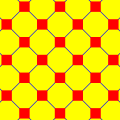 4.8.8 | 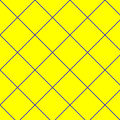 {4,4} | 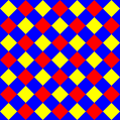 4.4.4.4 | 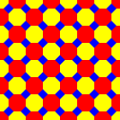 4.8.8 | 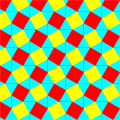 3.3.4.3.4 |
| Hexagonal tiling (6 3 2) | 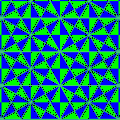 0 | 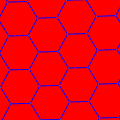 {6,3} | 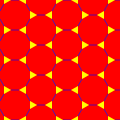 3.12.12 | 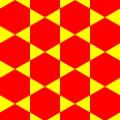 3.6.3.6 | 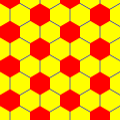 6.6.6 | 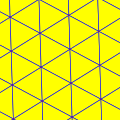 {3,6} | 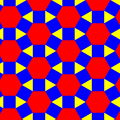 3.4.6.4 |  4.6.12 | 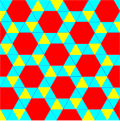 3.3.3.3.6 |
| Wythoff symbol (p q r) | Fund. triangles | q | p r | r q | p | r | p q | r p | q | p | q r | p q | r | p q r | | | p q r |
|---|---|---|---|---|---|---|---|---|---|
| Coxeter diagram | | | | | | | | | |
| Vertex config. | (p.q)r | r.2p.q.2p | (p.r)q | q.2r.p.2r | (q.r)p | q.2r.p.2r | r.2q.p.2q | 3.r.3.q.3.p | |
| Triangular (3 3 3) |  0 |  (3.3)3 |  3.6.3.6 | 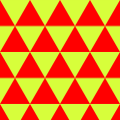 (3.3)3 |  3.6.3.6 |  (3.3)3 |  3.6.3.6 |  6.6.6 | 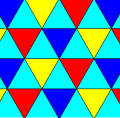 3.3.3.3.3.3 |
Uniform tilings of the hyperbolic plane
There are infinitely many uniform tilings by convex regular polygons on the hyperbolic plane, each based on a different reflective symmetry group (p q r). A sampling of these tilings can be seen using a Poincaré disk projection.
The Coxeter-Dynkin diagram for these tilings is shown in a linear form, although it is actually a triangle, with the trailing segment r connecting to the first node. Additional symmetry groups exist in the hyperbolic plane that can create new tiling forms.
| (p q 2) | Fund. triangles | Parent | Truncated | Rectified | Bitruncated | Birectified (dual) | Cantellated | Omnitruncated (Cantitruncated) | Snub |
|---|---|---|---|---|---|---|---|---|---|
| Wythoff symbol | q | p 2 | 2 q | p | 2 | p q | 2 p | q | p | q 2 | p q | 2 | p q 2 | | | p q 2 | |
| Schläfli symbol | t{p,q} | t{p,q} | r{p,q} | 2t{p,q}=t{q,p} | 2r{p,q}={q,p} | rr{p,q} | tr{p,q} | sr{p,q} | |
| Coxeter diagram | | | | | | | | | |
| Vertex config. | pq | q.2p.2p | p.q.p.q | p.2q.2q | qp | p.4.q.4 | 4.2p.2q | 3.3.p.3.q | |
| (5 4 2) |  V4.8.10 |  {5,4} |  4.10.10 |  4.5.4.5 |  5.8.8 |  {4,5} | 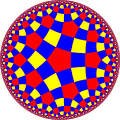 4.4.5.4 |  4.8.10 |  3.3.4.3.5 |
| (5 5 2) |  V4.10.10 |  {5,5} |  5.10.10 |  5.5.5.5 |  5.10.10 |  {5,5} |  5.4.5.4 |  4.10.10 | 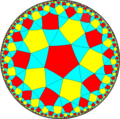 3.3.5.3.5 |
| (7 3 2) |  V4.6.14 |  {7,3} | 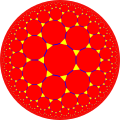 3.14.14 | 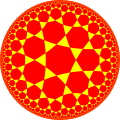 3.7.3.7 |  7.6.6 |  {3,7} | 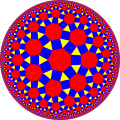 3.4.7.4 |  4.6.14 |  3.3.3.3.7 |
| (8 3 2) | 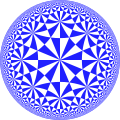 V4.6.16 | 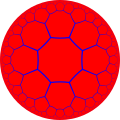 {8,3} |  3.16.16 | 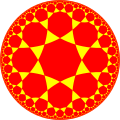 3.8.3.8 |  8.6.6 | 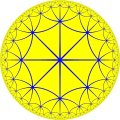 {3,8} |  3.4.8.4 |  4.6.16 | 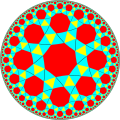 3.3.3.3.8 |
| Wythoff symbol (p q r) | Fund. triangles | q | p r | r q | p | r | p q | r p | q | p | q r | p q | r | p q r | | | p q r |
|---|---|---|---|---|---|---|---|---|---|
| Coxeter diagram | | | | | | | | | |
| Vertex config. | (p.r)q | r.2p.q.2p | (p.q)r | q.2r.p.2r | (q.r)p | r.2q.p.2q | 2p.2q.2r | 3.r.3.q.3.p | |
| (4 3 3) |  V6.6.8 |  (3.4)3 |  3.8.3.8 | 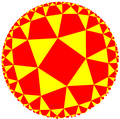 (3.4)3 | 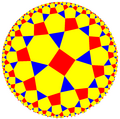 3.6.4.6 |  (3.3)4 |  3.6.4.6 |  6.6.8 | 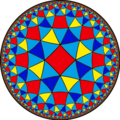 3.3.3.3.3.4 |
| (4 4 3) |  V6.8.8 | 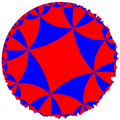 (3.4)4 |  3.8.4.8 |  (4.4)3 | 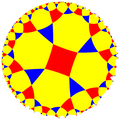 3.6.4.6 |  (3.4)4 | 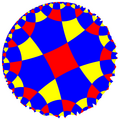 4.6.4.6 |  6.8.8 |  3.3.3.4.3.4 |
| (4 4 4) | 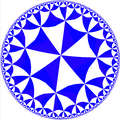 V8.8.8 | 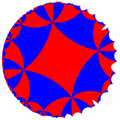 (4.4)4 |  4.8.4.8 | 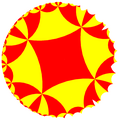 (4.4)4 |  4.8.4.8 |  (4.4)4 |  4.8.4.8 |  8.8.8 |  3.4.3.4.3.4 |
Expanded lists of uniform tilings
There are several ways the list of uniform tilings can be expanded:
- Vertex figures can have retrograde faces and turn around the vertex more than once.
- Star polygon tiles can be included.
- Apeirogons, {∞}, can be used as tiling faces.
- Zigzags (apeirogons alternating between two angles) can also be used.
- The restriction that tiles meet edge-to-edge can be relaxed, allowing additional tilings such as the Pythagorean tiling.
Symmetry group triangles with retrogrades include: (4/3 4/3 2), (6 3/2 2), (6/5 3 2), (6 6/5 3), (6 6 3/2). Symmetry group triangles with infinity include: (4 4/3 ∞), (3/2 3 ∞), (6 6/5 ∞), (3 3/2 ∞).
Branko Grünbaum and G. C. Shephard, in the 1987 book Tilings and patterns, enumerate a list of 25 uniform tilings, including the 11 convex forms, and add 14 more they call hollow tilings, using the first two expansions above: star polygon faces and generalized vertex figures.
H. S. M. Coxeter, M. S. Longuet-Higgins, and J. C. P. Miller, in the 1954 paper 'Uniform polyhedra', Table 8: Uniform Tessellations, use the first three expansions and enumerate a total of 38 uniform tilings. If a tiling made of 2 apeirogons is also counted, the total can be considered 39 uniform tilings.
In 1981, Grünbaum, Miller, and Shephard, in their paper Uniform Tilings with Hollow Tiles, list 25 tilings using the first two expansions and 28 more when the third is added (making 53 using Coxeter et al.'s definition). When the fourth is added, they list an additional 23 uniform tilings and 10 families (8 depending on continuous parameters and 2 on discrete parameters).
Besides the 11 convex solutions, the 28 uniform star tilings listed by Coxeter et al., grouped by shared edge graphs, are shown below, followed by 15 more listed by Grünbaum et al. that meet Coxeter et al.'s definition but were missed by them.
This set is not proved complete.
The tilings with zigzags are listed below. {∞𝛼} denotes a zigzag with angle 0
The tiling pairs 3.17 and 3.18, as well as 3.19 and 3.20, have identical vertex configurations but different symmetries.
Tilings 3.7 through 3.10 have the same edge arrangement as 2.1 and 2.2; 3.17 through 3.20 have the same edge arrangement as 2.10 through 2.13; 3.21 through 3.24 have the same edge arrangement as 2.18 through 2.23; and 3.25 through 3.33 have the same edge arrangement as 1.25 (the regular triangular tiling).
| McNeill | Diagram | Vertex Config. | Wythoff | Symmetry |
|---|---|---|---|---|
| I1 | ∞.∞ | p1m1 | ||
| I2 | 4.4.∞ | ∞ 2 | 2 | p1m1 | |
| I3 | 3.3.3.∞ | | 2 2 ∞ | p11g |
| Wallpaper group symmetry | ||||||
|---|---|---|---|---|---|---|
| McNeill | Grünbaum et al., 1981 | Edge diagram | Highlighted | Vertex Config. | Wythoff | Symmetry |
| Convex | 1.9 | 4.4.4.4 | 4 | 2 4 | p4m | ||
| I4 | 2.14 | 4.∞.4/3.∞ 4.∞.−4.∞ | 4/3 4 | ∞ | p4m | ||
| Convex | 1.24 | 6.6.6 | 3 | 2 6 | p6m | ||
| Convex | 1.25 | 3.3.3.3.3.3 | 6 | 2 3 | p6m | ||
| I5 | 2.26 | (3.∞.3.∞.3.∞)/2 | 3/2 | 3 ∞ | p3m1 | ||
| Convex | 1.23 | 3.6.3.6 | 2 | 3 6 | p6m | ||
| I6 | 2.25 | 6.∞.6/5.∞ 6.∞.−6.∞ | 6/5 6 | ∞ | p6m | ||
| I7 | 2.24 | ∞.3.∞.3/2 3.∞.−3.∞ | 3/2 3 | ∞ | p6m | ||
| Convex | 1.14 | 3.4.6.4 | 3 6 | 2 | p6m | ||
| 1 | 1.15 | 3/2.12.6.12 −3.12.6.12 | 3/2 6 | 6 | p6m | ||
| 1.16 | 4.12.4/3.12/11 4.12.−4.−12 | 2 6 (3/2 6/2) | | p6m | |||
| Convex | 1.5 | 4.8.8 | 2 4 | 4 | p4m | ||
| 2 | 2.7 | 4.8/3.∞.8/3 | 4 ∞ | 4/3 | p4m | ||
| 1.7 | 8/3.8.8/5.8/7 8.8/3.−8.−8/3 | 4/3 4 (4/2 ∞/2) | | p4m | |||
| 2.6 | 8.4/3.8.∞ −4.8.∞.8 | 4/3 ∞ | 4 | p4m | |||
| Convex | 1.20 | 3.12.12 | 2 3 | 6 | p6m | ||
| 3 | 2.17 | 6.12/5.∞.12/5 | 6 ∞ | 6/5 | p6m | ||
| 1.21 | 12/5.12.12/7.12/11 12.12/5.−12.−12/5 | 6/5 6 (6/2 ∞/2) | | p6m | |||
| 2.16 | 12.6/5.12.∞ −6.12.∞.12 | 6/5 ∞ | 6 | p6m | |||
| 4 | 1.18 | 12/5.3.12/5.6/5 3.12/5.−6.12/5 | 3 6 | 6/5 | p6m | ||
| 1.19 | 12/5.4.12/7.4/3 4.12/5.-4.-12/5 | 2 6/5 (3/2 6/2) | | p6m | |||
| 1.17 | 4.3/2.4.6/5 3.−4.6.−4 | 3/2 6 | 2 | p6m | |||
| 5 | 2.5 | 8.8/3.∞ | 4/3 4 ∞ | | p4m | ||
| 6 | 2.15 | 12.12/5.∞ | 6/5 6 ∞ | | p6m | ||
| 7 | 1.6 | 8.4/3.8/5 4.−8.8/3 | 2 4/3 4 | | p4m | ||
| Convex | 1.11 | 4.6.12 | 2 3 6 | | p6m | ||
| 8 | 1.13 | 6.4/3.12/7 4.−6.12/5 | 2 3 6/5 | | p6m | ||
| 9 | 1.12 | 12.6/5.12/7 6.−12.12/5 | 3 6/5 6 | | p6m | ||
| 10 | 1.8 | 4.8/5.8/5 −4.8/3.8/3 | 2 4 | 4/3 | p4m | ||
| 11 | 1.22 | 12/5.12/5.3/2 −3.12/5.12/5 | 2 3 | 6/5 | p6m | ||
| Convex | 1.1 | 3.3.3.4.4 | non-Wythoffian | cmm | ||
| 12 | 1.2 | 4.4.3/2.3/2.3/2 3.3.3.−4.−4 | non-Wythoffian | cmm | ||
| Convex | 1.3 | 3.3.4.3.4 | | 2 4 4 | p4g | ||
| 13 | 1.4 | 4.3/2.4.3/2.3/2 3.3.−4.3.−4 | | 2 4/3 4/3 | p4g | ||
| 14 | 2.4 | 3.4.3.4/3.3.∞ 3.4.3.−4.3.∞ | | 4/3 4 ∞ | p4 | ||
| Convex | 1.10 | 3.3.3.3.6 | | 2 3 6 | p6 | ||
| 2.1 | 3/2.∞.3/2.∞.3/2.4/3.4/3 3.4.4.3.∞.3.∞ | non-Wythoffian | cmm | |||
| 2.2 | 3/2.∞.3/2.∞.3/2.4.4 3.−4.−4.3.∞.3.∞ | non-Wythoffian | cmm | |||
| 2.3 | 3/2.∞.3/2.4.4.3/2.4/3.4/3 3.4.4.3.−4.−4.3.∞ | non-Wythoffian | p3 | |||
| 2.8 | 4.∞.4/3.8/3.8 4.8.8/3.−4.∞ | non-Wythoffian | p4m | |||
| 2.9 | 4.∞.4.8.8/3 −4.8.8/3.4.∞ | non-Wythoffian | p4m | |||
| 2.10 | 4.∞.4/3.8.4/3.8 4.8.−4.8.−4.∞ | non-Wythoffian | p4m | |||
| 2.11 | 4.∞.4/3.8.4/3.8 4.8.−4.8.−4.∞ | non-Wythoffian | p4g | |||
| 2.12 | 4.∞.4/3.8/3.4.8/3 4.8/3.4.8/3.−4.∞ | non-Wythoffian | p4m | |||
| 2.13 | 4.∞.4/3.8/3.4.8/3 4.8/3.4.8/3.−4.∞ | non-Wythoffian | p4g | |||
| 2.18 | 3/2.∞.3/2.4/3.4/3.3/2.4/3.4/3 3.4.4.3.4.4.3.∞ | non-Wythoffian | p6m | |||
| 2.19 | 3/2.∞.3/2.4.4.3/2.4.4 3.−4.−4.3.-4.−4.3.∞ | non-Wythoffian | p6m | |||
| 2.20 | 3/2.∞.3/2.∞.3/2.12/11.6.12/11 3.12.−6.12.3.∞.3.∞ | non-Wythoffian | p6m | |||
| 2.21 | 3/2.∞.3/2.∞.3/2.12.6/5.12 3.−12.6.−12.3.∞.3.∞ | non-Wythoffian | p6m | |||
| 2.22 | 3/2.∞.3/2.∞.3/2.12/7.6/5.12/7 3.12/5.6.12/5.3.∞.3.∞ | non-Wythoffian | p6m | |||
| 2.23 | 3/2.∞.3/2.∞.3/2.12/5.6.12/5 3.−12/5.−6.−12/5.3.∞.3.∞ | non-Wythoffian | p6m | |||
Self-dual tilings
A tiling can also be self-dual, meaning it looks the same when you imagine lines connecting the centers of its shapes. The square tiling, with Schläfli symbol {4,4}, is an example of a self-dual tiling. This means that if you draw lines connecting the centers of the squares, you get another pattern of squares that looks just like the original.
Uniform tilings using regular or isotoxal polygrams as nonconvex isotoxal simple polygons
Regular star polygons can be used in tilings when seen as special shapes with alternating outer and inner angles. These shapes help create patterns that cover the plane evenly. There are 22 such uniform tilings that use star polygons, some with adjustable angles and others that only work with specific angles. These tilings are related to ordinary tilings that use regular convex polygons, even though they look different.
4.6.4* π/6.6 Topol. related to 4.4.4.4 | (8.4* π/4)2 Topol. related to 4.4.4.4 | 12.12.4* π/3 Topol. related to 4.8.8 | 3.3.8* π/12.4** π/3.8* π/12 Topol. related to 4.8.8 | 3.3.8* π/12.3.4.3.8* π/12 Topol. related to 4.8.8 | 3.4.8.3.8* π/12 Topol. related to 4.8.8 |
5.5.4* π/10.5.4* π/10 Topol. related to 3.3.4.3.4 | 4.6* π/6.6** π/2.6* π/6 Topol. related to 6.6.6 | (4.6* π/6)3 Topol. related to 6.6.6 | 9.9.6* 4π/9 Topol. related to 6.6.6 | (6.6* π/3)2 Topol. related to 3.6.3.6 | (12.3* π/6)2 Topol. related to 3.6.3.6 |
3.4.6.3.12* π/6 Topol. related to 4.6.12 | 3.3.3.12* π/6.3.3.12* π/6 Topol. related to 3.12.12 | 18.18.3* 2π/9 Topol. related to 3.12.12 | 3.6.6* π/3.6 Topol. related to 3.4.6.4 | 8.3* π/12.8.6* 5π/12 Topol. related to 3.4.6.4 | 9.3.9.3* π/9 Topol. related to 3.6.3.6 |
Uniform tilings using convex isotoxal simple polygons
Isotoxal simple 2_n_-gons, written as {n𝛼}, can be convex. The simplest of these are called rhombi, which are 2×2-gons, or {2𝛼}. By thinking of these convex {n𝛼} shapes as "regular" polygons, we can find more patterns that fit together perfectly, called "uniform" tilings.
Related articles


This article is a child-friendly adaptation of the Wikipedia article on Uniform tiling, available under CC BY-SA 4.0.
Images from Wikimedia Commons. Tap any image to view credits and license.