 Safekipedia
Wind turbine
Adapted from Wikipedia · Discoverer experience
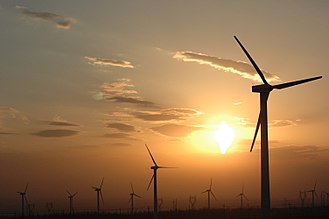
A wind turbine is a device that converts the kinetic energy of wind into electrical energy. These turbines are an important source of clean, renewable power, helping countries reduce their use of polluting fossil fuels. As of 2024, hundreds of thousands of large turbines, grouped in areas called wind farms, provided over 1,136 gigawatts of electricity worldwide.
Wind turbines come in many sizes and designs. Most common are horizontal-axis turbines with three blades, but there are also vertical-axis designs like the Darrieus and Savonius types. Blades are usually made from strong materials such as glass fiber or carbon fiber. Small turbines can charge batteries or power remote devices, while large ones help supply electricity to entire communities.
Although wind energy is one of the cheapest and cleanest ways to produce power, it does have environmental effects, such as impacts on wildlife. However, these effects can be managed. Because wind power depends on the wind, it is not always available when energy is needed unless special storage systems are used.
History
Main article: History of wind power
Wind power has been used for thousands of years. One of the earliest examples was a windwheel made by Hero of Alexandria around 10–70 CE. The first practical wind power plants were built in Sistan, Persia (now Iran), from the 7th century. These were vertical-axle windmills used for grinding grain or drawing up water.
Wind power came to Europe during the Middle Ages. By the 15th century, windmills were used in places like England and the Netherlands. The first wind turbine that made electricity was created in 1883 by Josef Friedländer in Vienna. In 1887, James Blyth in Scotland and Charles F. Brush in the United States also built wind turbines to make electricity. By 1900, Denmark had about 2,500 windmills making mechanical power, and by the 1930s, wind turbines were being used to help make electricity in places like the United States and the USSR.
Wind power density
Main article: Wind power
Wind power density (WPD) measures how much wind energy is available in one spot. It helps us understand how much power a wind turbine can make from the wind at different heights.
Wind turbines are grouped based on the wind speeds they can handle best, from class I to class III. They are also classified by how much the wind changes or gets mixed up, called turbulence intensity, which can be A, B, or C.
| Class | Avg wind speed (m/s) | Turbulence |
|---|---|---|
| IA | 10 | 16% |
| IB | 10 | 14% |
| IC | 10 | 12% |
| IIA | 8.5 | 16% |
| IIB | 8.5 | 14% |
| IIC | 8.5 | 12% |
| IIIA | 7.5 | 16% |
| IIIB | 7.5 | 14% |
| IIIC | 7.5 | 12% |
Efficiency
Wind turbines convert the movement of air into electricity, but they can't capture all the energy from the wind. According to Betz's law, the most a turbine can theoretically capture is about 59% of the wind's energy. This limit depends on the size of the turbine and the speed of the wind.
Factors like friction on the blades, gears, and other parts can lower this efficiency. Over time, dirt and bugs on the blades can also reduce how well a turbine works. Placing turbines in spots with steady, strong winds helps them operate more efficiently.
Types
Wind turbines can rotate around a horizontal or vertical axis, with horizontal-axis turbines being more common and effective. Large horizontal-axis turbines, often found in wind farms, usually have three blades and are mounted on tall towers. These turbines need to face the wind to generate power and often use a gearbox to increase the speed of the rotor for the generator.
Vertical-axis turbines have their rotor shaft arranged vertically, which means they don’t need to turn to face the wind. However, they generally produce less energy than horizontal-axis turbines and are less common. Some special types of wind turbines, like those with counter-rotating blades or floating platforms, are still being tested and developed.
Design and construction
Wind turbines turn the power of the wind into electricity. A typical turbine has three main parts: the rotor with blades that catch the wind, a generator that makes electricity, and a tall tower that holds everything up. One common type of turbine in the United States stands about 80 meters tall, with blades spanning the same distance.
To keep turbines working well, scientists watch them closely using special tools. These tools help find any problems before they become big issues, making sure the turbines stay safe and efficient.
Technology
Wind turbines become more efficient as their blades grow longer. The blades must be strong, stiff, and able to last a long time. Special materials like glass fiber and carbon fiber are used to make them.
Wind turbines usually last about 30 years, but their blades and gearboxes might only last up to 25 years.
The cost of wind turbines has gone down over time. In 2024, it cost about $1,041 for each kilowatt of power a wind turbine can make. This is much less than it cost in 2010. Smaller home wind turbines can cost as little as $700 for a tiny one that makes 400 watts of power.
Wind turbines on public display
Some places use wind turbines as attractions to draw people's attention. These turbines are usually the common three-bladed design and help power the electrical grid, but they also show the public how wind energy works. An example is the Bahrain World Trade Center, the first skyscraper to include wind turbines in its design.
Small wind turbines
Main article: Small wind turbine
Small wind turbines are used in many places where electricity is hard to get, like homes far from town, schools in rural areas, and even on boats or caravans. They can be very small, like a fifty-watt generator, or a bit bigger for other needs. These turbines often work well with solar power for things like traffic signs, saving the need to run long wires. Experts say small wind turbines are those that produce up to 100 kilowatts of power. They usually have special blades and parts that help them turn wind into electricity without needing many moving parts.
Wind turbine spacing
On most wind farms, the turbines are spaced about 6 to 10 times the size of their blades apart. For very large farms, spacing them about 15 times the blade size apart can be more cost-effective. This idea comes from research using computer simulations to study how wind moves between turbines.
Some studies suggest that vertical wind turbines could be placed closer together if they spin in an alternating pattern, allowing nearby turbines to move in the same direction as they get close to each other.
Operability
Wind turbines need regular maintenance to stay reliable and available. They can generate energy most of the time, usually about 98% of the time. In cold places, ice can build up on the blades, making them less effective. Special methods, like heating or using drones, help remove the ice.
When wind turbines need to be updated or replaced, a process called repowering can be used. This means putting up bigger turbines in place of older ones. Some old turbines are recycled, though their blades are tricky to process because they are made from special materials. Many people and companies are working on new ways to recycle these blades, finding useful purposes for them in different projects around the world.
Main article: Repowering
Comparison with other power sources
Wind turbines are one of the lowest-cost ways to get clean energy, similar to solar panels. As technology improves, the cost of wind turbines keeps going down. Wind is a free natural resource, so there isn’t a big market for it yet. The biggest cost for small wind turbines is buying and putting them up, which can cost between $48,000 and $65,000. But, over time, the energy they make is worth more than that cost.
Wind turbines are good because they don’t use much water and they don’t pollute the air. Using just one megawatt of wind energy can stop over 1,400 tonnes of carbon dioxide from being released into the air each year. However, wind turbines can sometimes harm birds, but they are not a big reason why bird numbers go down. Unlike fossil fuel power stations, wind farms do not cause as many bird deaths.
One downside of wind energy is that it doesn’t always work when we need it — it only makes power when the wind is blowing. This means we still need other kinds of power, too. Scientists are working on ways to store extra energy so we can use it even when there’s no wind. Some people who live near wind farms don’t like the blinking lights on the turbines, which can bother them at night. There are new systems being tested that only turn the lights on when airplanes are nearby.
Records
Wind turbines are amazing machines that turn wind into electricity. Some of the biggest ones can make a lot of power to help light up homes and cities. There is a special list of the strongest wind turbines ever made, which you can learn more about here. These turbines show just how clever engineering can be in using nature to give us clean energy.
| Record | Model/Name | Location | Constructor/Manufacturer |
|---|---|---|---|
| Largest and most powerful | DEC 26MW H26-313 | Fuzhou, China | Dongfang Electric Wind Power |
| Largest vertical-axis | Éole | Cap-Chat, Québec, Canada | NRC, Hydro-Québec |
| Largest one-blade turbine | Monopteros M50 | Jade Wind Park | MBB Messerschmitt |
| Largest two-blade turbine | SCD6.5 | Longyuan Wind Farm | Ming Yang Smart Energy |
| Most rotors | Four-in-One | Maasvlakte, Netherlands | Lagerwey |
| Highest-situated | 2.5 | Pastoruri Glaicer | WindAid |
| Largest offshore | MySE18.X-20MW | Hainan, China | Ming Yang Smart Energy |
| Tallest | Schipkau GICON Wind Turbine | Schipkau, Germany | Vensys, GICON |
Images
Related articles


This article is a child-friendly adaptation of the Wikipedia article on Wind turbine, available under CC BY-SA 4.0.
Images from Wikimedia Commons. Tap any image to view credits and license.