 Safekipedia
Woodwind section
Adapted from Wikipedia · Discoverer experience
The woodwind section is one of the important parts of an orchestra or concert band. It includes many special instruments that make beautiful sounds together. These instruments are called woodwind instruments because they were once mostly made from wood, even though many are made from metal or other materials today.
Woodwind instruments are grouped into two main families. One family is known as flutes, and these are edge-blown aerophones. This means that players blow across the top of the instrument to make sound. The other family is called reed aerophones. These instruments have a piece called a reed that vibrates when the player blows into them.
Woodwind instruments are different from brass instruments, which have their own section. Brass instruments are played in a different way and make sounds using a different method. The woodwind section adds lovely, colorful sounds to music and helps create the full, rich sound of an orchestra or band.
Orchestra
The woodwind section is an important part of a symphony orchestra. It usually includes instruments like flutes, oboes, clarinets, and bassoons. Sometimes, these instruments have special versions, like a piccolo (a small flute) or a cor anglais (a special oboe).
In the early 1900s, some composers used many woodwind instruments. For example, Mahler used lots of flutes, oboes, and clarinets in his music. But after World War I, orchestras often used fewer instruments, closer to the size of a small group called a chamber orchestra.
Today, the woodwind section usually has two to four flutes, two to four oboes, and two or three clarinets and bassoons. Sometimes, special instruments like a piccolo or cor anglais are also included.
Concert band
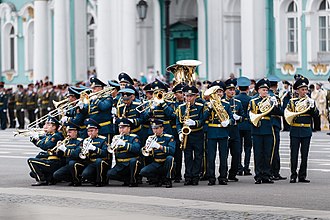
The woodwind section in a concert band is usually bigger than the one in an orchestra. It also has more types of woodwind instruments.
The woodwind section of a concert band often includes:
- Piccolo(s)
- Flutes
- Oboes
- Bassoons
- B♭ clarinets
- Bass clarinet(s)
- Alto saxophones
- Tenor saxophone(s)
- Baritone saxophone(s)
Other woodwinds that are used in concert bands, but not as often, include:
- Cor anglais (usually played by an oboist)
- Contrabassoon (usually played by a bassoonist)
- E♭ clarinet (usually played by a B♭ clarinetist)
- Alto clarinet or basset horn (usually played by a B♭ or bass clarinetist)
- Contra-alto clarinet or contrabass clarinet (usually played by a bass clarinetist)
- Soprano saxophone (usually played by the principal alto saxophonist)
Woodwinds that are sometimes, but very rarely, used in concert bands include:
- Alto and bass flutes
- Bass saxophone
Woodwind choir
A woodwind choir, also called a woodwind orchestra or woodwind ensemble, is a group that plays only instruments from the woodwind family. This includes flutes, oboes, clarinets, bassoons, and saxophones in different sizes. These ensembles have a small collection of special music written just for them, as well as arrangements of pieces originally written for orchestras, light music, and popular songs.
Wind music has a long history, dating back to medieval times in the United Kingdom. It was popular in European courts, with important events like coronations featuring wind performances. In the 1700s, special music for winds became common for outdoor and social events. Famous composers like Mozart and Beethoven began writing more interesting and creative music for wind sections in their works. By the end of the 1800s, interest in small wind groups like the wind quintet began to fade, but it returned in the 1900s with new works from modern composers. Today, there is a large and growing collection of music for woodwind choirs, thanks to the efforts of many musicians and organizations.
Related articles



This article is a child-friendly adaptation of the Wikipedia article on Woodwind section, available under CC BY-SA 4.0.
Images from Wikimedia Commons. Tap any image to view credits and license.