 Safekipedia
Ceres (dwarf planet)
Adapted from Wikipedia · Explorer experience
All About Ceres
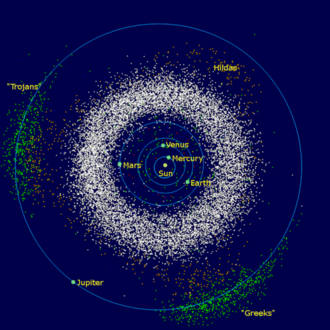
Ceres is a special space object called a dwarf planet. It lives in a place called the asteroid belt, which is between the planets Mars and Jupiter. Ceres was the very first asteroid ever found! A smart scientist named Giuseppe Piazzi spotted it on January 1, 1801, from a telescope in Sicily.
Ceres is smaller than our Moon—about a quarter the width. Because it is small and far away, we need a telescope to see it. In 2015, a NASA spacecraft called Dawn flew close to Ceres and showed us its surface. We learned that Ceres has water ice and minerals on the outside, and maybe even a hidden ocean of liquid water inside! Sometimes, salty water flows to the surface and makes icy volcanoes. This makes Ceres the closest active icy volcano world to the Sun. It also has a very thin atmosphere made of water vapor.
A Long History
Scientists have known about Ceres for a very long time. At first, Ceres was thought to be a planet. But as more objects like Ceres were found nearby, scientists called them asteroids. In 2006, Ceres was given the special name of dwarf planet because it shares its space with many other asteroids. Today, Ceres is known as both a dwarf planet and an asteroid.
Ceres moves around the Sun between Mars and Jupiter, right in the middle of the asteroid belt. It takes about 4.6 Earth years to finish one trip around the Sun. Ceres was once thought to be part of a group called the Gefion family, but it was later found to have a different makeup and is not from the same origin as those asteroids.
A Day on Ceres
Ceres spins around once every 9 hours and 4 minutes. That is one day on Ceres! Scientists use a special crater called Kait to mark the starting point for measuring this spin. Ceres leans just a little bit, with an axial tilt of 4 degrees. This small tilt means some craters near the poles stay in shadow all the time. These shadowy spots might trap water ice, much like what happens on the Moon and Mercury.
Images
Related articles


This article is a child-friendly adaptation of the Wikipedia article on Ceres (dwarf planet), available under CC BY-SA 4.0.
Images from Wikimedia Commons. Tap any image to view credits and license.