 Safekipedia
Event horizon
Adapted from Wikipedia · Explorer experience
What is an Event Horizon?
An event horizon is a special line in space. It is the edge of a place from which nothing, not even light, can ever escape. This idea was first named by Wolfgang Rindler in the 1950s.
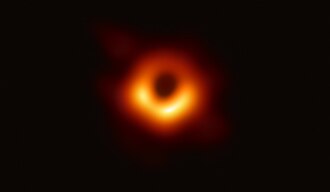
Event horizons are most famous around black holes. A black hole is a place where gravity is so strong that nothing can get out. The event horizon is like an invisible wall around the black hole. When something gets very close to this wall, it looks like it slows down and turns red. But we can’t actually see anything cross the wall — we only see bright lights around the black hole.
There are also cosmic event horizons. These are faraway places in the universe from which light has not had enough time to reach us. As the universe grows, these horizons change. Some parts of the universe may forever stay hidden behind these cosmic borders.
Why Do We Know About Event Horizons?
Scientists learned about event horizons by studying how gravity and light work together. Long ago, in 1784, John Michell thought that very heavy objects could trap light. Later, David Finkelstein used ideas about space and time, called general relativity, to explain event horizons better. Today, we study them to learn more about the universe and black holes.
Images
Related articles

This article is a child-friendly adaptation of the Wikipedia article on Event horizon, available under CC BY-SA 4.0.
Images from Wikimedia Commons. Tap any image to view credits and license.