 Safekipedia
Natural satellite
Adapted from Wikipedia · Explorer experience
Natural Satellites
A natural satellite is a special kind of astronomical body that orbits a planet, a dwarf planet, or a small Solar System body. We often call these objects moons. The most famous moon is Earth's moon, also known as Selene or Luna.
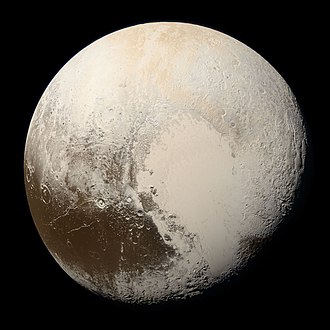
In our Solar System, six planets have moons. Even some dwarf planets, like Pluto and Haumea, have their own moons. Scientists have found that many smaller planets also have natural satellites. These moons come in many shapes and sizes, and they help us learn more about space.
The first known natural satellite was the Moon. Long ago, people thought the Moon was a planet until Copernicus changed that idea. Later, Galileo discovered four objects orbiting Jupiter, which we now call the Galilean satellites.
Natural satellites that orbit close to their planet likely formed from the same cloud of material that created the planet. Others might be captured asteroids. The Moon and the Moons of Pluto are special; they may have formed from a big crash early in the Solar System. Another example is Triton, which orbits backward, suggesting it was captured from space.
Most moons in our Solar System always show the same face to the planet they orbit. This happens because the planet's gravity slows the moon's rotation until it stops. One exception is Saturn's moon Hyperion, which spins unpredictably because of the pull from Titan. Pluto's small moons also spin chaotically due to the influence of Charon.
Some big natural satellites in our Solar System are still active today. Io is the most active volcano in the Solar System. Europa, Enceladus, and Triton show signs of movement and cold volcanoes. This activity is often caused by the pull of gravity from the planets they orbit.
Many other natural satellites, like Earth's Moon, Ganymede, Titan, Tethys, and Miranda, had geological activity in the past. This was powered by things like the breaking down of special materials inside them or changes in their orbits. Enceladus and Triton have features like geysers. Titan and Triton have atmospheres, and Titan even has lakes made of special liquids. Europa, Ganymede, Callisto, Titan, and Enceladus are believed to have oceans of water deep underneath their surfaces.
Images
Related articles


This article is a child-friendly adaptation of the Wikipedia article on Natural satellite, available under CC BY-SA 4.0.
Images from Wikimedia Commons. Tap any image to view credits and license.