Safekipedia

Octo Mundi Miracula

Explorer · ages 7 and underAdapted from Wikipedia
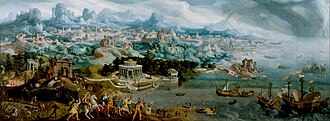
A 16th-century collage by Dutch artist Maarten van Heemskerck showing the Seven Wonders of the ancient world, the earliest known picture of this famous list.

What is it?

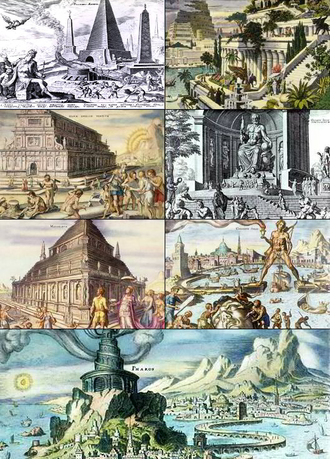
Octo Mundi Miracula is a set of pictures called engravings. They were made in 1572 by Philips Galle. The pictures were based on eight drawings by the painter Maarten van Heemskerck.

Where did the ideas come from?

Long ago, writers told about amazing buildings called the Seven Wonders of the Ancient World. They did not all agree on the same list. Heemskerck used a book by Pedro Mexía to help him learn about them. The book explained that people had different ideas about which wonders belonged on the list.

The pictures

The engravings show the wonders in the middle of each picture. Around them are people, rulers, and stories. Hadrianus Junius wrote a short poem in Latin for each picture. Heemskerck also included the Colosseum in Rome, which was not on the usual list. He had seen it for himself when he visited Rome.

Why people remember it

This is thought to be the first complete set of pictures of the Seven Wonders. It also helped make the list of seven that many people still know today. Before this set, there was no common way to show these wonders in pictures. After it, many artists copied the pictures in their own works.

Quiz time!

3 questions about Octo Mundi Miracula

Question 1 of 3

What kind of pictures are they?

Pictures

A painting by Maarten van Heemskerck from the 1530s that shows a wide landscape filled with the Seven Wonders of the Ancient World, along with a scene from Greek myth.
An old engraving from 1572 showing the pyramids of Egypt, made by Philips Galle after a drawing by Maarten van Heemskerck. It is one of the Seven Wonders of the World.
Pages from Pedro Mexía's 1547 book, which discussed the Seven Wonders of the Ancient World.
A 1572 engraving by Philips Galle, after Maarten van Heemskerck, showing the Lighthouse of Alexandria, one of the Seven Wonders of the ancient world.
An engraving from 1572 by Philips Galle, after a design by Maarten van Heemskerck, showing the Walls of Babylon, one of the Seven Wonders of the World.
An old engraving from 1572 by Philips Galle showing the Temple of Diana at Ephesus, one of the Seven Wonders of the Ancient World.
An engraving from 1572 by Philips Galle showing the great statue of Jupiter at Olympia, one of the Wonders of the World.
An old engraving from 1572 by Philips Galle, showing the Colossus of Rhodes, a giant statue of the Greek sun god Helios that was one of the Seven Wonders of the World.
An engraving from 1572 by Philips Galle, after Maarten van Heemskerck, showing the Mausoleum at Halicarnassus, one of the Seven Wonders of the Ancient World.
An old engraving by Philips Galle from 1572 showing the Colosseum in Rome, one of the famous buildings from the 'Eight Wonders of the World' series.
An old engraving from 1572 showing Egyptian pyramids and obelisks in the background. In the foreground, the pharaoh Psammetichus sits and watches an eagle carrying a sandal, a scene from an old fable.
An engraving from 1572 showing the circular walls of Babylon, the Hanging Gardens, and the legendary Queen Semiramis hunting a lion on horseback. It was made by Philips Galle after a drawing by Maarten van Heemskerck.
An old hand-colored engraving from 1572 showing the Colossus of Rhodes, a huge bronze statue of the sun god Helios that once stood above the harbour, with ships sailing between its legs.
An old engraving by Philips Galle, made after a drawing by Maarten van Heemskerck, showing the ancient Mausoleum at Halicarnassus and the Colosseum in Rome.

Keep exploring

This article is a child-friendly adaptation of the Wikipedia article on Octo Mundi Miracula, available under CC BY-SA 4.0.

Images from Wikimedia Commons. Tap any image to view credits and license.