Planetary-mass object
What is a planetary-mass object?
A planetary-mass object, also called a planemo, a planetary body, or sometimes just a world, is a space object. It is big enough to pull itself into a round, slightly squashed ball shape called an ellipsoid. It is not big enough to start fusion in its core the way a star does.
Scientists use this name because the word "planet" does not cover every object that acts in a similar way. One name helps group them together.
Many kinds of objects
Planetary-mass objects are very different from one another. They include planets, dwarf planets, planetary-mass moons, and free-floating planets. Some free-floating planets may have been pushed out of their star system. These are called rogue planets. Others formed when a cloud of gas and dust collapsed. These are called sub-brown dwarfs.
Moons as big as planets
Some moons are as big as planets. The three largest are Ganymede, Titan, and Callisto. They are about the size of Mercury or bigger. Titan has a thick air blanket around it and lakes of liquid methane on its surface.
Four more moons are Io, the Moon, Europa, and Triton. They are bigger and heavier than the dwarf planets Pluto and Eris. Some people call these planet-sized moons "satellite planets."
Dwarf planets
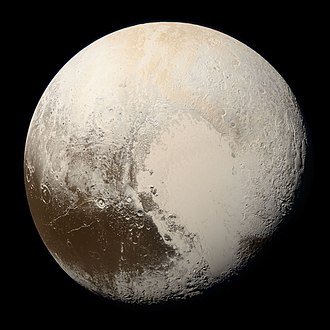
A dwarf planet is round. It goes around a star by itself, and it is not a moon. Alan Stern, a scientist from the New Horizons mission, suggested the name. He says dwarf planets are a kind of planet. The International Astronomical Union (IAU) chose the name, but it puts dwarf planets in their own special group.
Objects far out in space
Some planetary-mass objects float freely in space, like Cha 110913−773444 and OTS 44. Some are found in NGC 1333. Others, like VHS 1256-1257 b and BD+60 1417b, sit right on the edge between two groups.
Computer pictures also suggest that some of these objects could drift out into interstellar space. You can read more about one idea in the Five-planet Nice model.

Quiz time!
3 questions about Planetary-mass object
What shape does a planetary-mass object pull itself into?
Pictures
Keep exploring




This article is a child-friendly adaptation of the Wikipedia article on Planetary-mass object, available under CC BY-SA 4.0.
Images from Wikimedia Commons. Tap any image to view credits and license.