Safekipedia

Sagittarius A*

Adapted from Wikipedia · Explorer experience

An artist's view of our Milky Way galaxy, showing its spiral arms and central bulge.

Sagittarius A*

Sagittarius A* is a very special and important place in our universe. It is the giant black hole that sits right in the middle of our own galaxy, the Milky Way. This black hole is located near the constellations Sagittarius and Scorpius, close to two beautiful star groups called the Butterfly Cluster and Lambda Scorpii.

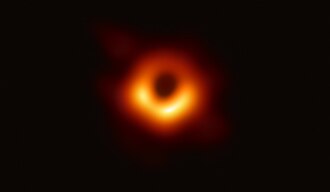
In May 2022, scientists shared the very first picture of Sagittarius A*. They used a group of telescopes all around the world called the Event Horizon Telescope Collaboration to take this amazing photo. Even though we can't see the black hole itself because its gravity is too strong to let light escape, we can see the area around it. This picture helped scientists learn more about space and time.

People first discovered Sagittarius A* in 1974, thanks to two astronomers named Bruce Balick and Robert L. Brown. The little star next to it, named S2, helps scientists figure out how big the black hole is. They think it is about 4.3 million times bigger than our Sun!

Two famous scientists, Reinhard Genzel and Andrea Ghez, won a special prize in 2020 for proving that Sagittarius A* is indeed a supermassive black hole. Their work showed just how powerful and important this mysterious object is in our galaxy.

Images

This image shows the first ever picture of a black hole, captured by a group of telescopes working together around the world. The dark center is the black hole's shadow, surrounded by bright material swirling around it.
A colorful view of the Crab Nebula, the remains of an ancient star explosion, captured by the Hubble Space Telescope.
An astronomy image showing the journey of a dusty cloud near the supermassive black hole at the center of our Milky Way galaxy.
An X-ray image showing a bright flare from the supermassive black hole at the center of our Milky Way galaxy, captured by NASA’s Chandra observatory.
Scientists used a special telescope to study dust left behind after a star exploded. This dust could help make new planets like Earth!
Scientists discovered that supernovae can create materials needed to form planets like Earth. This image shows warm dust (white) inside a supernova remnant, with different colors representing various types of emissions.
A NASA telescope shows us the supermassive black hole at the center of our Milky Way galaxy, with colorful areas representing different energy levels of light.
Astronomers discovered a special type of star called a magnetar very close to the giant black hole at the center of our Milky Way galaxy. This colorful image shows X-ray views of the area around the black hole, with the magnetar appearing as a bright spot during its eruption of X-rays.
An artist’s illustration showing how a gas cloud might break apart as it approaches a giant black hole at the center of our galaxy, with stars and their orbits also depicted.
Astronauts aboard Apollo 8 captured this stunning view of Earth rising over the lunar surface during their historic mission in 1968.
An animation showing stars orbiting a supermassive black hole at the center of our galaxy.
Animation showing stars orbiting the supermassive black hole at the center of our galaxy.
An artist's impression of HE 1523-0901, one of the oldest known stars in our galaxy, located about 7,500 light-years from Earth.

Related articles

This article is a child-friendly adaptation of the Wikipedia article on Sagittarius A*, available under CC BY-SA 4.0.

Images from Wikimedia Commons. Tap any image to view credits and license.