 Safekipedia
Ares
Adapted from Wikipedia · Adventurer experience
Ares is the ancient Greek god of war and courage. He is one of the Twelve Olympians, and the son of Zeus and Hera. Many Greeks had mixed feelings about him. He represents bravery in battle but can also stand for harshness.
In Greek myths, Ares does not play a major role. During the Trojan War, Aphrodite convinced Ares to help the Trojans, but they lost the war. Ares’s sister Athena helped the Greeks win instead. Most famously, when the god Hephaestus discovered that his wife Aphrodite was involved with Ares, he trapped them and showed them to the other gods.
Ares’s closest match in Roman religion is Mars. In Roman beliefs, Mars was respected as the protector of the Roman people. As Roman writers adopted Greek stories, the tales of Ares were told using the name Mars. Over time, the stories of Ares and Mars became very similar.
Names
The name Ares comes from an old Greek word meaning "war" or "battle." Some experts think the name might have come from a very old language spoken before Greek.
In stories, other gods were sometimes called "warlike" when they fought. For example, Zeus and Athena were sometimes called with this special name. In the famous poem called the Iliad, the word for "battle" was also used to mean Ares.
Epithets
Ares, the Greek god of war, had many special names. These names described his character and actions. Some names include aatos or atos polemoio, meaning always at war, and alloprosallos, meaning he leaned first one way, then another. Others like andreifontēs mean man-slaying, and enyalios means warlike. At Sparta, he was called Thēritas, a shorter form of the name Thersites, meaning bold. These names show different sides of Ares as a strong and fierce god of battle.
Cult
In mainland Greece and the Peloponnese, only a few places had temples to honor Ares. Pausanias, who lived in the 2nd century AD, wrote about an altar to Ares at Olympia. He also mentioned that a Temple of Ares was moved to the Athenian agora during the time of Augustus. The Areopagus was a place named after Ares where the gods tried him after a fight.
Ares was often shown with war items like a helmet, shield, and sword or spear.
Chained statues
Sometimes, statues of Ares were shown tied up. In Sparta, there was an old chained statue of Ares inside a temple. This was meant to keep the spirit of war close to the city. In some places in Asia Minor, people were told to create angry-looking statues of Ares and tie them up each year. They believed this would bring peace and good luck.
Sacrifices
Like other gods, Ares received offerings from people. In Sparta, after a battle, they might give him an ox if they won cleverly, or a rooster if they fought hard. Before battles, people usually gave offerings to Athena instead. In Sparta, young men would sometimes offer a puppy before a tough fight.
Thrace and Scythia
In Thrace, people worshiped a god they called Ares, along with Dionysus and Artemis. In Scythia, they also had a god like Ares, who was very important. They would offer animals and sometimes prisoners of war to this god.
Asia Minor
In parts of Asia Minor, Ares was very important and gave advice through oracles. People built many temples for him, and he appeared on coins. In a city called Metropolis, they built a big temple to Ares as their protector.
Crete
On the island of Crete, there was a place where people honored both Ares and Aphrodite. This spot was important for making promises and celebrating victories.
Aksum
In Africa, the kings of Aksum called their main god “Ares” in Greek writings. One king said Ares helped him win many battles, and he built a grand throne to honor him. Later, the last pagan king of Aksum also praised Ares for helping him.
Characterisation
Ares was one of the Twelve Olympians in ancient stories like the Iliad and Odyssey. In these stories, Ares often shows the tough side of war. He is very strong but also very aggressive, unlike his sister Athena, who is the goddess of intelligence and helps with planning in battles.
The Greeks did not always like Ares. In one story from the Iliad, the god Zeus scolds Ares for getting hurt in battle. Zeus tells Ares that he is not popular because he loves fighting and causing trouble.
People in Greece also linked Ares with the Thracians, a group they saw as very wild and fond of war. They believed Thrace was where Ares was born and where he went after other gods made fun of him.
Mythology
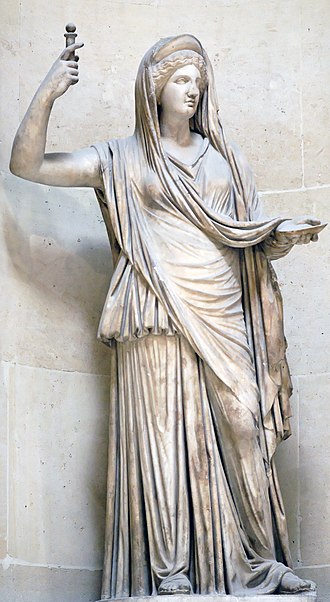
Ares is one of the Twelve Olympians, and the son of Zeus and Hera. In stories, Ares is the god of war and courage.
In myths, Ares has many important roles. He appears in tales about heroes and gods, like protecting a sacred grove or helping in battles. His stories show him as a strong and powerful figure in ancient Greek beliefs.
Mars
Mars is the Roman god who is similar to Ares from Greek myths. Mars is the son of Jupiter and Juno. He was very important to the Roman army's military gods, but he was first known as a god of farming. Mars was thought to be the father of Romulus, the legendary founder of Rome, so he was respected and protected all of Rome and its people.
As Greek culture influenced Rome, Mars was often thought to be the same as Ares. But they were different in many ways. Mars was seen as a way to bring peace, and he was called the father of the Roman people. Some stories say he had children with the goddess Venus, including Aeneas, a prince from Troy who helped start Rome long before Romulus.
Renaissance and later depictions
During the Renaissance and later times, artists often showed Ares with a spear and helmet. A dog was thought to be his animal, and a vulture his bird. In stories from these periods, Ares was usually replaced by Mars, the Roman god. Mars was seen as a symbol of brave and strong men, not the fierce warrior from older Greek tales.
In popular culture
Ares, the Greek god of war, is often seen in books, movies, and games. People enjoy including him in stories because he is strong and powerful. He is a favorite character in many kinds of entertainment.
Genealogy
Ares is the Greek god of war. He is one of the Twelve Olympians, the main gods who live on Mount Olympus. Ares is the son of two important gods: Zeus, the king of the gods, and Hera, his wife. Many ancient Greeks thought Ares was strong but sometimes hard to deal with.
Images
Related articles




This article is a child-friendly adaptation of the Wikipedia article on Ares, available under CC BY-SA 4.0.
Images from Wikimedia Commons. Tap any image to view credits and license.