 Safekipedia
Belgian Armed Forces
Adapted from Wikipedia · Adventurer experience
The Belgian Armed Forces are the military forces of Belgium. The King of the Belgians is the commander-in-chief of these forces. They were created after Belgium became independent in October 1830.
Since they were formed, the Belgian Armed Forces have been part of many important events. These include World War I, World War II, the Cold War (including the Korean War and the Belgian occupation of the Federal Republic of Germany), and recent missions in Kosovo, Rwanda, Somalia, and Afghanistan.
Today, the Armed Forces have five main branches: the Belgian Army, the Belgian Air Force, the Belgian Navy, the Belgian Medical Service, and the Belgian Cyber Force. These branches work together to keep Belgium safe and help with peace around the world.
History
Establishment
When Belgium separated from the Netherlands in 1830, people thought they didn’t need a big army. They believed nearby countries like France, Britain, and Prussia would protect them. Instead, they used a small group of volunteers called the Civil Guard. But they soon realized they needed a proper army.
At first, only a few men were chosen each year to serve, and many could pay to avoid it. This meant only poorer people usually served.
Early history
In the 1800s, Belgium’s army stayed near its borders with the Netherlands, Germany, and France, just in case of trouble. They didn’t plan exactly how to fight, waiting to see what happened. The army was smaller than they wanted, about 20,000 soldiers, because it was hard to get enough men. By 1868, new rules made it harder to avoid service.
The Franco-Prussian War in 1870 showed the army wasn’t ready. They had to call everyone in for almost a year, and many problems appeared. Even with help from Belgian intelligence, no fighting happened in Belgium.
By the 1890s, Belgium still picked only some men for service, unlike most other countries which required everyone. Richer men could pay to get out of it. Those who served spent eight years in the army and then five years ready to fight again.
Belgium sent small groups to help in other places, like Rome and Mexico. They also created a special force called the Force Publique in Congo to keep order.
Army in 1914
Before World War I began, Belgium’s army had 19 infantry regiments, 10 cavalry groups, and 8 artillery groups. They also had support teams like engineers and guards. The army planned to use seven divisions to move around, while 65,000 soldiers guarded strong forts around Antwerp, Liège, and Namur. These forts were built to protect the country but were becoming outdated.
World War I
When World War I started in 1914, Belgium’s army was not fully ready. Only 20% of men were called up quickly. But over time, 350,000 men joined the army. Belgium was surprised by Germany’s attack and fought hard for ten days near Liège.
For most of the war, Belgium’s army protected a part of the front near the coast and Ypres, working with other Allied forces.
In Africa, Belgian troops helped take over German areas and fought in East Africa. By 1918, Belgium’s army grew to 166,000 men and joined the final push that ended the war.
Between the Wars
After World War I ended in 1918, Belgium tried to keep its army strong but didn’t buy many new weapons like tanks or planes. They focused on making their forts stronger. The army got smaller over time. Most soldiers were young men who served only 13 months before becoming reservists.
World War II
When Germany invaded Poland in 1939, Belgium’s king ordered everyone to join up. About 600,000 men were ready. But Belgium was attacked and defeated in just 18 days in May 1940. Some Belgian soldiers escaped to Britain and joined forces there.
Belgian troops fought in Normandy and helped free France and the Netherlands. They also served in special units with the British and flew planes for the Royal Air Force. Belgian ships sailed with the British navy during the Battle of the Atlantic.
Post-1945
After World War II, Belgium joined NATO in 1948 to stay safe. They sent soldiers to help in the Korean War and set up big military bases in Congo. Over time, the army changed its rules and weapons.
Belgium took part in many peacekeeping missions around the world, helping in places like Rwanda, Bosnia, Afghanistan, and Libya. They also worked on training and protecting people in Tunisia and other areas. After some terrorist attacks in Europe, Belgium’s army helped keep cities safe by guarding important places.
Structure
Main article: Structure of the Belgian Armed Forces
Since July 2024 the Belgian Armed Forces are structured as follows:
- Belgian Army (Force Terrestre / Landmacht)
- Belgian Air Force (Force Aérienne / Luchtmacht)
- Belgian Navy (Marine)
- Belgian Medical Service (Service Médicale / Medische dienst)
- Belgian Cyber Force (Force Cyber / Cybermacht)
Special Operations Command or SOCOM, helps to coordinate special operations. It gives advice and helps share equipment for special operations units. SOCOM is managed by ACOS Readiness and Operations.
Currently, SOCOM is setting up a new command center called the Composite Special Operations Command Center or C-SOCC. This is a project with Special Operations units from Belgium, The Netherlands and Denmark.
The Belgian Army, Air Force, Medical Services, and Cyber Force all use the same military ranks. The Navy's ranks are different.
Belgian Army
Main article: Belgian Army
The Belgian Army is the ground part of the Belgian Armed Forces. The Army Commander is Major-General Pierre Gérard. The Army has one staff, one motorized brigade, one special operations regiment, and several support units. It also has three logistical units, three telecommunication units, four training camps and a training center.
The Army has around 10,000 troops. They train for operations with other countries. Many are part of the Motorized Brigade (Belgium), some are in the Special Operations Regiment (Belgium), and others are in different units.
Belgian Air Force
Main article: Belgian Air Force
The Belgian Air Force is the air part of the Belgian Armed Forces. The Air Force started in 1910. It has two wings with fighter planes, one wing with transport planes, and one wing with training planes and helicopters. The Air Force also has a unit with unmanned aircraft. It has several support units too.
Belgian Navy
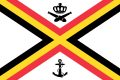
The Belgian Navy is the sea part of the Belgian Armed Forces. It has 1,200 personnel and 10 ships. The Navy Commander is Rear Admiral Jan De Beurme. The Navy has different types of ships including frigates, minesweepers, patrol boats, and an auxiliary vessel.
Frigates:
Minesweepers:
Patrol Boats:
Auxiliary Vessels:
- BNS A958 Zenobe Gramme (training ship)
Belgian Medical Service
Main article: Belgian Medical Service
The Medical Services gives medical help to all Belgian Armed Forces personnel. It is commanded by a Major General and has 1,700 active personnel. It includes a Military Hospital, 2 Medical Battalions, and a Medical Supply Unit.
Belgian Royal family in the Belgian Armed Forces
| Member | Belgian Army | Belgian Air Force | Belgian Navy | Belgian Medical Service | |
|---|---|---|---|---|---|
 |  |  |  | ||
 | The King | General | General | Admiral | |
 | The Archduchess of Austria-Este | Colonel (2003) | |||
| Crown princess Elisabeth | onderluitenant (2023) | ||||
 | Prince Laurent | Captain (2004) Fr : Capitaine de Vaisseau Nl : Kapitein-ter-zee | |||
| Prince Amedeo | Second Lieutenant (2007) | ||||
| Prince Joachim | Ensign 2nd Class (2011) | ||||
The Belgian Royal family has a long history with the Belgian Armed Forces. Some members of the royal family serve or have served in the military.
The King of the Belgians is the commander-in-chief of the Belgian Armed Forces. This means he has important responsibilities for the safety and protection of Belgium.
Some members of the royal family have chosen to serve in the military. They train alongside other soldiers and can hold important positions. This helps show their support for the men and women who work to keep Belgium safe.
Related articles


This article is a child-friendly adaptation of the Wikipedia article on Belgian Armed Forces, available under CC BY-SA 4.0.
Images from Wikimedia Commons. Tap any image to view credits and license.