 Safekipedia
Cortina d'Ampezzo
Adapted from Wikipedia · Adventurer experience
Cortina d'Ampezzo, often simply called Cortina, is a beautiful town in the Veneto region of Northern Italy. It lies in an alpine valley within the stunning Dolomitic Alps, right on the Boite river. The town is popular for vacations, especially for skiing and other snow sports.
Historically, Cortina has been ruled by many different groups, including the Republic of Venice, the Habsburg rulers, and later Austria-Hungary, until it became part of Italy in 1918. The town is known for its crafts, such as wooden furniture, tiled stoves, and items made from iron, copper, and glass.
Today, Cortina d'Ampezzo is a lively tourist destination, with its population growing greatly during the winter months. The town hosted the Winter Olympics in 1956 and will do so again in 2026, this time together with Milan. Visitors can enjoy many interesting places, such as the Basilica Minore dei Santi Filippo e Giacomo, the Rinaldo Zardini Palaeontology Museum, and the Mario Rimoldi Modern Art Museum. Famous movies like The Pink Panther and Cliffhanger were also filmed here.
History
Prehistory
In 1987, a very old tomb was found in the mountains near Cortina. This shows that people lived in the area as far back as 6,000 years ago. Around 600 B.C., people nearby started using writing from the Etruscans. Later, the Romans came and named the place Amplitium, meaning "wide."
Middle Ages to 19th century
After the Romans left, little was known about the area until the Middle Ages. During this time, the place was ruled by leaders from far away. In 1420, the Republic of Venice took control. Later, the Habsburgs took over, and the people promised to be loyal to their leader, Emperor Maximilian.
When a big agreement was signed in 1797, a leader named Napoleon let the Habsburgs keep the area for a while. But in 1810, he took it away and added it to another place. After some battles, the Austrian Empire took it back in 1813. The town became known as a healthy place to visit.
In 1874, the forests around Ampezzo became property of the Carnic Woods Consortium. Even though it was ruled by Austria until 1920, the people there mostly spoke their own language, Ladin.
20th century
When Italy joined World War I in 1915, many men from the town were fighting far away. After the war, in 1920, Ampezzo was officially given to Italy. It was renamed Cortina d'Ampezzo after one of its villages.
Cortina became a popular place for rich people to visit. It was planned to host the Winter Olympics in 1944, but this didn’t happen because of World War II. The Olympics finally took place there in 1956, making Cortina very famous for skiing and snow sports.
Winter sport resort destination
Cortina has always been a special place for visitors. After World War I, it became a favorite spot for wealthy Italians, too. It hosted the Winter Olympics in 1956 and became well-known for skiing and snow sports.
Cortina has about 6,150 people living there, but during busy times like Christmas and August, around 50,000 visitors come. The town has special streets where cars aren’t allowed. There are many ski paths spread over three areas, each with its own style. These areas are connected by buses, lifts, and ski paths. Cortina also has a ski school started in 1933 and many trails for cross-country skiing.
21st-century politics
In 2002, a group was restarted in Cortina. Since 2005, a leader named Charles I has been honored there. In 2007, the town voted to join a nearby region with lower taxes, but this needs approval from leaders in Italy. In European elections in 2014, the most popular party was the Democratic Party.
Geography and climate
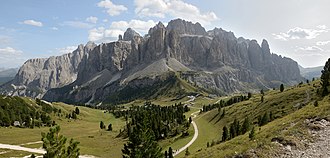
Cortina d'Ampezzo is in the Dolomites, a beautiful mountain area in Italy. The town is in a valley next to the Boite river and is surrounded by tall, rocky mountains. It is close to other valleys and small villages that still have their old, quiet charm.
The area has cold winters and cool summers, with lots of snow and rain. Animals such as marmots, deer, and chamois live there, and sometimes wolves, bears, and lynx visit. Much of the land around Cortina is protected in the Natural Park of the Ampezzo Dolomites.
Demographics
Cortina's population grew until the 1960s. After that, the number of people there dropped, but it is growing again. Today, 6,112 people live in Cortina d'Ampezzo. It is the seventh most populous place in the province of Belluno.
Many people in Cortina also speak Ampezzano, a local version of the Ladin language. This language is important to the local culture and appears on street signs.
Economy
In the 1800s, Cortina d'Ampezzo became known for its skilled crafts. A special school taught boys aged 13 and up to work with wood and metal.
Today, the town is famous for winter tourism. During snowy months, many more visitors come, growing from about 7,000 to 40,000. Cortina d'Ampezzo is one of Italy's most popular and costly ski destinations. It offers great skiing, skating, sledding, climbing, and hiking.
The town has many fancy shops, including well-known fashion brands and stores selling climbing gear. One of its oldest shops, La Cooperativa di Cortina, sells sweets, newspapers, toys, and skiing supplies. The town has many hotels, including the famous Miramonti Majestic Grand Hotel. This hotel has over 100 rooms and has appeared in movies such as those about James Bond.
Landmarks
Near the bridge on the Bigontina River is the Town Hall, a palace built in a special style from the Tyrol area. Piazza Angelo Dibona is the main square and has several important places. The Ciasa de ra Regoles is an old building where leaders from local villages used to meet. It also has offices and a museum of modern art named after Mario Rimoldi. The square is named for the famous local mountain guide Angelo Dibona.
The Regole d'Ampezzo manage three museums. The Rinaldo Zardini Palaeontology Museum, opened in 1975, shows many fossils found in the Dolomites. These fossils show what life was like long ago when the mountains were under a warm sea.
The Regole of Ampezzo Ethnographic Museum is located in an old sawmill and shows items from everyday life in the valley, including tools and clothes.
The Mario Rimoldi Modern Art Museum, started in 1941, has many artworks by famous Italian artists from the 1900s. It also has special exhibitions about different topics.
The Great War Tour covers 80 kilometers across the mountains and includes a museum with old trenches and tunnels from World War I. It can be visited by skiers in winter or by walking or biking in summer.
The Basilica Minore dei Santi Filippo e Giacomo was built between 1769 and 1775 where two older churches once stood. It has beautiful wooden carvings and paintings on the ceiling.
The Chiesa della Madonna della Difesa was built in 1750 and has lovely paintings and decorations inside.
The Cappella della Beata Vergine di Lourdes finished in 1907, shows detailed sculptures and paintings.
The Cappella di Sant'Antonio da Padova in the village of Chiave was finished in 1791 and has special wooden statues and an altar.
Sacrario militare di Pocol is a memorial built in 1916 for those who died during World War I. It includes a shrine added in 1935 and a tower that can be seen from far away.
The Castello de Zanna is a small fortress that started being built in 1694 but was never finished. It was burned down by French troops in 1809 and later restored.
Forte Tre Sassi is a fort built in 1897. It was damaged in World War I but has been restored and now holds relics from that time.
Castello di Botestagno was an old fort that mostly disappeared over time. Only a few parts of its basement remain today.
Culture
Cortina d'Ampezzo is a special place for writers and artists. Famous people like Ernest Hemingway and Saul Bellow have visited here and enjoyed the town's culture. The town holds book festivals and events, such as "A Mountain of Books," which happens twice a year.
Music is also important in Cortina d'Ampezzo. You can often hear young musicians playing in the streets. Every summer, the town hosts the Dino Ciani Festival for young pianists, honoring the talented Italian pianist Dino Ciani. There is also a yearly Festival of the Bands with music from around Italy.
The town has been a popular place for filming movies, including scenes for Cliffhanger and The Pink Panther. It was also a location for the James Bond film For Your Eyes Only.
Radio
Radio Cortina Dolomiti is a local radio station that has been on the air since 1980. You can listen to it in several nearby areas.
Sports
Cortina d'Ampezzo is famous for winter sports. It hosted the 1956 Winter Olympics, which were first planned for 1944 but could not happen because of World War II. The town has also held many important skiing events, such as the 1927 Nordic, 1941 Nordic, and 1941 Alpine World Championships.
Recently, Cortina d'Ampezzo hosted the 2021 Alpine World Championships and will co-host the 2026 Winter Olympics and 2026 Winter Paralympics with Milan.
The town has a professional ice hockey team called SG Cortina that plays in Italy’s top league, Serie A1. Each year, Cortina d'Ampezzo hosts the Dolomites Gold Cup Race, a special car event on public roads.
Cortina d'Ampezzo is a great place for skiers of all levels, with many trails and lifts. It is part of the large Dolomiti Superski area. In winter, people can enjoy skiing, snowboarding, and sledding. In summer, there are options for hiking, biking, rock climbing, and more.
Gastronomy
Cortina d'Ampezzo has a special mix of local and Austrian foods. You can try tasty dishes like "chenedi" and "Casunziei." There are also warm meat meals such as mushroom roast and "gröstl," showing the area's rich culture.
Transport
A special train called the Espresso Cadore started running again in 2024. The closest train station is Calalzo-Pieve di Cadore-Cortina, about 35 kilometers away. Trains from there connect to Cortina through a service called the Cortina Link, operated by Trenitalia and Dolomitibus. This service will have more trains during the Winter Olympic Games in 2026.
During the Milan–Cortina 2026 Winter Olympic Games, it will be easy to travel to Cortina from Venice Mestre every day. Cortina used to have a railway line, but it closed in 1964. Plans are being made to possibly build a new line. The Cortina Airport was built for the 1956 Winter Olympics but is now closed. The nearest airports are near Venice, about a two-hour drive away.
Notable people
Cortina d'Ampezzo has welcomed many famous people who loved the area. Italian writers like Dino Buzzati, author of The Tartar Steppe, and Ernest Hemingway, who wrote A Farewell to Arms, visited the town.
Other well-known visitors include Irish explorer John Ball, who climbed Monte Pelmo in 1857, and skilled skiers and climbers such as Enrico Colli and Stefania Constantini, who won gold in the 2022 Winter Olympics. The town has been home to talented artists and athletes over the years.
International relations
Twin towns / sister cities
See also: List of twin towns and sister cities in Italy
Cortina is twinned with:
Images
Related articles


This article is a child-friendly adaptation of the Wikipedia article on Cortina d'Ampezzo, available under CC BY-SA 4.0.
Images from Wikimedia Commons. Tap any image to view credits and license.