 Safekipedia
Darius the Great
Adapted from Wikipedia · Adventurer experience
Darius the Great
Darius the Great, also known as Darius I, was the third King of Kings of the Achaemenid Empire. He ruled from 522 BCE until his death in 486 BCE. Under his rule, the empire grew to include much of West Asia, parts of the Balkans, the areas around the Black Sea, Central Asia, the Indus Valley, and parts of North and Northeast Africa.
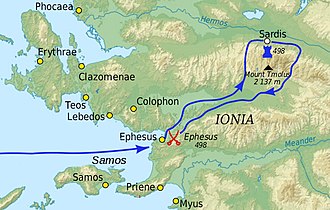
Darius became king after removing a ruler named Bardiya. He had to deal with many rebellions but brought the empire back under control. One well-known event was his campaign against Athens and Eretria for their support of the Ionian Revolt.
Darius organized the empire into provinces, each led by a governor called a satrap. He created a uniform system for money, made Aramaic an official language along with Old Persian, and improved roads and standard weights and measures. These changes helped unify the empire. Darius also built many important structures in places like Susa, Pasargadae, Persepolis, Babylon, and Egypt. He carved an inscription on Mount Behistun to record his achievements.
Etymology
Main article: Darius (given name)
The name Darius comes from old languages. In Latin and Greek, it is written as Dārīus or Dārēus. This comes from the Old Persian name Dārayauš. The name means "he who holds firm the good(ness)". The name appears in different forms in many ancient languages. This shows how people in many places used and understood the name.
Primary sources
The main writings about Darius the Great come from places where he built monuments and left messages.
Darius put up a big carving on Mount Behistun with words in three different languages. This told the story of how he became king after Cyrus the Great died. He said he was the right king because the god Ahura Mazda chose him.
We also have special gold and silver plates that Darius placed under the floor of the Apadana Palace. On these plates, he wrote about all the lands in his big empire, from places near Sogdia all the way to Lydia.
The Greek writer Herodotus wrote many pages about Darius and the wars between Persia and Greece. His book talks about how Darius became king and what happened during his time ruling.
Early life
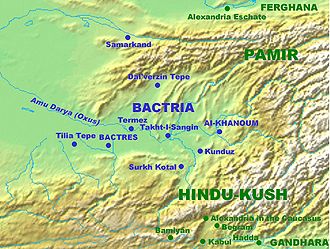
Darius was the eldest son of Hystaspes. His mother's name is not sure, but some think she was Rhodogune or Irdabama. Darius's father ruled Bactria.
Darius became king after some tricky events. The king before him, Cambyses II, had hurt his own brother, Bardiya. A man named Gaumata said he was Bardiya and took the throne. Darius and six other nobles worked together to stop Gaumata. Then Darius became the new king of the Achaemenid Empire.
Early reign
Main article: Achaemenid Civil War (522-520 BC)
After becoming king, Darius faced many challenges. People in different parts of his large empire, like Elam and Babylonia, rebelled against him. Darius worked hard to stop these uprisings. With the help of loyal soldiers and nobles, he managed to control the revolts within a year. He wrote about these events in the Behistun Inscription.
During this time, one of the noblemen who helped Darius become king, Intaphernes, did something that upset Darius. Intaphernes hurt some officers. Fearing that Intaphernes might cause trouble, Darius took action to protect his rule.
Military campaigns
Main article: Twenty-seventh Dynasty of Egypt
After becoming king, Darius worked to make his rule stronger. He brought [Egypt] back under his control and added more lands to his empire. His empire stretched from parts of the [Balkans] in the west to the [Indus Valley] in the east.
Main article: Achaemenid invasion of the Indus Valley
In 516 BCE, Darius led his armies through [Aria] and [Bactria], moving into [Afghanistan] and reaching [Taxila] in modern-day [Pakistan]. He spent the winter of 516–515 BCE in [Gandhara], getting ready to take over the [Indus Valley]. By 515 BCE, Darius had taken control of the lands around the Indus River, from [Gandhara] to modern [Karachi]. He also sent a Greek explorer named [Scylax of Caryanda] to travel the Indian Ocean from the mouth of the Indus to [Suez].
Main article: European Scythian campaign of Darius I
The [Scythians] were nomadic tribes who lived between the [Danube] River, the River [Don], and the [Black Sea]. They had fought against Darius and threatened trade routes. Darius built a bridge of boats to cross the [Black Sea] at the [Bosphorus] Straits and moved into [Scythia] in 513 BCE. The Scythians used tricky tactics to avoid fighting directly. Darius chased them but eventually stopped because his army was tired. He built forts as a defense and then returned to [Thrace].
Main article: First Persian invasion of Greece
See also: Ionian Revolt
Darius also wanted to bring Greek cities under his control. He had already taken control of many areas in [Thrace] and [Macedonia]. Some Greek cities, like [Athens] and [Eretria], supported a revolt by Greek cities under Persian rule. In response, Darius sent an army led by his admiral [Datis] and his nephew [Artaphernes]. They captured [Eretria] and marched toward [Athens]. In 490 BCE, the two sides met at the [Battle of Marathon], where the Persian army was defeated by the Athenians. This victory ended the first Persian invasion of Greece. Darius was planning a larger attack but died before he could launch it, leaving the task to his son [Xerxes].
Family
Darius was the son of Hystaspes and the grandson of Arsames. He married Atossa, the daughter of Cyrus, and they had four sons: Xerxes, Achaemenes, Masistes, and Hystaspes. Darius also married Artystone, another daughter of Cyrus, and they had two sons, Arsames and Gobryas. He married Parmys, the daughter of Bardiya, and they had a son named Ariomardus. Darius married his niece Phratagune, and they had two sons, Abrokomas and Hyperantes. He also married Phaidyme, the daughter of Otanes. Before these marriages, Darius married a daughter of his friend Gobryas, and they had three sons: Artobazanes, Ariabignes, and Arsamenes. Although Artobazanes was Darius's first-born, Xerxes became the next king because Atossa had great influence in the kingdom.
Death and succession
Darius wanted to lead another journey to fight the Greek city-states after hearing about a battle called Marathon. But before he could, a problem in Egypt made him very sick. He passed away after thirty days at around the age of sixty-four.
His body was prepared for burial and placed in a special tomb at Naqsh-e Rostam. His son Xerxes became the new ruler after him.
Government
Organization
Further information: Districts of the Achaemenid Empire
Early in his rule, Darius wanted to organize the empire better. He divided the empire into twenty areas called satrapies. Each area had a leader called a satrap who collected taxes. The taxes were paid in silver or gold, and each area paid a set amount.
Most satraps were from Persian families and were chosen by Darius. Each area also had sub-leaders chosen by the satrap or the king. To make sure no one got too powerful, each satrap had a secretary, a treasurer, and a military commander. Darius also sent royal inspectors to check on the satraps.
The empire used a central office to manage everything, with main offices in Persepolis, Susa, and Babylon. Darius chose Aramaic as the common language for the empire.
Economy
See also: Achaemenid coinage
Darius introduced a new money called the daric before 500 BCE. Before this, people traded goods directly or used money from Lydia or Ionian cities. The daric helped trade across the empire and was even used outside the empire, in places like Central and Eastern Europe. There were gold and silver darics. Only the king could make gold darics, while important generals and satraps could make silver darics.
The daric made it easier to collect taxes on land, animals, and markets. This helped the government improve roads and build irrigation systems in dry areas. Darius also built canals, underground waterways, and a strong navy to help trade. He improved roads and set up travel stops for officials.
Religion
"By the grace of Ahura Mazda am I king; Ahura Mazda has granted me the kingdom."
— Darius, on the Behistun Inscription
Darius believed in Ahura Mazda, whom he saw as the most important god. He thought Ahura Mazda chose him to rule. Darius respected other religions as long as their followers were peaceful. He helped restore the Israelite temple and supported temples in Egypt.
Building projects
Darius wanted to build grand places to show his power. He built new royal homes in Susa and Persepolis. He also built a canal connecting the Nile to the Red Sea, which helped trade. Darius improved roads and built temples in Egypt, even though he believed in Ahura Mazda. He used workers from many places, which helped the empire grow and share different cultures. When Darius died, his son Xerxes finished some of these projects.
Images
Related articles



This article is a child-friendly adaptation of the Wikipedia article on Darius the Great, available under CC BY-SA 4.0.
Images from Wikimedia Commons. Tap any image to view credits and license.